Saturday, January 31, 2009

Doubt

Doubt (U.S., 2008) written and directed by John Patrick Shanley, 104 min.

A potentially abusive priest? A cold, vindictive nun? Catholic schools in the 1960s? Meryl Streep? Philip Seymour Hoffman? Oy ... did I want to go down this well traveled road? Have we not had enough stories of priests and violated boys? My friend B convinced me see the film. Despite my reservations, I'm glad I did though.

I must say that I was impressed with the performances even though I am not a huge fan of the two aforementioned actors. This is potentially a treasonous opinion, I imagine, from a self-professed movie lover.

The ambiguity of the situation saves the film for me ... did Father Brendan Flynn (Philip Seymour Hoffman) abuse Donald Miller, the lone, often lonely, black student in the school? Was the relationship inappropriate despite the priest's apparent sincerely felt feelings for the boy? Was the boy a "willing" participant, if so? How complicit was his mother, Mrs. Miller (the Oscar nominated Viola Davis), who has a few very powerful scenes with the formidable Sister Aloysius Beauvier (Meryl Streep)?

Here, for me, Streep is free of those nervous acting tics which annoy me ... please don't ask me to number them. It's like that 1964 Supreme Court definition of pornography: "I know it when I see it." At times she seems the only actress of her age who seems to be employed. Sigh.

But she is formidable here and seems eerily familiar to this former Catholic school girl. The icy precision with which she tracks down every errant boy or girl in the school or in church. Her cold and unforgiving nature. The fact that she never smiles, never warmly greets a child, never shows tenderness or love put me in mind of our very own principal in grade school, Sister M, a severe nun in traditional habit, feared and hated by all (including the teachers). That's how terrifying she was, even the kids realized that the teachers hated her.

Sister Aloysius is frighteningly self-assured in her crusade to destroy the charming Father Flynn and almost persuades the tentative but spunky Sister James (Amy Adams) of her certainty. Sister James has doubts of her own but cannot side against the warm, charismatic Flynn who has a genuine love for the children and is trying to introduce a level of progress into the stultifying atmosphere of the school in 1964. Adams is graced with a beautiful face which can still convey, in these cynical times, innocence and grace. She is perfectly cast. Her star turn in Enchanted (2007) as the fairy tale princess come to life brought her well deserved acclaim and attention.

But if Flynn is innocent - and not even Donald Miller's mother is sure of this - why does the camera linger on a certain boy who recoils from any physical contact with the priest and revels in his potential demise when he learns of it? Is it just childish malice or a secret knowledge of the true situation?

The film is so good that I forgive Shanley my long standing grudge against him for the atrocious Moonstruck (1987).

Friday, January 23, 2009

Gran Torino

Gran Torino (U.S., 2008) directed by Clint Eastwood, 2 hrs.

Clint Eastwood's halo is barely obscured by the racist, xenophobic ex-Korean War veteran that he plays in this film. Walter Kowalski is recently widowed, a former vet, who is alienated from his two kind-hearted, if slightly dim-witted, sons and his obnoxious grandchildren who seem eager to paw over his possessions (specifically his Gran Torino car) once he too expires.

He refuses to leave the old Detroit neighborhood now dominated by a growing Asian community of Hmong (pronounced "mung", an ethnic group found in Southeast Asia, including northern Vietnam, Laos, Thailand, and Myanmar-Burma). He inadvertently and reluctantly becomes involved with the family next door when Thao Vang Lor (Bee Vang), an introverted, socially awkward boy, is coerced into trying to steal Walt's car on a dare by a Hmong gang trying to recruit him.

They are thwarted of course by Walter and his sizable stash of weaponry and ammunition. Walt, the octogenarian, is able to fend off a gang member who wants to punish Thao for failing to steal the car. The Lor family and their kin try to thank Walt by bringing food and flowers to his home which he angrily refuses initially despite his lonely and underfed existence.

Soon he is captivated by Sue Lor (Ahney Her), the smart mouthed older teenage sister of Thao, who seeks to mediate between the mystified Walt who merely wants to be left alone and the equally mystified Lor family that only wants to give thanks for his assistance, trying to "repay" him for his protection and atone for Thao's transgressions.

Walt is compelled by Sue to accept the services of the sullen Thao in a series of tasks around his house and the neighborhood. Eventually both embrace these new roles - the teacher and the pupil. Walt finds Thao a job in construction. He tries to "man up" the shy boy in a stereotypically sexist fashion by teaching him to talk about cars, joke in a racist manner with the local barber, and be a bit more crude about girls and male body parts, etc ... it's not offensive really as it is so out there but it is also not particularly funny either.

Racist Walt is thrust into the life of the family and, because this is a Hollywood film, Walt soon grows to care for them and serves as a sort of protector in this troubled neighborhood. Because Thao's family and Walt foil the gang's intentions to embroil Thao in the gang's criminal activities, the gang begins a long and protracted war against both - physically harassing them, destroying their property - compelling Walt to retaliate in the expected and violent manner.

The story reaches a denouement when they target Sue and both Walt and Thao must decide how they will react to this extreme violence.

Since the film Unforgiven (1992), Eastwood seems to have consciously striven to present a path of non-violent reaction to violent situations as if to atone for the outlaw/cowboy/dirty detective savagery of his Josie Wales/The Good, the Bad and the Ugly/Dirty Harry oeuvre. The film follows in this vein.

But Eastwood's cinematic persona is so big, so all encompassing, that it is difficult to believe in this misanthropic, curmudgeonly persona in the early portion of the film. One simply does not believe it. Perhaps as a former war hero with thirteen kills under his belt, Walt's actions may seem credible and one could believe the extent that Walt is willing to sacrifice himself for the Lors. But the conclusion seems too pat, too heroic, to be truly satisfying.

The Asian cast is weak and I can guess why. There is so little work for Asian actors to cut their teeth on. They are usually forced into the old cliched roles: the tight-lipped scientist, the brainy nerd, the vicious gang member.

But this film does reveal to the filmgoer an Asian community that many of us are not aware of and few of us have exposure to. In our home, we are so pleased to see any Asians in the cinema or TV that we are now reduced to yelling "Asians on TV! Asians on TV!" when we see any.

True dat.

Wednesday, January 21, 2009

The Curious Case of Benjamin Button

The Curious Case of Benjamin Button (U.S., 2008) directed by David Fincher, 2 hrs., 40 minutes

Two things motivated me here to see the film. Perhaps name them lust and its better bred cousin literature: Brad Pitt as the character of Benjamin Button and the writer F. Scott Fitzgerald who wrote the original story that the film was based on. I must say that the effects are phenomenal but my first warning that I would have reservations about it was that the script was written by Eric Roth, the same screenwriter who wrote Forrest Gump.

I remember I shocked family and friends by declaring that I disliked Gump – it was truly one of the worst films I had seen in many years. Tom Hanks, whom I think is talented, gave such a stunted, annoying, actorly delivery of his lines which I presume was considered to be endearing that it totally put me off. I had the same reaction to Brad Pitt in the film as he plays the character in the beginning of the film. The purpose of this style of delivery is inexplicable to me. Is he meant to be some sort of idiot savant at that stage of his life because clearly, later, he is seen to be intelligent and thoughtful? Is this what the actor envisages as the aspect of an old and infirm person?

It is surprising to me that this film comes from David Fincher (think of the excellent films Seven, Fight Club, Zodiac) who, in the past has directed very intense, very violent films. This film is so … yearnful, nostalgic, gentle, perhaps too much so, although I loved the original premise.
The story of Benjamin's life is told through his diary which is read aloud to Daisy (Cate Blanchett), his life long love, now dying in a hospital in New Orleans, Louisana during Hurricane Katrina, by her daughter Caroline (Julia Ormond).

As every filmgoer likely now knows, Benjamin is born old: a small, wizened, ugly, arthritic creature whom, it is predicted, will not live long. His horrified father (Jason Flemyng), an affluent Louisiana button maker, gives the boy away after the mother dies in childbirth, leaving him on the doorstep of a nursing home run by a soft hearted woman named Queenie (the now Oscar nominated Taraji P. Henson) who cannot bear to give the child away despite how frightening he appears physically. It is thought that she will never bear children.
Benjamin grows to the size of small but feeble man but he is old, very old, confined to a wheelchair as the film begins, and although he has the mentality of a child, he suffers all the indignities of old age physically. Here in the nursing home, at least, he finds some comfort and companionship primarily with a very young, red haired, blue eyed girl named Daisy whose grandmother also resides in the nursing home. His relationship with Daisy is discouraged even though, mentally, they are very close in age. He falls in love.

Then the “curious” thing happens, Benjamin appears to be growing younger to the astonishment of all. Although appearing old (and curiously, magically, very small on screen compared to Pitt’s true height) he is fleet enough to work on a ship swabbing decks and begins his world travels on a boat named the Chelsea.

In his travels, he falls in love with Elizabeth Abbott (Tilda Swinton), a slightly brittle, neurotic woman who is the wife of an English spy living in Russia. He takes an active part in WWII while on his ship and watches his friends die in the war. He becomes an adult away from Queenie's loving but somewhat smothering embrace. When he returns to the nursing home to live with his mother Queenie after the war, he again encounters Daisy, an aspiring ballet dancer, tall and beautiful and very pretentious. Here is Blanchett at her most annoying: "Acting" with a capital “A”. Perhaps even more annoying than her attempts to portray the dying, very old Daisy at the start of the film.

For some unknown reason, Benjamin cannot be with Daisy. Again, this is inexplicable to me - she is no longer a child but an adult woman, what are his reservations now? Is there a part of the back story that we are not privy to here? They part – she in a great huff to New York to dance in the ballet and he to other adventures. Eventually he follows her to New York (a jazzy, very exciting Beat-like atmosphere prevails here) and he is then rebuffed by Daisy – again the reasoning is unclear to me (c'mon Daisy it's Brad Pitt, and he looks like Brad Pitt now) unless it is to delay the moment when these two can meet and procreate when they are at their hottest on film. When they do meet he is exquisite – “perfect” as Daisy says. One disgruntled friend commented to me, "Yeah, but we had to wait until two thirds of the film to see him look like Brad Pitt."

Still the couple is plagued by the inevitable quandary: when they finally come together, she will age, he will grow younger. When will their relationship end? How will it end? Daisy gives birth to their child and Benjamin cannot face the future with his new daughter whom he will never see grow to adulthood. He leaves with regret and decides to tour the world; Daisy runs a small dance studio and raises their daughter who has no memory of her biological father. When Benjamin returns he is a teenager (how they did this effect is really remarkable – it is Pitt in aspect but much younger, looking perhaps twenty).

And they meet again when he is much, much younger but to say more would spoil the ending which I found truly beautiful. The end, when it comes, is heartrending. But I cannot forgive Pitt that accent and his wooden delivery during the scenes when he is "old". I can forgive him much - but not that!

Monday, January 19, 2009

Slumdog Millionaire

Slumdog Millionaire (U.K.) 2008 directed by Danny Boyle, 2 hrs.

I resisted this film for a long time ... I'm not sure what put me off. Director Danny Boyle? The perceived sadness of the topic? The poverty of India? It did incredibly well at TIFF. People were raving about this film and I felt I had to see it. It did not disappoint.

In Mumbai, three orphaned children Jamal (Dev Patel), his older brother Salim (Madhur Mittal) and their friend Latika (Freida Pinto) navigate a difficult childhood filled with scheming opportunists and sadists who try and exploit the children. They almost succeed in destroying all three.

The children are subjected to the worst imaginable horrors: poverty, destitution, preyed upon by the mercenary, hunger, exposed to the elements, absolutely horrific circumstances, portrayed in extremely realistic detail. But India, even amongst this degradation, somehow appears beautiful, vibrant, astonishing. I finally understand how people come to utterly love this country despite all its troubles.

Through a series of incidents, they are separated and divided and grow into unhappy adulthood.

Salim, the tougher of the two, eventually becomes a gangster's minion after stealing Latika away from his brother Jamal. Latika becomes the submissive moll of a vicious, sadistic gangster. Jamal, a self described slum dog, working as a "lowly" tea server to tech support workers in a large multi-national in Mumbai, decides to enter an Indian version of the game show "Who wants to be a Millionaire?" and to his surprise wins millions of rupees. His objective is to attract the attention and love of Latika, convinced that all of Mumbai is watching this show. They are.

He does win her - but he also raises the ire of the host, a previous contestant winner convinced that Jamal is a cheat and he sics the police on him, who torture him to try and get him to confess to no avail.

I will not spoil the ending but I will say that the entire package is mesmerizing: the acting of these three relative unknowns, the music, the cinematography, the rapid, artful editing, the colours of Mumbai, the beauty of the young actors played by three different sets of actors for each of the three main characters.

Utterly amazing and satisfying. It deserves all the accolades it has been receiving.

Saturday, January 10, 2009

The Anti-Titanic Movie


Revolutionary Road (U.S., 2009) directed by Sam Mendes, 1 hr 59 min

Well, this is not for the faint of heart or those dreading the prospect of marriage. It's a brilliant move actually on the part of Kate Winslet (April Wheeler) and Leonardo Di Caprio (Frank Wheeler) as they could never match the astronomic success of Titanic so they have chosen a small but extremely emotionally explosive vehicle for their considerable talents and acting reunion.

The film was adapted from a 1961 novel by Richard Yates and, it has been implied, carries some autobiographical content. In the Winter 1972 issue of Ploughshares, Yates described in detail the title's meaning:

“I think I meant it more as an indictment of American life in the 1950s. Because during the Fifties there was a general lust for conformity all over this country, by no means only in the suburbs — a kind of blind, desperate clinging to safety and security at any price, as exemplified politically in the Eisenhower administration and the Joe McCarthy witch hunts. Anyway, a great many Americans were deeply disturbed by all that — felt it to be an outright betrayal of our best and bravest revolutionary spirit — and that was the spirit I tried to embody in the character of April Wheeler. I meant the title to suggest that the revolutionary road of 1776 had come to something very much like a dead end in the Fifties."

It's a portrait of a particular kind of American marriage. The Wheelers see themselves as special - are they? Others say they are too. I'm not sure - I feel as if an important element of April and Frank's back story is missing here. As charming as both actors are (and good looking) I failed to sense their "specialness". They quickly become disillusioned by the suburban life they lead: a boring, stultifying white collar job in Manhattan for him; a stay at home mom existence for her despite failed acting ambitions. Each is deeply unhappy in their own way. He has affairs. She plots endlessly to escape suburbia.

At last she hits on a sort of escape plan that everyone around them thinks is foolish and a little mad: they will live in Paris. She will work as a secretary and support Frank so that Frank can determine what he wants to do with his life artistically - what is Frank's talent I wondered, I saw no evidence of it. She convinces Frank and they tell all of their friends about their plan.

Fate (or a lack of contraception) conspires to foil their plans. April becomes pregnant after a giddy night of celebrating but does not tell Frank until she is ten weeks pregnant and her options narrow regarding keeping the baby. Already he is having reservations about the life changing move as he has caught the eye of his superiors at work who offer a better job and much more money if he abandons his plans to move to France.

Representing a sort of wise fool in the film, John Givings (Michael Shannon) the son of friend, who has been institutionalized for his mental illness and is given to bluntly honest and inappropriate remarks, recognizes the truly brave thing they are trying to do but harshly castigates them when the plan falls apart, blaming the failed scheme on Frank's weakness and fear of change.

I knew nothing of this film so was a bit shocked by the ending. However, it was a very brave novel to have written at the time, at the end of an era of 50s conformity and the unraveling of the myth of always happy suburban families.

Monday, January 5, 2009

Finding Rosa

Finding Rosa by Caterina Edwards (Douglas & McIntyre, 2008) 304 pages

Full disclosure: Caterina Edwards, the author, is a friend of mine from Alberta. We meet very infrequently, usually at writing conferences, but it is always a pleasure to see her (and to read her work). Please go to her beautiful website for more information on Caterina.

This book is part memoir of Caterina caring for her mother Rosa Pagan Edwards during the last years of her life with Alzheimer's and a historical survey into what happened to the people of Rosa's homeland, Istria. Even many Italians may not know where Istria is and its troubled history (I certainly did not) ...

Istria is the largest peninsula in the Adriatic Sea between the Gulf of Trieste and the Bay of Kvarner and it is now a part of Croatia. Yes, it's history is as complicated as it sounds.

Rosa's illness and disappearing memory seems to prompt Caterina's inquiry into the stories that her mother has spun about herself and the Pagan family... this leads her to travel to to the town of Lussino (now named Losinj in Croatia), Venice, England (where Caterina was born to an Italian mother and English father) and many other places to talk with the few remaining relations she has who can shed some light on the fate of the various members of the Pagan family.

She uncovers the long suppressed history of Istria which involved the ethnic cleansing of the Pagan family and other Istriani of Italian descent. She tries to uncover how Rosa's father Onorato Pagan disappeared (did he die in a submarine attack during the war?), where the Pagan family was exiled to despite conflicting remembrances (some said interned in camps in Sicily), to whom her mother first lost her heart as a girl who in her later dementia she might have referred to as her "first husband".

This historical information you will not find in a wikipedia entry. The brutality of the expunging of various ethnic groups as nations battle over tiny Istria is both horrifying and, sadly, not surprising, in light of the events of the 20th c. during both World Wars.

But with the exodus of some peoples (obviously not always, clearly not always) there has sometimes been a record of the devastation ... this is not true of Istria where the very little information there is must be mined from the few and very old survivors - some with conflicting memories - or found in exchanges over the internet by the few who want to keep the memory of Istria alive. Some today still claim that the only Italians killed or deported to camps were Fascist loyalists operating under Mussolini, or disloyal to whatever new power came into being. Not true, i Rimasti (those who remained), claim. There was no pattern, no sense to the slaughter, perhaps only a vicious hatred of the Italians among them and a sense of personal vengeance.

As always, mother/daughter relationships can be difficult - this one is no different. Caterina paints an honest, many times painful, picture of the struggle between a daughter determined to do the right thing despite difficult circumstances and a very ill, very unhappy mother as she deteriorates further and further in her illness, paranoia and anger which is often directed towards Caterina. She does not paint herself as a saint but these must have been very trying times and the temptation to give up very strong.

It makes one uneasy too as you read the book ... would I be this selfless in dealing with a difficult, sometimes verbally abusive, parent? Could I manage the raising of my child (for Caterina two teenage daughters), working outside the home and caring for that parent 24 hours a day? Could I find the energy to write? I wondered this continuously as I read.

This is beautifully written, often riveting and completely heartfelt.

Tuesday, December 30, 2008

War and Peace in Pieces 2

War and Peace, Volume 2 by Leo Tolstoy (Published 1869 - republished by Penguin Books Ltd., 1957) translated by Rosemary Edmonds, 732 pages

On to volume 2 as the winter advances! I promised myself that I would finish the book by year's end and by god I did. Leo Tolstoy is pictured to the right here with his granddaughter at Yasnaya Polyana, his home, near Tula, Russia.

Is it true that women cannot write about the big issues I wondered as I finished the book and thought about what I had enjoyed? Germaine Greer said in a recent article in The Independent that women are "more interested in understanding than explaining, in describing rather than accounting for."

I know that what interests me the most, as a writer, isn't the historical forces which caused the Napoleonic wars and which Tolstoy dwells on at length but how the Natashas, the Countess Rostovs and the Princess Marias deal with with the repercussions of the wars: the loss of loved ones, the grief, the destruction of family and fortune, the fortitude with which they forge through these difficulties.

Why is this less valid than examining the historical causes of this great rupture in Russian society? Isn't the loss of one's son or one's father, the grave illness of one's only daughter of more weight emotionally than all the wars combined? Are we as women obsessed with the "small issues" - who is to say they are small?

Napoleon, foolishly and famously, moves into Russia disregarding overtures of friendship and explicit agreements that he must not do so by Alexander I, the Russian czar. Tolstoy reiterates the historic causes of the rise and fall of Napoleon and then discounts them all: "Every action of [Russian emperor Alexander I and Napoleon] that seems to them an act of their own free will, is in the historical sense not free at all but bound up with the whole course of history and pre-ordained from all eternity."

Tolstoy disputes that the wars were caused by Napoleon, the conqueror of many. He likens this theory with the Russian peasants' belief that a "cold wind blows in late spring because the oaks are budding". Instead, Tolstoy sees a "coincidence of occurrences such as happens with all phenomenon of life".

I am more concerned with what is happening on the home front. Natasha, who narrowly avoided being kidnapped and tricked into a false marriage by Anatole Kuragin (Pierre's brother-in-law), becomes very ill. Her shame, disappointment and exposure to the speculation of high society creates a dangerous state of health for her. She is consoled by Pierre, Andrei's best friend, and although Pierre is married to the treacherous and beautiful Helene, he is in love with Natasha.

Having read Anna Karenina first (although it was written after War and Peace), Natasha's illness and disappointed hopes can't help but remind me of Kitty's situation with Vronsky in Anna Karenina. She, too, is manipulated and discarded by an older, more experienced would-be lover. And thinking even further on it ... aren't these two scenarios very reminiscent of Marianna's situation at the hands of John Willoughby in Jane Austen's Sense and Sensibility? Tricked and made vulnerable and then unceremoniously discarded when found out by those closest to the girl?

But on to the war ... Smolensk, a town near Bald Hills and Prince Andrei Bolkonsky's estate, is attacked (an historical fact). The French soon invade. Prince Andrei, still serving with the army, asks that his family evacuate to their home in Moscow but his father, the irascible Prince Nikolai, refuses. Then the elder Prince has a stroke and his daughter, Princess Maria, must commandeer the sizable household to move. More preoccupied with the spiritual world than the material, she attempts to rise to the occasion.

Maria watches her father die after a second stroke and becomes immobilized. Tolstoy depicts the demise of the tyrannical prince, realistically and beautifully. In the end, the women of the household "washed what had been the prince" after his death.

The serfs, starving and surrounded by the French, doubt Princess Maria's motives in giving them her grain reserves and urging them to join her at the Moscow estate. Cue the arrival of Nikolai Rostov, Natasha's brother, who was once to be her brother Andrei's brother-in-law. He has wandered on to the estate in the middle of this near rebellion. Appealed to for assistance, Rostov terrorizes the peasants in a rage when he learns that they have refused to allow the Princess and her entourage to leave the estate.

Despite the brutality of Nikolai's response (and it is unconscionable how he treats the serfs, brutally, as if they were dogs or chattel) it becomes a moment of intense romance for Nikolai and Maria. Maria sees Nikolai as her hero, her white knight; he is moved by her plight, forgetting her plainness, her devout nature, and he, too, falls in love. Her sizable fortune ain't bad either. Nikolai had been pressured by his mother to marry an heiress and forsake the orphan Sonja (to whom he has pledged his love) for the sake of the family fortunes which he had previously refused to do.

As the enemy advances on Moscow, the Russian people become more frivolous, Tolstoy notes. Do the Paris Hiltons (here perhaps represented by Pierre's wife Helene Kuragin) multiply during times of crisis? An intriguing thought.

Tolstoy caricatures the "great" Napoleon as vain, brilliant, arrogant, tyrannical, unmindful of the human losses he incurs during his quest for power. Men literally drown before him to prove their fidelity to the cause, unnoticed by the great conqueror. His imminent defeat at the hands of the Russians is likened to a gambler on a winning streak who suddenly faces disastrous losses. He cannot quite absorb the shock of it.

The Battle of Borodino on September 7th, 1812 is given significant description. Here several of our principal characters meet again ... We learn of Prince Andrei's fate, dispirited, embittered by Natasha's unfaithfulness, he finally meets with his nemesis Anatole Kuragin (who tried to lure Natasha away from him by tricking her into marriage) on the battlefield. Andrei at times seems to exist merely to await his own death. But Anatole get his dues too.

Pierre Bezuhov wanders into the path of the battle, merely as a spectator not as a warrior (oh noblesse oblige), nearly ending his own life because of his curiosity regarding the war. He returns to Moscow as the government debates the abandonment of Moscow to the French and Pierre's wife Helene plots to abandon him and marry another. His utter indifference hastens her conspiracy to divorce, unheard of in Russian society at that time.

The Rostovs scurry to leave Moscow. Count Rostov is unequal to the task leaving the preparations almost to the last moment that the French arrive in Moscow. The wounded are begging for assistance from the Muscovites, literally gathering before their houses begging for shelter. Dozens appear at the Rostovs, among them Prince Andrei, unbeknownst to the family. As the thirty(!) carts are loaded when they prepare to flee with their personal possessions, Natasha realizes with shame that they should be offering the carts to the wounded and convinces the family to do so.

Tolstoy does not spare the Russians even as the French pillage Moscow. The aristocratic Rostovs (with the exception of Sonja, a poor relation who lives with them) are selfish and slow to react to the tragedy of the situation, unable to comprehend that life as they know it has ended. Pierre is befuddled and afraid, latching on to a mildly insane plot to kill Napoleon. Helene thinks only of divorcing Pierre regardless of the oncoming deluge, debating between two suitors.

But overnight, Natasha is transformed from a frivolous, impetuous girl to a determined, sensible, compassionate woman scurrying to remove their possessions and make room for the wounded men. She learns that her former fiance Andrei is among the men and, at last, Natasha and Andrei, find a kind of peace together. She nurses him perhaps to atone for her perceived infidelity; Andrei "forgives" the young girl as he has forgiven Anatole. Marie soon joins them and the once to be sister-in-laws are reconciled over Andrei's slow demise.

While Moscow is sacked and burning in 1812, Pierre wanders the streets disguised as a peasant bearing a pistol and a dagger with a wild plan to kill Napoleon and he tries to goad himself into action - fearful, ashamed of his own cowardice, his easy mingling with the French conquerors who have taken a liking to him because he saved one from attack and speaks French. He is saved from this violent act by the distraught pleas of a mother he finds on the streets of Moscow, begging that he return to her home which caught fire and search for her three year old daughter.

He finds the child and attempts to return her but then encounters a young Armenian girl being attacked by two Frenchmen in the street. In a rage, he himself attacks the men and is arrested by the French. Thus ends Part Three. Released emotionally by these acts of bravery, and imprisoned by the French and very nearly executed, he no longer feels compelled to act against Napoleon.

Much of the plot surrounding the Napoleonic Wars involves the tactical maneuvers of General Kutuzov on the Russian side and Napoleon on the French. Napoleon's "genius" is mocked and his role in history is diminished; Kutuzov is exalted as a an unsung hero who saved Russia. To what does history owe this discrepancy in perception? "For the 'great' man nothing is wrong; there is no atrocity for which the great man can be blamed." Hence, Napoleon passes into legend; Kutuzov is a footnote in Russian history sometimes criticized for his small vices and the infirmities of his old age. As a former soldier in the Crimean War himself, Tolstoy capitalizes on his speculation regarding the cynical motives behind each tactical move by the Russians and the French.

To this I cannot speak. I must admit the last 200 pages are challenging to get through with regards the war ... I can only comment on the humanity with which Tolstoy approaches both sides, the conquerors and the vanquished, the oppressed and the oppressors. If the French are cruel and vindictive, the Russian are foolhardy and obstinate, burning Moscow almost to the ground as if to punish the French for invading.

Pierre (and I feel Tolstoy) marvel at the frenzy which seizes both the French and the Russians as if some external force has taken possession of them which they can't relinquish. We see this is in the scene where the French "try" captured Russians in quick succession and then execute them with relish. Or we see it in the scene where Pierre sees a group of Russian peasants torturing a French solider. Or in Pierre's shirking of his fellow prisoner Karatayev whom he sees, he senses, is dying. It does not elicit compassion but horror, repulsion despite his great love for the man. In this new world, something terrible has become unleashed: violent passions, the desire to destroy, to vindicate, to humiliate ... When Pierre tries to save an Armenian girl being harassed by French soldiers he knows that his plot to kill Napoleon will be foiled if caught by the French but he cannot contain his rage.

When Pierre's wife Helene dies during the course of his his wanderings so does Pierre's old way of life (was it a botched abortion? - the language is cryptic, veiled) but there appears an almost knowing leer in the response of society to her sudden death. Pierre has been changed forever by what he has seen. He cannot return to the life he led with Helene. He literally feels liberated by her death and by what he has experienced.

Pierre is found, starving, weakened, and freed by a Russian regiment ... the young, over zealous Petya Rostov meets an early demise. As always, it is the women who must pick up the pieces. Andrei perishes and his sister Maria nurses Natasha back to health; Petya dies and Natasha must sustain her mother, the countess, who is lost in delirium and great suffering at the death of her youngest son.

Wounded, chastened by the ravages of the war, Pierre and Natasha meet once again ... he has matured and found a sort of emotional and spiritual equilibrium in his life. Natasha has aged and altered both physically and emotionally with her grief and is almost unrecognizable to Pierre at first as she has suffered such a great deal as well.

In the Epilogue, we have a coming together of these different life forces: Natasha Rostov who is loving, emotional, spontaneous, impetuous and Pierre Bezuhov, the sometimes cynical but a big-hearted, spiritual searcher who seeks to better the world. Marie Bolkonsky, devout, loving, Christian in the best sense of the word, marries Nikolai Rostov who represents the old order, good and bad. He is socially conservative, loyal, devoted to family, manly, authoritarian, paternalistic.

I know we are meant to favour Natasha and Pierre but my heart has been won over by the devout Marie. Her spirituality and devotion to those she loves touches me. That she (whom everyone describes as plain and implies that no one could ever love), triumphs in the end and gets all that she desires is tremendously satisfying: the man she loves, children, the care of her beloved nephew, all the joys and trials of family life.

At the end of the book, we are face to face with two opposing historical forces represented by Pierre and Nikolai, now brothers-in-laws and representing opposite ends of the political spectrum amongst the aristocracy. Pierre represents change, possibly even revolt against the old institutions and the government which he feels are destroying Russia. Nikolai represents the old order, conservatism ... some forty odd years after the writing of this book these forces will collide catastrophically in the Russian Revolution in 1905 and then 1917. The impulses are embodied in the young Nikolai, son of Prince Andrei, who under the influence of Pierre dreams of glory, perhaps even revolt, a place in history.

I don't know if it is fortunate or unfortunate that Tolstoy (1828 -1910) did not live to see what would become of his beloved Russia and see the final fruits of the revolution that many longed for.

Friday, December 26, 2008

Christmas Drama at Stoney Creek

I blame la sorellina ... she started the whole thing. It's all her fault.

We spent Christmas eve at my brother's home in Stoney Creek, a pretty little suburb east of Hamilton where he lives. The drive was slow as the roads were tricky and clogged with Christmas visitors but we made it in one piece. J fell asleep in the car and I was speaking about lu Papa, how hard he worked, how young he was ... R said gently, "You are very emotional lately". Yes, I had to concur. I was, I am.

The Italian tradition is to make seafood on Christmas eve. When we arrived, la sorellina F was busy making a delicious seafood risotto at the oven; my brother C and s-i-l B were scurrying around making other preparations. They laid out a lovely feast for all of us: nonna, the three sibs and their partners, and three granddaughters. The girls were being alternatively charming, naughty or occupied with the things that I, a 9 year old, and J and M, a couple of 12 year olds occupy themselves with: their cell phones, texting, their Nintendo DSs, the internet, music, the puppy Frankie, etc ... The house is beautifully decorated to the hilt.

For dinner we had grilled salmon, sole, seafood risotto, grilled vegetables, pizza, rapini, everyone contributed a dish. Homemade cookies, lemon streusel coffee cake, lemon tart, homemade brownies, chocolates for dessert. The table was gorgeously set and festive (thank you s-i-l!) and the perfect size for the ten of us.

La sorellina gave me a Christmas card with an old B&W photo in it: F, as a toddler of perhaps three, with lu Papa at the beach, kissing. It is a great photo which gives us tremendous pleasure to see, to remember. I don't care what you say sistah, you were a cute baby. Okay here go the waterworks ... I had been having a moody, nostalgic evening thus far and that tipped me over the edge. As you likely know, lu Papa has been much on my mind lately. Keep it together I thought. There are children present.

I think I am undergoing a sort of post-baby blues feeling since the publication of the book ... joy, sadness, nostalgia, morbid sensitivity, overwhelming love for one's family, oh, pretty much everything under the sun. It's intense and disconcerting. And I like intensity, I revel in intensity, and I have always had a close relationship with intensity, but inconsolable weeping at the drop of a hat? Okay here I draw the line. Intensity and I have to set up some boundaries here or we can't have a relationship.

So I'm trying to stay level and joyful and positive ... the three girls are anxious to open gifts and were badgering us all night long to open them. After dinner we agree to do so. We start, halfway through, I think when J is opening her aunt's gifts, J turns to me and says something to the effect that, "Oh no, I just realized that I will never be an aunt ..." in a mournful way and comes up to me, sorrowfully, tears in her eyes. We have had our infertility woes, our adoption woes, J's only child issues. J suffers too a great deal. I am trying to console her then I get started ... but all the family sees is me with tears streaming down my face.

"What's going on? What's going on?" people start to ask. The family is getting concerned. "Nothing, nothing." I try and reassure J. We sit down and compose ourselves and carry on. Mildly perturbed and puzzled, my sister tells me later that the family thinks I don't like my gifts. Oh my, am I considered to be that much of a shallow idiot that I would do that to my family - burst into tears in front of them over a thoughtless gift? But I don't find this out until after Christmas much to my embarrassment.

The night proceeds ... there is Christmas music, drinks, merrymaking, my s-i-l's relations drop in one by one. A vicious game of Mexican Train with dominos ensues where all four of us (me, brother, sister, mother) are yelling at each other. Well not so much the sister who seems cowed by how aggressively my mother and brother are playing: cajoling, bullying, advocating cheating, berating a weak play ... nice famiglia nice, competitive much? Husband R and the girls are enjoying themselves immensely watching us. We will all take turns playing.

A nice evening. Then near relation M shows up with his new baby - a beautiful pink doll with golden red hair and a sweet disposition, asleep. It is absolute bliss to hold her as she sleeps. You guessed it.

I think I need to have another talk with my old friend intensity.

Sunday, December 21, 2008

Numbers


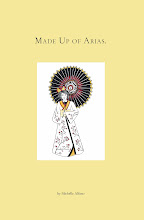
With the publication of Made Up of Arias, I am thinking of my father a great deal. He was exactly my age when he died. What a life of toil for him only to end in an early death ... two jobs, three kids, helping out two brothers and their families when they emigrated to Canada from Italy and England respectively, helping to financially support his mother who was widowed at 34 when my father was nine ...

Don't get me wrong, he wasn't a saint by any means. The man was a classic 50s stereotype with all the good and bad that implies: strong, self-assured, self-involved. I never heard him complain about his responsibilities or chores or work - it was just something that he had to do so he did it because he was a man, a husband and a father. He was definitely in charge. And sometimes not in a particularly good way. Muy muy macho as they say ... it was a man's world and he liked it that way. My mother couldn't wear the pants in that house even if she bought and paid for the damn things herself!

But she gave him a good run for his money - she was very tough with him and challenged him quite a bit. Fireworks would ensue. He was the type of husband that if my mother cut her hair without his "permission" there would be a ferocious fight (there was - that night when they went out she wore a wig to disguise her short hair). Despite their complex, prickly personalities, one thing I knew from an early age was that these two people felt very passionately about each other which sometimes exploded in arguments, bad behavior, moodiness, melancholy.

Oh the melancholy ... what is this thing that we Sicilians carry around? This sadness, mournfulness? I think we like the sadness, the longing for something else. I do love that about the culture, and the seriousness, the deep sense of loyalty to memories, the nostalgia, the sense of respect for what has passed. And I find that attractive in other people, that bit of sadness, thoughtfulness, melancholy.

I still have feelings for the people I loved and lost more than 30 years go. Not just my father ... lovers, friends, teachers, even enemies ... No one holds a grudge like a Sicilian. But this doesn't upset me. Rather it reassures me greatly. I very much want to keep that part of me alive. When that part of me dies (which I hope never happens) I will know that I am truly old and used up. When I stop falling in love with a beautiful face or an image I've seen, or thinking with longing of those who have gone, or wanting to have new experiences, or being moved by beauty and art and youth ... then I will know, sadly, that my number is up and it is all over.

This book, and my being the same age as Papa when he died, has made me feel a number of things ... anxious, fearful, a little fixated on time wondering exactly how much time is left, full of hope in an odd way for the future and for what needs to be done.

It has compelled me to start thinking about some of the things I want to do ... finish this new novel that has been languishing for the last two years, rekindle old relationships, start new ones, seize new opportunities, use my modest powers for good rather than evil. Live. Because, like my father, like all of us, I have no idea what lies before me and when my number will be up.

One thing that I have always wanted to do is start a small, beautiful literary magazine with a specific focus (to be disclosed a a later late as they say).

Excuse me folks, I have work to do.

Friday, December 12, 2008

Last night, she said ...

Made Up of Arias Book Launch
Tuesday December 9, 2008
Globe Bistro
ALC with the poet Giovanna Riccio
who also served as the emcee.
She did a wonderful job stepping in at the last minute too.

Maria Scala, poet, editor and super mom of the
beautiful bambina L. reading during the first set.

Friends Tracy and the poet Sandra Di Zio.
Sandra was the first reader at the launch.

Friends Paul and Val, looking wedding picture perfect here!

My dashing b-i-l Terry with Marjorie, my s-i-l's mom.
She and husband Colin brought beautiful flowers.

Friends Ben, Marie and Anna with the looking very pretty Penny Winspur, Editor, Blaurock Press, and Stan Johannesen, Senior Editor, Blaruock Press, looking formidable (as usual).


The "Party Girls" from the 'hood:
Lynda, Gillian, Shannon & Jessica.


Giovanna Riccio introducing ALC


R and J, my two beloveds.
R designed all the promotional materials (using Amber Albrecht's beautiful illustration)
for the launch despite being ill. J helped choose the music.


J and one of her best friends.


Friends, family, friends (almost said work friends).


Mia famiglia: sistah-in-law Tami,
Marjorie & Colin (Julie's parents),
brother-in-law Todd and sister-in-law Julie.


Sorellina Franca with J and friend. The character of the youngest child Clara
Pentangeli in the book is based, in part, on Franca.


My home girls Daphne and Susan,
Susan was the super organizer of this event. She did an amazing job.


From left to right, friends Jan, Barbara, Sean,
Bel, Eva and Anthony.


The Barnes family: Paula, Clark, Samantha & Yvette (missing is my bud Nigel).
Yvette and Nigel are friends from high school in Hamilton and officially my oldest friends. Yvette asked me to stop saying that.


ALC, humbled and extremely pleased at the turn out. Eighty five people attended.


Friends Alex and her son Pablo confer ...

The launch for Made Up of Arias was fantastic … so good! Beyond my expectations. There were perhaps 85 people there, many I wasn't expecting. The room was packed. My friend Susan, superstar event planner, helped me with selecting the venue, the wine and canapé selection, the creation of a "special" martini, etc ...

We had music - R made up a playlist of forty songs for me on my ipod which J helped me select. We had these lovely canapés provided by the Globe Bistro and a cash bar in a very beautiful venue above the Globe. R said why not opera? But I wanted to dance ... alot.

R, the dutiful husband and gifted graphic designer, created tent cards for the tables ... some had the price of the book, others the contents of the special "Aria" martini created for the event. He made up CDs of the song we played as gifts for the readers, emcee, the event organizer and others. The crowd milled around from about 7.15pm to 8.00pm and then my friend the talented poet Giovanna Riccio, who served as emcee and with whom I have recently reconnected since having met her in the 90s at various literary events, got the proceedings going. I signed books frantically trying to speak with everyone before the readings started. My sister and I sold about 65 books between us.

At 8pm, the poets Sandra Di Zio and Maria Scala, my friends, read very well and were well received. I gave them CDs of the music played that night. Beautiful, talented, blessed in many ways, these gals have it all.

A ten minute intermission - I run and hide in the bathroom to calm my nerves. I was to read after the poets. People were very receptive. I was a wreck of course inside but I was told I seemed calm. As I read, I could see the lovely, smiling face of my friend E over the edge of my book and that calmed me quite a bit. I could feel all the positive energy in the room, all the love and good wishes flowing towards me. It was so empowering and moving. People were listening, really listening to the reading .... it was awesome and humbling, almost spiritual in a way.

I think my friends were stunned at the quality of the book. They thought it was beautiful. The comments were so kind, so complimentary. I was over the moon.

People brought flowers (Colin & Marjorie, Anita), chocolates (Maria & her bambina L), prosecco (Chris & Alex), a Xmas gift (Antonia). I was completely overwhelmed, shocked, happy ...

After the readings the group cleared out fairly quickly as it was a Tuesday night and many had babysitters to attend to or a ways to go home. As we were leaving my friend J came bounding up the stairs, we almost missed her but invited her across the street for a drink at Allens. Six adults and two tweenies thrilled to be up at 10.30 for a quick drink ...

My only regret is that Christian Snyder, our Blaurock Press publisher, was unable to attend due to an emergency at home and that another friend Barbara traveled across the city (she had three competing commitments that night!) only to find that we had gone. Ugh! I felt so badly for her as it was a very busy night for her and she was nowhere near her home at the end of the night. I must make amends.

That night, I was so wound up I could not sleep. My heart and head were into overdrive ... I got e-mails from a half dozen friends requesting more copies the next day.

Viva la vida!

Thursday, December 11, 2008

Some blog saved. some blog saved. some blog saved my life tonight

The car alarm belonging to the "genius" down the street (I will refrain from expletives here), who will remain unnamed and who likely keeps solid blocks of gold in his car, went off again at 3ish this morning. This is a frequent occurrence on our street laden with children and toddlers. This coupled with my mind being in overdrive from the book launch the other night (more deets to follow) has driven me out of bed and on to the computer. I wish I could be like my spouse, blissfully asleep and oblivious to all. He murmurs sweetly and then falls asleep again after these incidents. Not I ...

I go to the third floor of our Victorian where the computer is and Lolli, the older of the two cats, pads upstairs quietly with me. Oh don't get me wrong, she doesn't do it because she likes me (she is completely enamored of the husband R, who isn't?) but she is a nosy little thing and must sniff about. She sits and stares at me with her beautiful green eyes as I type in the darkness. "Why can't you be R?" her look seems to say.

Reactions are quickly coming from friends who have read Made Up of Arias, which is quite short, and the comments, inevitably stick in my mind, mostly kind, sometimes cryptic ... one particularly literate friend K, an accomplished poet and publisher, called it a "commemoration and an expiation". Yes, the commemoration part is obvious, a sort of homage to a style of life that is no longer my own, perhaps never was my own, but my mother's, my extended family's in Hamilton. With my mother's generation (she is now 73 with two older siblings gone) that life has become more and more tenuous.

The other day, in response to my innocent query: "So, without the kids tonight?", one exasperated first cousin (a mother) explained why none of her children had shown up at a family function that day. She started to rhyme off the reasons as to why they were busy, uninterested, occupied, etc ... broke off in mid stream and suddenly burst out angrily and said, "Okay! So now I have no children!"

I had to suppress my surprise and laughter because as distressful as it was to her, this was exactly the sentiment I was trying to capture in the book on the part of Seraphina, the passionate and volatile mother of three, who has these from zero to ten bursts of passion ... and good Lord, I know I have them with my own child. My vehement, and sometimes passionate volatility about J's behavior and well being, usually having to do with issues of her safety, are legendary in this house. This is often puzzling to the usually level headed spouse who looks at me in an alarmed fashion most days.

But an expiation? An atonement of sorts? Hmm, an atonement for abandoning that life? For, in effect, abandoning my mother to that life when I was eighteen and moved away to Toronto to the shock and horror of those in our tightly knit Sicilian community? This was considered a really unconscionable thing to do especially as my mother had been widowed two years before and depended on me to assist her in the family business. I did not abandon her but I'm sure she felt I did, as did many others.

I doubt this was what my friend meant but, okay, let's haul out that emotional baggage ALC, that huge piece of old Samsonite luggage that is my Italian girl guilt. I did construe it to be that way when K mentioned it.

I have come to repeat to whomever will listen that I could not have written this book at any other time in my life except for back in the day...

Firstly, I had the time to write, working only part-time or sporadically at that point, fully immersed in trying to find my voice, starting with family fictions and weaving an intricate web from there. Secondly, I was trying to piece together in my own head how my mother's mind worked at that time, and found, for myself, the perfect metaphor in Seraphina's obsession with opera, with the histrionic gesture, with family honour, and familial love. Thirdly, I was pregnant in the earlier and latter parts of the writing process not once but twice, once miscarrying and then giving birth to J the next year which infused the process somewhat with hope, with intense love, with despair at times.

I was wondering: what did it mean to love your child so intensely that you expose them to these terrible rages of passion and fury over seeming trifles as does Seraphina? As I do and my cousins seem to now? What is at the root of that passion? Would I be that sort of mother one day I wondered then?

An expiation indeed.

Tuesday, December 9, 2008

Made Up of Arias Toronto Launch


"Michelle Alfano's Made Up of Arias beautifully evokes an immigrant childhood lived against the backdrop of opera, which stands in for all that her characters have lost or will never attain even while it speaks to the most common and everyday of their tragedies and joys. Alfano writes with the humour and compassion of someone who not only understands her characters, but forgives them." Nino Ricci, Governor General Award winning author of
The Origin of the Species
and Lives of the Saints

Tonight is the Toronto launch! Everything is in place ...

Place: Globe Bistro
124 Danforth Ave. at Broadview Ave., Toronto
In the upper lounge

Time: 7.30pm

With readings by: Michelle Alfano, and the poets Sandra Di Zio and Maria Scala

Books will be for sale: Made Up Of Arias by Michelle Alfano $20
Between O and V
by Maria Scala $5

There will be music, readings, canapes, consumption of alcoholic beverages and general merrymaking. Please join me!

Please order Made Up of Arias here.