Monday, February 8, 2010

The Girl Who Played with Fire

The Girl Who Played with Fire by Steig Larrson (Penguin Group, 2009) 503 pages

As the second novel of the Millennium trilogy opens, we meet Lisbeth Salander again. Here she is a 13 year old held captive by an unidentified man and then we begin to see but a small portion of what she refers to as "All the Evil" which began in her youth and which plagues Lisbeth for all her life and contaminates her relationship with men.

Christopher Hitchens described Lisbeth in a recent Vanity Fair article
Miss Salander is so well accoutred with special features that she’s almost over-equipped. She is awarded a photographic memory, a chess mind to rival Bobby Fischer’s, a mathematical capacity that toys with Fermat’s last theorem as a cat bats a mouse, and the ability to “hack” ... into the deep intestinal computers of all banks and police departments.

Truly a formidable female. Lisbeth has the appearance of a 90 pound waif but has the morality of a vigilante which is why, I think, she is so appealing to readers. Her previous guardian mused:
Palmgren was sure that Salander was a genuinely moral person. The problem was that her notion of morality did not always coincide with that of the justice system.
Flash forward approximately dozen years: Lisbeth has walked out on the journalist Mikael Blomkvist, her older lover, with whom she has brought down and destroyed Wennerström, a particularly venal and corrupt industrialist as well as Martin Vanger, a serial rapist and murderer. Our girl had a very busy year. But at the conclusion of these adventures she suspects that Blomkwist has taken up with an old lover and so she disappears in a fit of pique.

She leaves Stockholm for more than a year on money she embezzles from the Wennerström empire (some 3 billion kronor - today's value CDN$435,362,691). Would Lisbeth do this? Steal from a criminal and go on a shopping spree? She travels to Grenada and various other countries including Italy where she, inexplicably, gets breast implants. This seems out of character to me somehow.

But in Grenada we witness the full velocity of Lisbeth's moral code when she suspects that a man in the next hotel room is assaulting his wife. He soon becomes the object of Lisbeth's wrath in a frighteningly violent scene set during a hurricane. Okay, Lisbeth is a badass and is not to be toyed with. This sets the stage for some later violence and horror.

Back in Sweden, Blomkvist and Erica Berger, the Millennium publisher, agree to publish an account of an investigation into the illegal sex trade involving East European prostitutes put together by a journalist and a criminologist who are a couple. A sinister figure named Alexander Zala slithers through their notes regarding the investigation but his identity is unknown to them or the publishers.

As Lisbeth prepares to return to Sweden, re-enter Lisbeth's new guardian Nils Bjurman, known to readers from the first book. He is plotting revenge on Lisbeth. After he had sadistically raped Lisbeth, she orchestrated her vengeance by hogtieing him, tattooing him on the belly with a nasty message, videotaping the results and blackmailing him. He now plots to have Lisbeth kidnapped and killed by some thugs.

One day, while Mikael is skulking around Lisbeth's apartment (she still refuses to respond to his calls or letters) he witnesses her being attacked, presumably by someone hired by Bjurman. She survives the attack without Mikael's intercession.

The journalist and the criminologist are murdered - the gun used in the murder is linked back to Bjurman and has Lisbeth's fingerprints on them. At the same time Bjurman is also murdered and the police think Salander is involved in a triple homicide. She becomes a fugitive and then real and imagined salacious information about Lisbeth is leaked to the press by her enemies.

Knowing that Lisbeth regularly hacks into his computer Mikael leaves a series of messages for her asking if she knows who killed the three people. She types back one word: Zala. This frightening figure holds a central role in the novel.


To say more would ruin the plot which is complex and at times convoluted. I have to say that Larrson never fails to surprise me as I did not see certain key plot resolutions coming. At one point we have Blomkwist explain the murders to a colleague at the end of the novel and this is welcome as there are so many characters (all referred to by their surnames, even the women) that the reader struggles to keep them straight in her head (hint - the explanation starts on page 467).


But my main concern is that Larsson (now deceased - he died in 2004 of a heart attack although other paranoid theories have since surfaced about how he died) played a dubious game here as a writer and respected member of the Swedish left. On the one hand he openly deplores the injustices against women. There is no question that we, as the readers, are meant to deplore the atrocities inflicted on women. His first book, The Girl with the Dragon Tattoo, was called Men That Hate Women in Swedish.

Yet he provides an abundance of salacious detail and situations: incest, serial murders, s&m, lesbianisn and bisexuality, fetishes, prostitution, rape, murder. And then he has the sexy, avenging angel Salander (complete with tattoos, piercings, waif-like appearance and now with her new breasts) cleaning up the riff raff. I think this is called having your cake and eating it too ...

Thanks to Bronwyn Kienapple of Penguin Group (Canada) for the review copy!

Thursday, February 4, 2010

Madame Butterfly's Servant

"Deep into some of Madame's secrets I had entered ..."
Villette, Charlotte Bronte

A Gate at the Stairs by Lorrie Moore (Bond Street Books, 2009) 321 pages
~ MAJOR SPOILER ALERT~
I often start a review with the thought that if I had known the topic I might not have picked up this book so it is fortunate (sometimes) that the book club makes choices for me and I am glad that I was compelled to read some of the books. But this book irked me in inumerable ways and hit so many emotional buttons - and not in particularly good ways. Moore has a wonderful reputation and is a skilled and intelligent writer (best known for her short story collection Birds of America) but this story is an odd and improbable tale. There are traces of the operatic tale of Madame Butterfly losing her child, told from the servant Suzuki's acerbic perspective but it never holds together for me.

Tassie Keltjin, a gourmet potato farmer's daughter, is a first year college student living in the fictional town of Troy, Wisconsin who needs job. She gets one as a nanny for a bi-racial child named Emmie adopted by the odd, and oddly paired, Sarah and Edward Brink (first symbolism alert! Brink, as in what Brinks truck - more money than sense? or brink of madness?). They come across as self-absorbed yuppies who don't seem to know how to parent. She owns a high end restaurant called Le Petit Moulin and he is a scientist with a roving eye, always seeking out the most inappropriate object of desire in the nearest vicinity.

Sarah appears to be a kookier, older version of Tassie - two halves of the same coin with an intelligent if odd sense of humour and a hyper-aware, neurotic parenting style. Sarah's objections to Tassie singing "I been working on the railroad" to Emmie because of its "bad" grammar and "possible use of slave labour" in the song leaves Tassie speechless. Alternatively, she leaves no food in the house for the child and informs Tassie that she will have risotto fedexed to her from the restaurant. Probably due to liberal guilt, she blithely states that poor people are entitled to do things others are not, because they are poor and, I guess, so disadvantaged that this is their privilege.

Tassie becomes a confidante and sounding board observing the strange rituals of the Brinks and the odd nature of their relationship. Edward seems completely uninterested in Emmie and Sarah overly obsessed with the idea of being the white parent of a bi-racial child.

Sensing a racist environment in the town, Sarah forms a support group where the mostly white parents of the mostly brown adopted children gather at Sarah and Edward's home and kvetch about the overt and covert racism that they and their children experience. Their complaints and observations range from the obvious to the absurd. But being somewhat familiar with the adoption process I did recognize the truth of some of those complaints. People tend to laud your choice to adopt in terms of doing a brave or wonderful thing for an adopted child almost as if you have taken on some horribly unpleasant task that they could never take on themselves (sometimes they even say explicitly that they could never do so).

And Moore captures the, among other things, weirdness of having perfectly rational people touch your curly or "exotic" hair as they do to Emmie which is certainly something I can relate to. It's as if a black or bi-racial child with white parents is an odd and weird thing that they can scarcely comprehend.

People still seem discomfited by bi-racial families today. As the mother of a half-Asian child I still remember with some humour, mixed with chagrin, being asked by a member of my mothers' group if people thought I was my daughter J's nanny. Really? Here in Toronto, in politically correct, multi-cultural Riverdale - having two parents of different races is still seen as unusual?

I must say that Ms. Moore certainly has a flare for language, expressed in quirky and intriguing ways. She describes a bridesmaid's dress as "fit for a pornographic milk maid" or "what Scarlett O'Hara might have done with a shower curtain, if she were trying to snag a plumber". Strawberries grow "the wise and cheery beards of Santa Claus". Moore is erudite and cultured and clever (she quotes Charlotte Bronte and knows the plots of operas) but the word play grates on you after a hundred pages or so.

A terrible secret is revealed many pages into the book regarding Sarah and Edward's first child Gabriel (refered to as an, ahem, angel) and how he died. The story of Gabriel's demise is unbelievable. I am incredulous that it could have transpired in such a ridiculous manner, even in this fictional setting. I am reluctant to use the word never but in my estimation I cannot imagine two parents behaving in such a reprehensible and improbable manner.

Emmie, their adopted child, is taken away once the secret is revealed. Tassie is let go and returns to her parents in Dellacrosse (oh the symbolism - so many crosses to bear!), the restaurant closes, and, a sad chapter in Tassie's young life ends.

Tassie displays a wonderful, charming manner with Emmie which demonstrates to me that Moore understands and likes children and has some experience with them. But the disturbing backstory about Gabriel suggests that she has no idea how parents view their children and what they would or would not do in a crisis situation. If you have already lost a child in such horrific circumstances, how could you be so cavalier with a second one?

There are enough explicit references to the opera Madame Butterfly that we are meant to see both Sarah (the adopted mother) and Bonnie (the hapless biological mother we meet early in the novel) as Butterfly whose child is taken away from her and Tassie as Suzuki, the faithful servant who witnesses it all but can take no action. Tassie even drives a Suzuki. It's that clever plot maneuvering and word play that kills the story for me.

Two sub-plots also confounded me ... both with a vaguely post-911 feel to them. Tassie becomes smitten with an attractive Islamic student posing as a Brazilian international student at her college. There are vague connotations that he is a jihadist. He simply and ruthlessly disappears from her life with virtually no explanation. His role, figuratively and literally, in the novel is a mystery to me.

The other sub-plot involves the death of Tassie's brother Bob who enlists with the military and is soon killed. Early in the novel he sends an e-mail to Tassie half jokingly asking her to talk him out of military service. She files it away for later reading and never gets to it. She only reads the e-mail after his death. I find this inexplicable. To add to the bizarre nature of this Moore writes a scene where Tassie crawls into the coffin with her brother's partially destroyed corpse (he was blown up in some sort of bombing incident) and crawls out when the casket is being carried to the cemetery. This creepy, improbable scene has no explanation.

It is difficult for me to separate the outraged mother from the disinterested reader here. As my mother said to me once when I expressed maternal alarm at some situation: "Finally, she responds like a mother!" I  know this might not be the optimal response when reading literature but it is the one that lingers here.

Monday, February 1, 2010

A TV set with no picture

Don't nobody want me. Don't nobody need me. I know who I am. I know what they say I am.

Push by Sapphire (Random House, 1996) 175 pages
~MAJOR SPOILER ALERT~

Lately I am have been sulking around like a petulant teenager, deeming things phony (ala Holden Caulfield) when they irk me and seem inauthentic. It's the kinda mood I'm in ... call it the February blues.

Despite the hype surrounding the film (now renamed Precious because of a 2009 sci-fi film similarly named), I wanted to read this book. I wanted to hear the voice of this writer. I wanted to see if Sapphire could create, and sustain, the voice of an illiterate sixteen year who seems to hold little promise based on how she looks and what she has experienced at the hands of her parents and the world.

Is it a grotesque carnival of negative stereotypes about black people or a message of hope and a realistic portrayal of a troubled young black girl with few hopes?

I would have to say that Sapphire largely succeeds in this attempt to create a voice for Precious. This is a brutal, unrelenting portrayal of Precious' life: sexually abused by her father and impregnated by him twice; mentally and physically abused by her mother; despised by the world, vilified and ignored. I don't think I am telling you anything that the movie trailers have not.

When dealing with disturbing material in art - here there is incest, rape, sexual abuse, violence, what might be perceived as negative stereotyping of black people - when is it too much to include? I think it is when its artistic value becomes less important than the sensationalism of the material. Sapphire walks a fine line but she does not cross it I feel.

She is deemed too fat, too ugly, disposable and useless. But the real Precious is a girl of intense emotions and vulnerability with aspirations beneath a forbidding exterior. Both mother and daughter are morbidly obese. Of her mother Precious says, "She ain' circus size yet but she getting there."

Even Precious' dreams are haunted by abuse - too disturbing to detail here - where she pictures herself a tiny child at the mercy of her mother. A memory? A dream? In it, the tiny baby trills the alphabet - is that Precious as she might have been if she had had the proper care and upbringing? If she had been taught to read properly?

Precious escapes into a fantasy world where she is the star. In moments of stress (is this scene real or imagined?) Precious cuts herself:
Get Daddy's razor out cabinet. Cut cut cut arm wrist, not trying to die, trying to plug myself back in. I am a TV set wif no picture. I am broke wif no mind. No past or present time. Only the movies of being someone else. Someone not fat, dark skin, short hair, someone not fucked. A pink virgin girl ...
Her fantasy self has light skin and long hair that she can swing back and forth, small breasts, a thin physique - an image created and sustained by the media and racism.

When Precious is suspended for getting pregnant a second time, an alternative school is recommended for her despite her mother's objections. Her mother Mary prefers Precious to remain as she is: abject, cooking for her, caring for her mother's needs, and devoid of self esteem which Mary seems dedicated to destroying every last ounce of.

Precious finally leans to read with the assistance of a savvy teacher at the alternative school with a pretty but unlikely name, Blue Rain, who grows to love the seemingly unlovable Precious. This is Precious' journey to becoming a writer, to literally learning to write.

Precious steals a file from the social worker that she is forced to go to and reads the file with the assistance of a friend. Precious is appalled when she reads that it would be difficult for her to get her GED, that she should get employment instead, possibly as a home attendant. Here Sapphire tackles the logic of workfare, of forcing the impoverished to deserve what they get from the government. 

Precious gives birth to her son Abdul and debates whether she can return to school. When she returns from the hospital, a vicious surprise lies in wait for her as her mother tries to kill her. Precious flees with nothing but the baby and seeks the help of an overburdened but sympathetic nurse at Harlem hospital. She ends up in an armory for shelter that night - with addicts and homeless people - and is robbed during the course of the night.

Blue Rain, perhaps expressing all our rage and sense of futility as a reader, is outraged at Precious' situation and manages to find a place for her at a home called Advancement House so that Precious may continue her education and still have childcare for Abdul.

At times the plot feels like the plagues of Egypt upon the Israelites with one catastrophe following another for Precious. When we learn that Precious' father died of AIDS it feels that the reader can bear no more tragedy. She has contracted AIDS but, blessedly, her baby is safe.

At times her despair is so overwhelming that it is difficult to keep reading:
I always thought I was someone different on the inside. That I was just fat and black and ugly to people on the OUTSIDE. And if they could see inside me they would see something lovely and not keep laughing at me ...
But it ends with some sense of hope. She will continue her education. She joins an incest survivors' group. She learns to read and write. She loves and cares for her child. She will not return to her mother. She has hope and we all need a little bit of that.

My only concern regarding the structure of the work is the short essays appended to the novel, written by the other members of Precious' literacy class. I wish Sapphire had found a way to include their back stories in another fashion. As it is it feels tacked on and somewhat superfluous.

Tuesday, January 26, 2010

Lina Medaglia's The Demons of Aquilonia


My friend and colleague, Lina Medaglia, recently published a new book entitled The Demons of Aquilonia (Inanna Publications, 2009). Lina read with us at The (Not So) Nice Italian Girls & Friends reading at supermarket on January 19th, 2010. See the pics from the event here. Please view a intriguing video promo for the book here
 
Praise for Lina Medaglia's work:

Be prepared to be transported into the world of Southern Italy to the sleepy sun-drenched village of Aquilonia, a place rich in lies, betrayal, secrets, and family tradition. With an engaging voice and a flair for dialogue, Lina Medaglia creates characters and stories, layer after layer that engage and disturb. In the style of Nino Ricci, she paints a vivid portrait of an Italian village and its villagers that you will not forget. A wonderful read by an appealing storyteller.
Maria Coletta McLean, author of My Father Came from Italy

The strong narrative flow and exquisite use of poetic and lyrical language draw the reader into the vibrant folds of this auto/biographical fiction, creating compassionate connections with the characters that often took my breath away, made my heart stop. The novel reminds readers of the complexity of the human condition, of the necessity of challenging the patriarchal and political status quo, and of the complex challenges that originate for women of first- and second-generation immigrant families, and even subsequent ones, from their birth places.
Erika Hasebe-Ludt, co-author of Life Writing and Literary Métissage as an Ethos for Our Times

The life and family of Licia Giganteschi make for a complex and alluring story of love and hate, fate and courage. Family intrigue festers for generations below the surface of an Italian village and seems inescapable even in Toronto; that is, until Licia can finally conquer the demons by finding the truth.
Maria Cioni, author of Spaghetti Western: How My Father Brought Italian Food to the West


Order the book here! You won't be disappointed.

Friday, January 22, 2010

Opera 101: Carmen


Mezzo-soprano Elina Garanca as Carmen with tenor Roberto Alagna as Don Jose 

Carmen by Georges Bizet directed by Richard Eyre, broadcast live from The Metropolitan Opera, New York, January 16, 2010

As a novice in the watching of live opera, I often feel a sense of unease. I'm not an expert in music, I don't have enough knowledge to know if the singers are singing really well or how any given operatic production rates. Those well versed in opera will often compare singers in different roles, current productions to the many they have seen in the past or legendary productions that have passed into operatic history. My experience is limited and based solely on my emotional reactions. I can only say what I like and what I dislike and what appeals to me visually.

Unfortunately, often that's not enough in viewing art. Viewing an art form that you are unfamiliar with is like learning a new language. You can't just say it doesn't make any sense or it has no value because you don't understand what is being said or don't know anything of the culture and history attached to it. I know enough to know that I know very little.

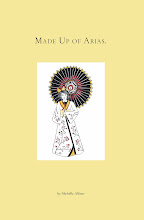
When I was writing and researching my first book Arias, I would go to the library and return with a stack of LPs - yes, that's how long ago it was. I would play them and pour over the libretto for clues as to what I liked and what would work in my book as part of the plot (a working class Italian woman with three kids obsessed with Maria Callas and the fantasy of opera). What I didn't like I discarded and I just went with what appealed to me. Invariably, it was the 19th c. Italian composers Verdi and Puccini with a little bit of Bizet and Leoncavallo thrown in.

When I saw La Traviata for the first time at the COC, when I was twenty or so (I was brought by a friend, long since departed from my life but she gave me this lovely gift), I finally got what made people so passionate about opera. I saw that there was magic here ... how did it work I wondered? Why did it work? Why did it make me emotional and vulnerable? I tried to capture the experience of seeing this in the opening chapter of Arias

So as much as I have enjoyed certain operas - I realize that I may seem disappointingly old school and retro in my taste - I can only speak with limited knowledge of what I see. But I am new to the process of speaking about and thinking about opera as an art form and perhaps you are too. If we approach this together perhaps it will not seem as forbidding as it does to the novice, as it often does to me. Consider this blog Opera 101 for the both of us ...

When I had heard that Angela Gheorghiu was dropping out of Carmen to be replaced by the Latvian mezzo-soprano Elina Garanca in the Met production, I was very disappointed because I have a specific image of Carmen in mind as do most people who love Prosper Merimee's original novella. Gheorghiu is a dark haired, fiery Romanian soprano (perfect for the role of the renown gypsy no?) with a wicked tongue and an imperious persona. Just check out what she has been saying about her ex-husband Roberto Alagna, the French tenor, who was to play opposite her as Don Jose in Carmen, a role he has made his own.

Gheorghiu is temperamental and bitchy ... she has been dismissed from roles, gotten into altercations with directors, says disparaging things about her ex. She has a marvelous diva aura and has been physically compared to Callas. My husband fell for her when we saw the Met broadcast of La Bohème with Gheorgiu in the lead role of Mimi. He has a passion for temperamental Europeans, you see.

So, in my mind, Carmen is not a blue-eyed, blonde from Latvia but a fiery Latina or at the very least a Romanian or a Greek diva. But it wasn't just the physical aspect of the role (which can easily be disguised with elaborate wigs and makeup) it's the nature of the singer. Garanca gives off an icy, self-assured princess vibe which irks me a little. My discomfort with Garanca is best expressed here by the anonymous and quite bitchy blogger at intermezzo.typepad.com which I am beginning to enjoy a great deal:
Carmen needs a bit of dirt under her fingernails, and no, an elegant smudge of brown greasepaint is not the same thing. Her agile, honeyed voice is elegance personified; there's little to suggest an earthy gypsy heart beating beneath.
I have only ever seen Garanca in the role of Cinderella in La Cenerentola, again broadcast live from the Met but, I realize, due to lack of experience and knowledge, I have underestimated her talent. Physically, she did manage to embody, somewhat, the fiery, independent gypsy Carmen with a long train of dark curls and an appropriately insolent attitude. Carmen is indomitable, even when she faces certain death she will not back down, preferring to die (as she foresees in the cards) than lie with a man she no longer loves.

In the Intermezzo review, the reviewer disdained Garanca's Carmen in The Royal Opera production in October of last year by saying that she was "dry-humping everything" on set from "the horse trough to the village idiot like a randy Yorkshire Terrier". Ouch. That production was directed by Francesca Zambello, not Eyre, who is somewhat more restrained in this production.

Setting the story during Franco's Spain in the 1930s almost a hundred years after the original story, Eyre, the director, tries to avoid the usual physical acting cliches about Carmen: the hand on hip, strutting about the stage that has become part of the character Carmen's shtick. Carmen is physical and sensual and this is sometimes taken to the extreme with the legs splayed, hip thrusting gestures that are  employed, here too at times. These are cheap tricks meant to convey a woman of easy virtue. It is much harder to convey the tough, indomitable spirit of the gypsy without these tricks.

Having read the Carmen novella and seen Bizet's opera, I don't see Carmen as the promiscuous whore. Read the original Carmen by Prosper Merimee here - the novella is quite short. She's not a prostitute either. She wants what she wants when she wants it and isn't afraid to use her sexuality to get it. This is why she is so mesmerizing, so powerful an image. And this is likely why she ends up dead at the end of Act 4 because she cannot be contained or controlled by anyone.

Carmen is disdainful and proud and refuses to obey any man. When she leaves Jose for the toreador Escamillo she does so without any contrition - she is bored and wants to move on to the next adventure. Garanca's Carmen and Alagna's Jose are physical and violent - wrestling on the ground and clawing each other in the final death scene where he stabs her for having left him and refusing to return to him.

The stage, while beautifully and authentically designed, is also often "overpopulated" by the cast and too busy as the Intermezzo review mentioned in the Royal Opera production. I sometimes wonder if the director feels we will not be engaged enough with the story and so must fill the stage with dozens of beggar children, soldiers, peasants, gypsies, smugglers etc ... in various scenes. In this story we have passionate and unrequited love, murder, smuggling, bullfights, what more do you need?

The opera was conducted by the young French-Canadian conductor Yannick Nézet-Séguin with passion and great enthusiasm and it is thrilling to see the conductor and the musicians performing up close on screen.

This has become a signature role for Alagna and he bestowed the ultimate compliment on Garanca during the intermission interview conducted by Renee Fleming calling her the "most complete Carmen" he has ever sang with - ouch - take that Angela! Still, despite the power of his voice and his considerable acting skills, he leaves me cold. I should be rooting for this French operatic tenor of Sicilian descent but he leaves this MTV generation, visually-oriented spectator unmoved, feeling he lacks the heroic demeanor that I admire in the much older Placido Domingo or Jose Carreras.

This is another challenge that the HD opera-going crowd must face: in certain respects, viewing the performance live in a cinema is a heightened visual experience as you can see the expressions, the gestures, indeed the sweat on their brow on a twenty foot screen in extreme close up. It is a very intimate experience that I don't think can be captured in the same way from the back row of the theatre during a live production.

Conversely, despite a beautiful voice you are very aware of Micaela's (Barbara Frittoli) chinless, middle-aged demeanor and the image of the gentle, naive virgin who loves Jose is soon destroyed. This is sacrilege in opera, of course, because you start to focus on the wrong things: the weight of the soprano, the amount of sweat glistening on the tenor's brow, whether the set looks realistic enough, does the singer physically resemble the character enough. You are moving away from what should be the true focus: the music and the quality of the singing. 

And did I imagine it but was the chemistry between the New Zealander Teddy Tahu Rhodes (who stepped in at the very last minute to play Escamillo due to Mariusz Kwiecien's illness) much more intense than that between Garanca and Alagna? Rhodes was charming and self-effacing in the intermission interview where Frittoli came off as brittle and cold - was it Renee's little bit of extra attention being paid to the handsome Rhodes? We learned that he had been told at 10.00 am that morning that he was to play Escamillo at 1.00 pm matinee. He was amazingly self assured in the role even if it seemed that he might be more comfortable on a surf board rather than in a bullfight.

Some did not like the climax of the opera but I thought it was an intriguing twist. Once Jose has killed Carmen, the turntable stage revolves and turns to reveal the inside of the crowded stadium where Escamillo is standing before the slain bull. "Ah, symbolism." muttered one critic. And yet it is an apt, if heavy handed, metaphor.

Carmen is a force of nature whose life force can only be extinguished by unimaginable, extreme violence.

Post-Script: The Canadian encore presentation will be on March 13, 2010, 1.00 pm

Tuesday, January 19, 2010

The (Not So) Nice Italian Girls & Friends ...

The (Not So) Nice Italian Girls and Friends were formed in the summer of 2009. It was the brainchild of myself and a friend, Giovanna Riccio the poet, who wanted to create a forum for new and established writers in the Italo-Canadian community. We wanted to offer a fresh and challenging perspective - poetry and short fiction that might offer an alternative to the usual images in the media; hence, the tongue and cheek reference to being "not so nice".

We have created a new blog to promote the events: notsoniceitaliangirls.blogspot.com. We will list upcoming readings and, hopefully, pics from each event as well as bios and links to the writers' websites and blogs. And we look forward to seeing you tonight!


Sunday, January 17, 2010

Otto e mezzo, forse dieci

8 1/2 (Otte e mezzo) (Italy, 1962) directed by Federico Fellini, 138 minutes

Marcello Mastroianni? Claudia Cardinale? Anouk Aimee? Who could ask for more in a film?

Fellini had a talent for bringing together the grotesque and the beautiful but never more so than in this film; hence, the creation of the adjective Felliniesque.

Guido Anselmi (Marcello Mastroianni), a famous Italian film director loosely based on Fellini himself, struggles to put together a new film - having no script, no new ideas and a crisis of conscience about his life and the women in it.

He seeks refuge in a fashionable health spa which resembles a sort of Roman ruin. There he is joined by his mistress Carla (the delightful confection Sandra Milo) whom he ferrets away in a nearby shabby pensione in an attempt to conceal their relationship.

The writer involved with the film plagues him and serves as a nagging conscience: "You see, what stands out at a first reading is the lack of a central issue or a philosophical stance. That makes the film a chain of gratuitous episodes which may even be amusing in their ambivalent realism. You wonder, what is the director really trying to do? Make us think? Scare us? That ploy betrays a basic lack of poetic inspiration."

This unnerves Guido as do a host of ghosts and apparitions from his past and imagination: his deceased parents whom he seems to have displeased, cabaret singers, an angry producer, agents, sycophants, journalists, a magician and his elderly female assistant, insecure actresses anxious about their parts, priests and a cardinal whom he seeks approval from, and the sometimes grotesque inhabitants of the spa themselves.

Guido, harassed, looking ill and uncomfortable, has comforting memories of childhood which mingle real life and fantasy. His memories are sweetly strange.

A visit to la Saraghina, a local prostitute who lives in a stone house on the beach near Guido's school, takes centre stage. She is both monstrous and magnificent, with enormous, blackened eyes, dramatic, smeared makeup, wild raven hair and tattered clothes. She dances wildly for money for the schoolboys until they are hauled away by the priests and Guido is disciplined as the ringleader with his shamed mother looking on.

His obsession with women seems to begin here for he covets many: fair, grotesque, thin, voluptuous, cold and withholding, emotional and volatile. These include his adored if exploited wife Luisa (Anouk Aimee); his mistress Carla (Sandra Milo); his sister-in-law Matilde; Madeleine (Madeleine Le Beau), the aging beauty who is to play his mother in the film; his muse the international film star Claudia (Claudia Cardinale); his best friend's young fiancee (Gloria Morin); Rossella (Rossella Falk), Luisa's best friend ... His tastes in women may be said to be catholic.

Luisa, also invited by Guido to the spa, has reached her breaking point with Guido's fantasies and insecurities after she spots Carla at the spa. The women could not be more different: Luisa is beautiful but severe and serious in aspect with dark glasses, sensible clothes and shoes. Carla is feminine and deliciously silly with a veiled pillbox hat, stiletto heels, heaving cleavage and elaborate makeup.

Claudia appears in two guises as a fantasy of a sweet chambermaid in the spa and as the film star offering advice to Guido. She says she wants "to create order", "to cleanse", something Guido desperately seems to need.

The classic archetypes emerge: mother, wife, mistress, muse, fantasy sex object ... none can offer solace. In one disturbing scene he kisses Luisa and she morphs into his mother before his eyes. Luisa does assume that somewhat motherly role in his life: disapproving, stern, unhappy with her lot, unforgiving.

The women come together in a final fantasy sequence where they all live together in relative harmony presided over by Luisa, who in this scenario, controls and admonishes the women to defer to Guido's wishes, the perfect Italian wife, considerate, deferential, tolerant.

The women bathe Guido (as he had been bathed by women as a child), feed him and his enormous ego. Despite the sexist scenario Fellini has obviously created it tongue in cheek. He quickly loses control of the women. A rule of the house is that any female over 26 is banished to the upstairs.

One show girl, complete with feathers and jewels, from his past who is well past her best by date vehemently protests and sets off a storm of anger which Guido attempts to control with a bullwhip, barely unable to restrain the women. One recognizes the conflict between his immense desires and his own recognition of the unreasonableness of those desires.

He tells the cardinal from whom he seeks advice that he is unhappy, the cardinal retorts gently, "Who said you were meant to be happy in this life?"

When Guido decides that only by speaking the truth in his art can he continue to create, his emotional conflict appears resolved. This is symbolized by the physical coming together of all the players in his life in a circus like environment in the finale. Lead by the young Guido clad in white and a number of circus clowns playing instruments, the key players are all dressed in white like angels or apparitions and approach Guido. The women in his life, the people from his past, priests, actors, coveted women, his producer, the writer who plagues him during the course of the film, the spa guests. Even the reluctant Luisa joins them at the end.

At one point the the writer taunts Guido, "Why piece together the tatters of your life - the vague memories, the faces... the people you never knew how to love?

The cast appears on the set for the film that has already been built: a futuristic launching pad which puzzles and alarms everyone involved particularly the exasperated, overtaxed producer. Does it represent the future for Fellini?

This circus like scene had such an impact on me that I remember trying to duplicate this atmosphere in my novella Arias in a sly wink to Fellini where the children perform before the giant billboard in their homemade costumes for the grownups with the character of little Joey Pentangeli dressed as Canio from I Pagliacci.

This film still thrills me with each successive viewing. I felt a lump in my throat as I watched the last scene. Could I ever produce anything so beautiful in my own art?

Wednesday, January 13, 2010

Jersey Redux

Being of Sicilian descent I love an argument so I would like to respond to my impassioned friend Shorty's response to my post on Jersey Shore (see below for Shorty's comments).

I don't have a problem with negative representations of Italians in the media. You could argue that a great deal of the art produced by Italians and Italo-Americans may present Italians in a negative light.

Think of Fellini's philandering, lying womanizers in 8 1/2 or La Dolce Vita. Or Michael Corleone in The Godfather trilogy directed by Francis Ford Coppola. Almost the entire gangster oeuvre of Martin Scorsese. Or David Chase's superb television series The Sopranos. Read Roberto Saviano's brilliant expose on the real-life Napolitano mafia in Gomorrah. All great art to varying degrees in various media.

In my own writing I have often tackled difficult and unpleasant scenarios within the Italo-Canadian community: domestic abuse, the damage done by patriarchal culture, denigration of women, violence, an infatuation with the mafia subculture (I admit it - I am enamored of the gangster subculture too). So I am not for antiseptic, squeaky clean representations of our people. I am for nuance, complicated personalities and sensitivity in creative work.

It's just a reality show and some would argue it shouldn't be taken that seriously. But what does Jersey Shore bring to the table? The opportunity to laugh at some uneducated, vain kids who think this is their ticket to fame and fortune? What value is there is watching Snooki get punched in the face by a man twice her size?

As I said I don't blame them - I'm sure this is more fun than going to college or working in the family business.

What makes the biggest media splash - episodes of Jersey Shore on MTV or the publication of The Origin of Species, a recent award winning book by the Canadian writer Nino Ricci, in which the main character, Alex Fratarcangeli, is a coward and a heel and is vaguely ashamed of his roots?

The show and its content matters because it has so much exposure. It has exposure because it is sensational and draws attention to bad behavior that is rewarded with media attention.

I am not the "media". I'm just a thinking person with a point of view who is free to express it - as is Shorty. Ain't America beautiful?

Tuesday, January 12, 2010

Jersey Girls and Boys

Maybe I should be insulted and angered by MTV's reality show Jersey Shore and its portrayal of Italo-Americans in the full flower of their youth, cavorting and sharing a summer house in Seaside Heights, N.J. Vinnie, Nicole (Snooki), Mike (the "Situation"), Sammi (Sweetheart), Jenni (JWoww), Angelina, Ronnie and DJ Pauly D are billed as eight of the "hottest, tannest, craziest Guidos" ever by MTV. By the way, they say that the descriptor "Guido" is a compliment. I guess we live in quite different 'hoods kids.

But I feel a little like Dolly Parton when asked if she was offended by dumb blonde jokes. She retorted sweetly, "I'm not offended. First of all because I'm not dumb; and, secondly I'm not blonde."

I feel the same way. It's not my lifestyle being ridiculed here nor have I ever been like these kids despite our shared heritage. These are not the people I grew up with although I do definitely recognize the types.

I empathize a bit with the Snookis and the JWowws because I would not have wanted a camera constantly trained on me at that age recording every stupid thing I ever said or did and then have the media and general public say humiliating things about my appearance, clothes and the way I spoke.

Some would argue that these people deserve everything they get as they appear to be unfathomably dumb, shallow, opportunistic, vain, ignorant of Italian culture and unpleasant to be around. I can't even begin to describe what transpires on the show (you can easily look up episodes on youtube or MTV if you like).

But I will say, based on the episode I saw and a perusal of their antics on-line, that there's a lot of tanning, preening and prepping for the club scene, flashing one's crotch on the dance floor (a Snooki specialty), getting your hair cut, picking up girls or guys, physical and verbal fights with other club patrons (including an infamous scene with Snooki being punched in the face by a guy), swearing, bickering amongst the friends and generally making a jackass of oneself.

I'm more inclined to blame the people responsible for putting it on the air such as, oh say, Tony Di Santo, MTV's President of Programming. I'm guessing with his last name that Di Santo is a brother. Or ... check out the preponderance of names ending with vowels in key senior roles on the show in the end credits.

Where is their responsibility in all this, in exploiting less sophisticated, uneducated kids who would otherwise have no place on TV except for the laughs they provide for non-Italians? These kids think they are cool and sharp and beautiful and probably did not suspect that they would be viewed with such derision and contempt. I don't think they could have foreseen the firestorm of criticism they seem to have ignited within the Italian community, especially in the U.S.

I'm going to go out on a limb and say that I don't think that these eight individuals will evolve or change in any substantial way during the course of the series. They will have no arc of evolution in behavior or feelings. I don't think that they will grow to see that there is more to life than clubbing, getting smashed or laid and that it is unacceptable to physically attack other Jersey kids in the streets like a pack of rabid dogs. I don't see that happening.

And someone (I ain't saying who) is making a great deal of money reinforcing these negative stereotypes and encouraging this behavior for the camera.

Tony Di Santo - your mamma must be sooo proud.

Saturday, January 9, 2010

The Bishop's Man

The Bishop's Man by Linden MacIntyre (Random House, 2009),
416 pages

I dreaded this book. I was not enthusiastic when it was selected as our next book club choice. Pedophilic priests and the church's efforts to conceal these crimes? That tired, upsetting story? But that is the beauty of the book club, it compels you to read books that you might otherwise not read.

Who is the Bishop's man? I say, semi tongue in cheek, think Michael Clayton in the film by the same name: a fixer. Someone who is sent in by a big powerful organization to deal with all the human detritus that somehow manages to imperil the reputation and the livelihood of said organization. Now you have sense of what the priest Duncan MacAskill has been asked to do within the Catholic church.

The portrait of the priest Duncan McAskill, the main character, is nuanced and subtle; MacIntyre easily assumes the voice and temperament of this man - a good man who has been lead astray by his desire to do the best he can to serve the Church and yet he has become an unwilling accomplice in covering up many of its most heinous crimes. His past with the church is a web of manipulation and deceit despite his best efforts.

It was not always so ... we get a clear sense of a young, idealistic boy from out East who wanted to serve God. In 1968, when he witnesses some untoward behavior by an elderly and well respected priest, a sort of mentor named Roddie MacVicar, and tries to report it to the Bishop he is summarily shipped off to Tegucigalpa in Honduras and keeps mum about what he saw, seeming to doubt his own eyes.

There are hints throughout the novel, in the form of diary entries, that things did not go well in Honduras. Alfonso, a fellow priest, dies under circumstances that are not immediately evident. Jacinta, a colleague and possible love interest for Duncan, disturbingly occupies a great deal of his writing and thoughts. Alfonso's purity seems to serve as a sort of foil to Duncan's self-perceived moral weakness.

Proving himself to be reliable to the Bishop when he returns to Canada, he becomes a sort of hit man for the church speaking to errant priests and questioning parishioners, smoothing the waters, talking families out of criminal charges against priests and the church. A philandering priest sent to Toronto, a pedophile sent to Boston. He is the fixer, the bearer of bad news for the misbehaving priest and the soother of the angry, frustrated families implicated.

In the 1990s, he is taken out of the comfortable university environment that he he now lives in and gets sent to the small parish of Creignish in Cape Breton, very close to where he once grew up. The portrayal of its inhabitants is sharp-eyed and clear, unsentimental but sympathetic.

Duncan is lonely, drinks too much, is underemployed and emotionally disengaged. He struggles with his faith and the dictates of the church that he tries to observe. He is not so far removed from the feelings of other men that he is not turned by a pretty face or ankle.

His parishioners are unhappy in various ways: demoralized by the lack of work, the industry which once brought work wreaks havoc on the pretty land they worked on. Now that the fishing industry is dying they have neither: no work and a wasting of the once unspoiled beauty of the land and waters. American tourists, referred to as "foreigners", seem to provide the main source of income but it is not received without some sense of bitterness.

In Creignish he encounters a trail of broken lives created by the silent complicity of the church hierarchy and slowly learns what was the cause of such misery. The priest observes:
"I see it now, and the amber light of the falling September sun turning fields to gold and setting first in the windows of the silent houses where all the secrets are."

There were so many hints along the way that the community was not at peace with the church: the angry glare of a young girl forced to give up her child that she conceived with a priest who was shipped out of the parish; the ever present Brendan Bell, ex-priest with a dubious past floating in and out of the story line; young Danny McKay's disturbing and tragic acting out and its ultimate conclusion; a young man who wishes to be a priest accused of being homosexual; Danny's aunt Stella McKay's mysterious hints about Danny's behavior; the aggressiveness of the priests in dealing with Danny's mischief and self-destruction ...

It is to MacIntyre's credit that we feel both a repulsion for MacAskill's role and a deep sympathy for the man. Because he is fundamentally decent there is the inevitable crisis of conscience and emotional turmoil which, oddly for me, I left me cold, unbelieving in the narrative voice.

It is now widely known that Church covered its tracks in the case of unmasking pedophiles and abusers. I believe in the chaos and destruction that ensued but I don't believe that this priest, in particular, did not understand the extent of what he had tried to cover up. It seems too little, too late.

There is a ham-fisted metaphor about MacAskill seeing an eagle tear a heron to shreds ... is that the priest MacAskill being destroyed by the church? The priests and their alleged pedophile victims? Young Danny McKay done in by unknown exploiter? Or all of them?

The answer may surprise you.

Monday, January 4, 2010

A Single Man

A Single Man (U.S., 2009) directed by Tom Ford, 101 minutes

Perhaps you recognize Tom Ford as the former head designer for Gucci or perhaps as the guest editor of a particularly heinous issue of Vanity Fair in February 2006 just prior to the Oscars.

Ford seemed to have a particularly retro images of sexuality to present in that issue: a plethora of nude and semi-nude females and boring 1980s s&m iconography. He succeeded in being both boring and insulting to women at the same time.
Not to mention he managed to repulse the actress Rachel McAdams who fled the photo shoot rather than appear nude on its cover with Keira Knightley and Scarlett Johansson.

So it is with mild surprise that I report that A Single Man is a film sensitively conceived and delivered. Described as homoerotic, that seemed an odd designation for me. Because it is more about love and genuine passion than eroticism.

Based on a novel by Christopher Isherwood, George Falconer (Colin Firth) is a 52 year old British college professor living in L.A. who struggles emotionally after the death of his longtime partner Jim (played with a convincing American accent by the British actor Matthew Goode) in the early 1960s. He appears lonely and unfulfilled with only his closest friend Charley (Julianne Moore), a fading, philandering beauty with whom he once had an brief affair, to comfort him.


The most affecting moments are George’s reactions to those things that remind him of Jim or of the beauty of life: a glimpse of a small dog which resembles one that they owned together and which disappeared with Jim’s death; George’s clandestine observation of the 50s perfect family next door which seems to be struggling with its own issues; George's clandestine observation of a beautiful student in one of his literature classes; the prettily made up eye of a modishly attired young woman at the university.


George lives in a sort of pristine, gorgeously appointed prison in his home which once provided a happy, romantic refuge but now houses only memories of his past happiness with Jim. But George has a plan. As methodical and careful as he has been in life he plans to be in death and he plots to end his life by the end of a certain day: the perfect outfit to be found in, detailed notes to be followed after his death,
rehearsing how he will be found in his bed upon completion of the dreaded task. He goes about it with a grim precision.

But George is sidetracked by an attractive and persistent student who appears to have fallen in love with him. Perhaps the message is not new here but it is still emotionally very effective. It reminded me of a Fellini character, the older man who is jaded and cynical, but becomes reinvigorated by youth and beauty (such as the character of Marcello and the pretty young waitress in the final scene of La Dolce Vita). Here, that ideal is represented by one of George’s students Kenny (Nicholas Hoult).


Frankly, I was tiring of Firth's bumbling British heartthrob routine which represented a complete reversal from the icily sexy Darcy of the Pride and Prejudice TV serial where Firth shot to fame in 1995.

Perhaps the pressure to maintain this sexy image was too much or too boring for Firth for we began to see him in semi-mediocre roles where he seemed half-heartedly engaged in the film and the process of acting: a less dashing stand-in for Darcy named Mark Darcy in
Bridget Jones' Diary (2001); an uptight, aristocratic father with political ambitions in What a Girl Wants (2003); the hapless, lonely writer in Love Actually (2003); a widowed father of many in Nanny McPhee (2005); a bumbling divorcee in Then She Found Me (2007); a closeted homosexual in Mamma Mia (2008). All very disappointingly un-Darcy like and perhaps that was the point.

But here George Falconer is dry, cerebral, cold, withholding and unhappy. It doesn't make for a pleasant human being but it makes for a more complex, emotionally engaging character on film. And it is unclear what happens to George in the end which is my favourite kind of ending.

Friday, January 1, 2010

The Girl with the Dragon Tattoo

The Girl with the Dragon Tattoo by Stieg Larsson (Viking Canada, 2005) 465 pages

A Vanity Fair article on the Swedish writer Stieg Larrson triggered my interest in this book. A fervent anti-racist, there was a great deal of speculation about the true cause of his death when Larrson died in 2004 at a relatively young age in his 50s. Larrson wrote a trilogy of books (also known as the Millennium Trilogy), all handed over to his publisher before his death. This book is the first of the series and has achieved international success.

The Swedish journalist Mikael Blomkvist, our protagonist, who is also the publisher of the magazine Millennium loses a libel case brought by the industrialist Hans-Erik Wennerström. In the wake of financial uncertainty and imminent unemployment, Blomkvist agrees to be hired by Henrik Vanger, the scion of a dysfunctional, powerful corporate dynasty and the former CEO of the Vanger companies.

Henrik Vanger lures Blomkvist to his home on a secluded island under the pretense of having him write a family history but his true motive is to persuade Blomkvist to to solve the disappearance of Vanger's great-niece Harriet (his brother Harald's granddaughter). She disappeared when she was sixteen in 1965. Vanger believed Harriet was murdered by a family member. The island on which Vanger lives was sealed off from the mainland on the day of Harriet's disappearance because of a road-tanker crash on the only bridge leading to the island.

An odd clue remains from that time, Harriet had given Vanger pressed flowers every year since she was eight. After her disappearance, on Vanger's birthday, he began to receive pressed flowers from an anonymous source from various locations in the world. He believed that these were sent by Harriet's killer.

In exchange for the investigative work, Vanger was to provide incriminating info on Wennerström to Blomkvist.

The real main character of the story is Lisbeth Salander. As the book opens Lisbeth is preparing a detailed profile on Blomkvist for a client (who is, it turns out, is Henrik Vanger). She has her own sordid story of abuse and exploitation by the men in her life which is revealed much later in the novel. When Blomkvist learns that Salander is the person who gathered intelligence on him for Henrik Vanger he hires her to do some research into some long unsolved murders that seem relevant to Harriet's disappearance.

Lisbeth is asocial, taciturn, covered in tattoos and piercings, rides a motorcycle ... disassociated from mainstream society and with a well deserved dislike of authority and men who have both treated her with great contempt and extreme violence. She wears her alienation from "normal" society like a badge. She operates under the radar as an expert computer hacker as well as an investigator.

But she is somewhat charmed by Blomkvist and intrigued by the project. Why had the disappeared girl Harriet recorded the sexual abuse and murders of a number of women who were killed before her and linked their deaths to key passages of the bible in her journal in code? That is the riddle that they set out to find. Why does Cecilia Vanger, now Blomkvist's new love interest, seem to appear in an incriminating photo shot on the day of Harriet's disappearance?

The remaining members of the Vanger clan unite against Blomkvist once they learn of his poking around in their past. A series of violent incidents take place against Blomkvist and then the pair know that they have come across some incriminating evidence which is threatening either the person responsible for Harriet's disappearance or someone protecting that person.

Lisbeth's superhuman resolve and initiative to protect Blomkvist has created a new kind of fictional heroine: tough, resilient, smart, resourceful and more than capable of saving the day. She would be phenomenal on film. She almost makes up for all the goriness of the women's' murders.

The resolution of the girl's disappearance is satisfying and plausible and does not disappoint. However, the final thirty pages are devoted to a resolution of the Wennerström situation which serves, I think, a left leaning political agenda (corporations are evil and must be destroyed or at least disabled) rather than serving a satisfying fictional conclusion.

What other thing perturbed me. The crimes against the murdered women that they uncover are horrific in nature, terrifically violent. Need they be? From a purported feminist and anti-racist writer, they are described with too much graphic detail which, I think, serves to titillate rather than enlighten at times. It paints a bleak picture of Swedish men (if it is accurate I cannot say) as violent misogynists with the exception of Blomkvist.

There is some clumsy writing from Larrson, or perhaps Reg Keeland the translator, who for instance describes an abusive husband as "a brutal domestic". This leads me to believe that English is not his first language. A potential suspect is referred to as "a common or garden bastard" perhaps meaning "garden variety" bastard. Sexual coercion of a certain type of act perpetrated upon Lisbeth is described as rape (as heinous as it is - it does not constitute rape). Her guardian describes Lisbeth is described as basically "mentally handicapped". Yet she works in a job juggling complex information and reports on clients, preparing reports and has her own place. There are many such awkward instances of mangled English.

Despite a slow start having to do with the libel case which provides the trigger for Blomkvist's leaving Stockholm, the story does pull you along as the hidden story of the Vanger family unravels across two continents. Larrson weaves together many complex elements to create a compelling story. I raced to the end to finish the story and I look forward to the second book The Girl Who Played with Fire.

For a more thorough analysis of those elements perceived to be feminist by some and misogynistic by others see this F Word review.