![]() |
| Jude Law as Karenin |
Friday, February 15, 2013
Oscars 2013: Anna Karenina
Nominated for Four Oscars
Best Cinematography
Best Costume Design
Best Music (Original Score)
Best Production Design
Joe Wright
(Atonement, Pride & Prejudice) as the director: good. Tom Stoppard (Rosencrantz and Guildenstern are Dead, The Real Thing,
Shakespeare in Love) as the screenwriter: even
better!
Comparing a
film based on the classic Tolstoy novel is, of course, monumentally unfair.
However, there is nothing to be done about it – the comparison will be made
regardless. Need we review the plot? If you are reading this blog post I think
it is likely that you are well versed in the plot details and my obsession with Tolstoy's novel.
The new, the
intriguing aspects of the film: the story is presented as if done on stage,
this is difficult to describe and must be seen. There is an element of
theatricality, of unreality, to the film that is rather beautiful. The scenery
and costuming are gorgeous, sumptuous, exquisite. Every production detail is
lovingly and beautifully done. Certain scenes resemble balletic dances with odd,
yet lovely, movements as the characters segue into the next scene. The reasoning behind this is unclear to me - is it merely the old Brechtian artistic vision on Epic Theatre that "the audience always be aware that it is watching a play"?
The story moves
swiftly from Anna and Vronsky’s illicit romance to a much more subordinate
subplot involving the relationship between Kitty and Levin. This is not true to
the novel, where the latter’s relationship is at least as important as the
former’s. The Kitty/Levin relationship is given short shrift here – nearly all of the
tension regarding Levin’s animosity towards Vronsky, as Kitty’s previous suitor, and
Kitty’s anger towards Anna is absent.
But on to the
more problematic aspects of the film: Keira Knightly (as Anna) and AaronTaylor-Johnson (as Vronsky) are, I feel, inappropriately cast. Both are too youthful. Knightly lacks
Anna’s soulfulness and sense of anguish, not to mention lacking her mature
beauty. It’s difficult to see her as the emotionally complex Anna who is torn
between her love for Vronsky and her love for her son Seryohza. Taylor-Johnson
presents as far too young for Vronsky – although handsome in aspect he lacks in
sexual appeal for me as a film goer. His performance is sometimes petulant,
unappealing and it remains a mystery to the filmgoer why Anna would destroy
herself over this puppy.
Knightly, half
dressed and walking in a daze, hardly convinces one of her emotional
deterioration and mental instability. Jealousy, recrimination and paranoia was
a slow poison that invaded Anna’s spirit – that is not communicated here because we move so quickly in the film from Anna's initial unhappiness with Vronsky to her suicide.
The one bright
spot is the casting of Jude Law as Karenin, Anna’s husband. In a lovely twist,
Taylor-Johnson actually looks remarkably like a younger version of Law –
prettier and shinier, but very close in resemblance. Law's performance is
restrained, suggesting both inner turmoil and supreme self-control over one’s
emotions – exactly as one imagines Karenin to be.
The length of
the novel, which exceeds 800 pages, necessitates a certain economy in 129
minutes of film; however, the film feels truncated and emotionally unfulfilling,
virtually eradicating the last third of the novel. When the tragic denouement
comes, it is quick and lacking the tragic punch of the book. The most horrific
aspect of Anna’s death is her last minute confusion as she lies fallen on the
tracks and her intense desire not to die when she realizes what she has done.
Still there are
enormous expectations to fill with this film and it is valiant of Wright and
Stoppard to try.
Wednesday, February 13, 2013
Oscars 2013: Searching for Sugarman
![]() |
| The enigmatic, and largely unknown, Rodriguez in the 1970s |
Nominated for One Oscar
Best Documentary
In the 1970s, a Detroit singer/songwriter named Rodriguez mesmerized white Afrikaners in South Africa who were resisting apartheid and a repressive regime with his lyrics of rebelliousness, despair and political awareness. His music, pirated or bootlegged in South Africa, sold in the millions and yet nothing was known about the sunglasses-clad enigma whom many claimed was bigger than Elvis, bigger than the Beatles, in South Africa.
When wild rumours surfaced that he had killed himself on stage in a particularly guesome manner, many in South Africa where he had a cult following believed it. However, in the 1990s two South African fans - Stephen 'Sugar' Segerman and Craig Bartholomew Strydom - wanted to know the truth. Was Rodriguez alive or dead? If dead, how did he die? They wanted to uncover the truth; they succeeded beyond their wildest dreams in 1996.
Rodriguez was very much alive, living in Detroit where he was born and had never left. He was a labourer working in construction, nearing fifty at the time (he is now seventy) and still working. He had sired a tribe of devoted daughters but had never achieved the fame in America that he had reached in South Africa.
This documentary is as poignant and effective as the best mystery novel yet it is not until very much into the film that we learn the truth about Rodriguez being still alive, which very much sweetens the pleasure of that knowledge. The encounter with this musician will please you - plainspoken, humble, generous and clearly gratified by his newly found recognition, in a way, this is long deferred fairy tale come true.
Monday, February 11, 2013
Oscars 2013: The Master
Nominated for Three Oscars
Best Actor
Best Actor in a Supporting Role
Best Actress in a Supporting
Role
Where to start when reviewing the work of
P.T. Anderson as a director and intellectual presence in cinema? His films
often confound, sometimes infuriate, in the oblique nature of their
presentation. We are definitely in the presence of an artist who doesn’t seem
to particularly care if the work is completely understood or not.
I could recite the plot of this film but I
don’t think I can properly “explain” what it’s about. Here is a synopsis. Let’s
reconvene, shall we, once you’ve read this?
I think many of P.T. Anderson’s films are about
the struggle to free oneself from some controlling, often authoritarian,
element in one’s life - often represented by a father figure: the charismatic
cult leader Lancaster Dodds in The Master; the brutal oil baron Daniel Plainview
in There will be Blood; Claudia Wilson’s child molesting father the game show
host, or, the professional misogynistic Frank Mackey’s conflicted relationship with
his own father in Magnolia.
Here in The Master it is represented by
Lancaster Dodds (Philip Seymour Hoffman), who some have said greatly resembles
the controversial Scientology founder L. Ron Hubbard (an observation that
Anderson somehow manages to elude in conversation about his film). Dodds
controls and manipulates the volatile, alcoholic Freddie Quell (Joaquin
Phoenix), a returning WWII seaman who fails at virtually everything he attempts
to do from photographing customers in a department store to labour as a migrant
worker where he inadvertently poisons a fellow worker with homemade hooch. His temper, his alcoholism, make him appear untameable and unemployable until …
Quell falls under Dodds’ spell, as do
hundreds of others; he becomes a kind of body guard/bully boy for the
charismatic leader even going so far as manhandling Dodds’ own son for
criticizing his own father. Dodds alternately coddles and torments Freddie –
appearing to be charmed by Freddie’s more feral characteristics. Dodds subjects
Quell to a series of intrusive and often prurient questions that are supposedly
meant to break down the subject’s resistance to “The Cause” and are said to
resemble the interrogations that Scientology members are often subjected to.
Much of the film is about how Freddie responds to this control of his
personality.
Phoenix is remarkable here. His inner torment
informing every gesture, every grimace. So often in contemporary films dealing
with a historical period does the viewer feel the anachronism of an actor’s
face, gestures, body shape, tone. Not so with Phoenix, who looks and acts every bit
the hard-bitten, angry, alcoholic loner who has lived through the Depression and WWII.
When Quell finally eludes Dodds he returns
perhaps to an even more elemental form of nature – woman – sleeping with a bar
maid (virtually the first woman he meets when he leaves Dodds forever after their meeting in England) and
seeming to, for at least a short while, attain some sort of inner peace.
The last shot of the film shows Quell, back in his days as a seaman, lying beside and caressing a dissolving form of a woman made of sand on a beach. Is this what men must return to – why he must escape the control of the patriarch – to seek solace in woman? Perhaps, perhaps.
![]() |
| Quell under Dodds' spell |
Saturday, February 9, 2013
Oscars 2013: Argo
Nominated for Seven Oscars
Best Picture
Best Actor is a Supporting Role
Best Film Editing
Best Original Score
Best Sound Editing
Best Sound Mixing
Best Adapted Screenplay
I was completely taken in by Argo, much to my surprise. Perhaps I shouldn’t have been as I thoroughly enjoyed Affleck’s last offering, the Oscar nominated The Town, from two years ago. The Iranian hostage situation in the late 1970s and early 1980s is but a dim memory for me and I had no knowledge of the true back story behind the escape of the six American Embassy workers hidden in the Canadian embassy with the assistance of Ambassador Ken Taylor (here portrayed by Victor Garber). The story was officially declassified by President Clinton in 1997.
Some background on the events leading up to the crisis here. The film does a great job of providing a very short synopsis of Iranian history up until the crisis.
CIA agent and "exfiltration" expert Tony Mendez (here a bearded and oddly attractive Ben Affleck) was sent in to find a method to get the six out of Iran. Rejecting a hare-brained government scheme that suggested six bicycles be smuggled into the embassy to have the four men and two women ride 300 miles to the next border, he came up with a possibly equally bizarre plan. It was an elaborate ruse to suggest that a Canadian film crew was shooting a sci-fi film entitled Argo in Iran and that the six were members of that film crew who had flown in for two days to scout the location and were flying back out.
This involved the cooperation of an established Hollywood film producer Lester Siegel (played by the excellent Allan Arkin) and a master make up artist John Chambers (John Goodman) to establish the credibility of the film: optioning an existing script, hiring actors, creating ads for industry publications in Hollywood, organizing a public reading of the script, securing the permission of the Iranian government and various officials. Affleck has a good time skewering the labyrinthine nature of Hollywood production process.
The tension of this ordeal is unbearable throughout the film and even when we know the outcome (the good guys win of course), the audience remains in a constant state of terror that the ruse will be discovered.
Affleck wisely shifts the story away from Mendez and focuses a great deal of attention on the six Embassy workers (named here) – their anxieties, fears and despair between accepting the plan and trying to remain in the embassy that will soon be overrun. But Ambasador Ken Taylor has a sense that a household staff member has become suspicious about the presence of the Americans (he has told her that the six are Canadian friends from abroad).
The filmed scenes are effectively interspersed with news footage from that time. The Iranians are portrayed in an evenhanded way without shrinking from the violence and terror of that time (those of Persian heritage may not agree but I thought it was fairly evenly done): the public beatings and hangings in the street, the spontaneous crowds of rioting citizens, the enormous hostility towards America for harboring the Shah of Iran, the daily betrayals of those suspected of not supporting the Ayatollah Khomeini. Ambassador Taylor is seen as compassionate and brave – taking in the Americans when several embassies turned them away at the door.
The post-script in the film originally offered short shrift to Taylor's efforts but Affleck moved very quickly to amend that post-script and to publicly acknowledge Taylor's role.
There is a harrowing last scene at the airport with the group and Mendez barely escaping the wrath of the duped Iranians. As political thrillers go, they don’t get much better than this.
![]() |
| Ken Taylor, one of the heroes of the hostage crisis |
Thursday, February 7, 2013
Oscars 2013: Brave
![]() |
| Our princess heroine Merida |
Nominated for One Oscar:
Best Animated Feature Film
Charmed as I
was by this animated Pixar film, I was somewhat puzzled by its message, which I will talk about in a moment. It’s
very refreshing to see a princess, especially a red curly-haired princess named
Merida, who is not saved by, awakened by, nor defended by, a prince. The story is
actually about a complex and problematic relationship between a high-spirited daughter and an
imperious mother.
The
animators do a captivating job of presenting Merida (voiced by Boardwalk Empire's Kelly MacDonald
as the older Merida), our wee Scottish princess, who does not fit the princess
mold – she is rambunctious, loves archery and the outdoors, rides her horse
with desperate abandon and has no interest in romantic entanglements. Her red curls
are wild and willful and beautifully illustrated as is the rest of her realm.
Her parents,
voiced by Billy Connelly and Emma Thompson, have a specific plan for her. Her
chilly mother Elinor constantly berates Merida on her “unprincess-like
behavior” and urges her to be more princess-like (here read feminine). She
admonishes Merida, “Princesses don’t leave their weapons [bow and arrows] on the
table!”
Her parents ask the clans to send forth their sons
to win Merida’s favour. Queen Elinor has the
girl gussied up like a Christmas turkey in a girdle, tight dress and with all her
luscious curls bound and covered. Merida demands that her would be suitors must demonstrate their skill
at archery, where Merida excels, to win her favour.
By allowing
her to marry one of the sons of the clans in the kingdom the King and Queen will
retain the peace between the clans. However, Merida does not want to be wed to any of the bovine,
gormless and barbaric sons of the realm – none of whom rival her in archery
where she reigns supreme. The aspirants are a comic concoction of Looney Tunes
meet Braveheart. I know it’s impolitic to say so but I love the depiction of the
Scottish youth as a horde of barbarians
barely crawling out of their caves to win Merida’s favour.
In a
desperate bid for freedom, Merida eludes her parents during the archery
tournament and finds a witch whom she hopes will grant her a
potion to “change” her mother’s mind. This potion has a curious effect, or
defect, it turns her ferocious mother into a bear which, conveniently enough, is
perceived to the realm’s most fearsome enemy. The King has lost a leg to a bear in the opening scene so he is particularly vigilant in wishing to hunt it down.
By now,
as a mother, I’m thinking someone has some serious mommy issues … as Merida
tries desperately to convert her mother back to her humans elf and protect her from both her
father and the clans who wish
to destroy the bear as well.
Intriguingly,
Elinor in her new body as a bear, has her own troubles as she fluctuates from
lady-like, prissy behavior (eating blueberries with a knife an fork) and almost
devouring her own daughter when she reverts to a more bear-like state that she
can’t seem to control. You know that Merida will find a way to save her mother … and isn’t it nice to
think that this princess is doing the saving rather than being saved for a
change?
Tuesday, February 5, 2013
Oscars 2013: Silver Linings Playbook
![]() |
| Bradley Cooper and Jennifer Lawrence tangle as Pat and Tiffany |
Silver
Linings Playbook (U.S., 2012) directed by David O. Russell, 122 minutes
Nominated for Eight Oscars:
Best Picture
Best Supporting Actor
Best Supporting Actress
Best Director
Best Actor
Best Actress
Best Adapted Screenplay
Best Film Editing
You've gotta love Pat Solitano (Bradley Cooper),
bipolar, wackily charismatic, and recently released from a mental health
facility and allowed to go live with his benighted parents Pat Sr. (Robert De Niro)
and Dolores (Jackie Weaver) if he promises to remain on his meds. Having almost
beat his wife’s lover to death after he catches them in flagrante delicto, Pat
is hospitalized for eight months and compelled to take medication to control
his intense and erratic behavior.The dynamic between father and son is poignantly realistic – DeNiro as Pat Sr. is equally emotionally volatile, domineering, a sports fanatic banned from Eagles games because of his disruptive behavior. Pat Sr. tries reason, gentle cajoling, then ultimately bullying his troubled son and this lends most of the comedy to the film – the contrast between the prickly, rough speaking but loving father and the slightly deluded, lovesick son. Mother Dolores tries to mediate, often unsuccessfully, between the two hot-headed men.
But Pat has a plan … he will get in shape (jogging around the neighborhood wrapped in a garbage bag to sweat and lose more weight), he will make amends to his wife Nikki (Brea Bee) who has since moved away and refuses to see him, with the restraining order against him to boot.
In an effort to help him adjust to being back home, his best friend Ronnie (John Ortiz) invites him to dinner with his wife (Julia Stiles) and his sister’s wife, the caustic but sexy Tiffany Maxwell (Jennifer Lawrence), who is recently widowed, currently jobless and recovering from her own addiction to sex after the death of her police officer husband. Tiffany is troubled but determined to captivate Pat’s attention and admiration.
Oddly, they bond, somewhat, over shared medications and broken hearts. Knowing that Pat is still smitten with Nikki, Tiffany offers to act as a go-between if Pat will consent to act as his partner in a local dance competition. He reluctantly agrees and they train rigorously.
The silly plot details don’t matter and are somewhat convoluted but in order to help his father Pat Sr. win a large bet to help finance his father’s dream to open a restaurant, Pat and Tiffany must score a certain minimum score in the competition. Reluctantly, during the process, Pat falls in love with the overpowering Tiffany who dangles reconciliation with Nikki like a carrot before the still smitten Pat.
The supporting roles are compellingly humorous with a surprisingly subdued Chris Tucker as Pat’s closest friend while hospitalized; Julia Stiles as Ronnie’s combative wife; Jackie Weaver as Pat's sympathetic mother and John Ortiz as Ronnie, Pat’s hen-pecked best friend.
Mental illness isn’t often funny … but director David O. Russell, director and scriptwriter (who wrote this a number years as a way to provide insight into his own son's mental health issues), does a great job of presenting a troubling situation in a compassionate and intelligent manner.
Sunday, February 3, 2013
Oscars 2013: Moonrise Kingdom
![]() |
| Suzy's bewildered friends survey Sam on first encounter |
Moonrise Kingdom (U.S., 2012) directed by Wes Anderson,
Nominated for One Oscar
Best Writing (Original Screenplay)
I have
searched for the right word to describe Wes Anderson’s directorial efforts. I
am happy to relate that I have found it: twee! Twee: Something that is sweet, almost to the point of being sickeningly so.
Rushmore, The Royal Tenebaums, The Life Aquatic with Steve Zissou, The Darjeeling Limited … the only film that I have ever had any unequivocal delight in was his first film, the refreshingly weird Bottle Rocket. I know that I am in the minority in this view of his work as being twee but it seems especially so in this film. However, inexplicably to me, many people I know loved this and many of his other films.
On a
fictional New England island called New Penzance (hints of Gilbert & Sullivan's The Pirates of Penzance?) in 1965, an unhappy,
unconventional girl named Suzy (Kara Hayward) runs away
with Sam (Jared Gilman),
an equally unhappy, orphaned boy whose foster parents have abandoned him. They are pursued by a number of exceptionally
odd adults – her vaguely hippie-ish lawyer parents (Bill Murray and Frances McDormand); Sharp, the
local police captain (Bruce Willis); Social Services (played by a sour-faced Tilda
Swinton); and, the boy’s sympathetic Scout Master (Edward Norton).
The young lovers meet
at a concert and begin a feverish correspondence by mail. The quick cuts and crayon scrawled messages truly are fun and whimsical - until you realize that the scribbles resemble the work of young grade school children.
Of course,
when they run away, Suzy, clad in a very short, mod-like dress, where we
periodically glimpse her underwear, brings a record player, a cat and books. Of
course she does. Adorable. Details
such as this cloy … come on, she’s twelve and a bit volatile but razor sharp, and she is not four years old. Sam at least has the good sense to
bring camp equipment. Their goal is to reach a secluded cove on the island that
they name Moonrise Kingdom. Inevitably, Anderson’s seeming talisman in almost
all his films, Jason Schwartzman, appears as cousin Ben.
After
eluding the adults for most of the film, weathering a hurricane, flash flood
and lightening, the pair survive. All
ends well for Sam and Suzy. Sam finds a guardian and the pair are permitted to continue as boyfriend and girlfriend. Everything is bathed in a golden glow, very
prettily reflecting the cinematic look of that period. I can't say the film is not pretty.
Why does his
work annoy me so … the aura of phoniness, the longing for a non-existent,
nostalgic childhood that seems so evident in most of his work, the quirkiness of almost
all of his characters, the heightened sense of hyper-reality where virtually
none of the characters can act in a natural manner.
Or maybe I’m
just a curmudgeon and have a hate on for young love … yeah, maybe.
Friday, February 1, 2013
Oscars 2013: Les Misérables
![]() |
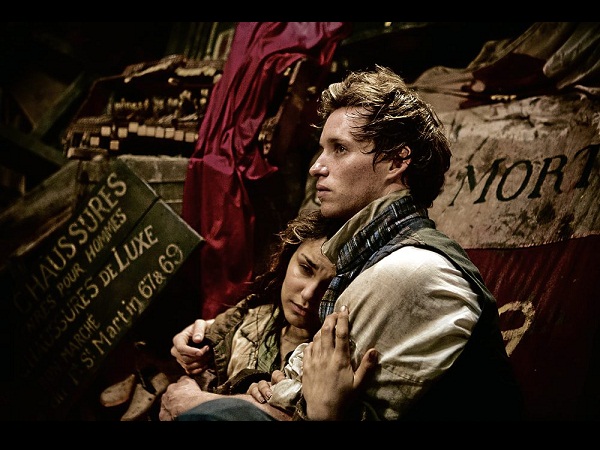
| Eponine (Samantha Barks) and Marius at the barricades |
Nominated
for Eight Oscars
Best Actor
In a Leading Role
Best Actress
In a Supporting Role
Best Picture
Best Costume
Design
Best Makeup
and Hairstyling
Best Music
(Original Song)
Best
Production Design
Best Sound
Mixing
This is the beginning of a month of reviews of Oscar nominated films ... with, perhaps a slight emphasis on the smaller films but first we will start with a blockbuster.
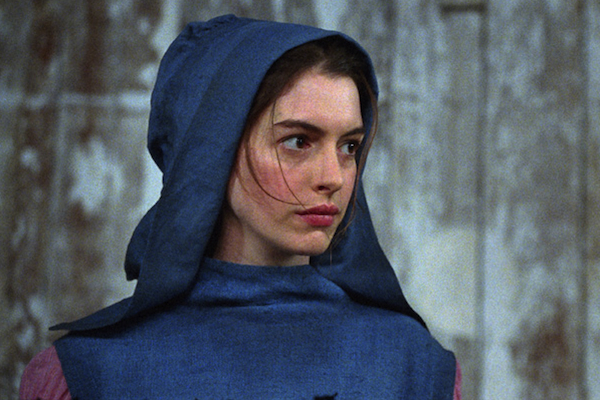
If weeping copiously throughout a film is an indication of its artistic value, then, yes, Les Misérables is a good film as this is exactly what I did during, and after, viewing it recently. This film pushes so many emotional buttons it is difficult to remain objective about its artistic worth: the fallen Fantine's (Anne Hathaway) love for her daughter Cossette who has to resort to prostitution to feed her child; a good man's persecution under unjust laws (Hugh Jackman as Jean Valjean) by a harsh law official Javert (Russell Crowe); the revolutionary fervor of the June rebellion in Paris in 1832; and, romantic love between the orphaned Cossette (Amanda Seyfried) and the revolutionary Marius (Eddie Redmayne).
If I felt emotionally manipulated at whom do I point the
incriminating finger? Victor Hugo, the novelist? Tom Hooper, the director? The
lyricists? Perhaps all three ... although I do not recall these emotions when I
read the book or saw the musical many years ago.
The movie is undeniably beautiful; the effects are
impressive if over-wrought particularly in depicting the manning of the
barricades in the rebellion of 1832 or when Javert ends his life by plunging
into a surging river. The costuming is for the most part perfect: sumptuous and elegant. The music inspires and yet overwhelms as well frantically inspiring romantic or patriotic feeling. The camera
work often ecstatically soars into the blue after particularly dramatic scenes.
I struggled with the performances of Hathaway as Fantine and
Jackman as Valjean whom I always find artificial, solidly belonging to the
"Look, I'm acting!" school of drama. Jackman is too young, too healthy looking, to be referred to as "the old man" Valjean. However, both have received both
critical praise and award nominations. Only Eddie Redmayne evoked real emotion
for me particularly in the scene where he weeps for his lost comrades.
Some of the blame lies with Hooper as a director. The pace
is brisk, too brisk at times, but with the sprawling nature of the book and
film topping more than 2 and 1/2 hours there must have been a sense of urgency
in presenting all the pertinent bits of the plot.
Other aesthetic choices rankle ... why dress Fantine's fellow prostitutes like obscene dolls in surreal makeup replete with foul and ribald dispositions? Why not represent them as they likely were - as desperate women with no other options but to live off the streets? If only the revolutionaries were not so perfectly groomed and handsome rather than the dirty ragamuffins that I imagined them to be. Could Javert and Valjean have been more nuanced rather than literally representing two extremes of the moral spectrum - utter villain and unimpeachable saint?
Subscribe to:
Posts (Atom)