Friday, November 16, 2012

Fighting on the Side of the Angels

Italo-Canadian internees at Camp Petawawa
An unpleasant thought often sneaks into my consciousness when I think about radical elements in the Islamic community who have engaged in extreme violence abroad ... where are the moderate voices within the Islamic community who are condemning these acts? Where are those who are brave enough to fight on the side of the angels?

Thomas Friedman, The New York Times Foreign Affairs columnist, has been very diligent in highlighting where those voices are in the Middle East and abroad ... Imad al-Din Hussein, a columnist for Al Shorouk, Cairo’s best daily newspaper; Mohammad Taqi, the liberal Pakistani columnist; Khaled al-Hroub, a professor at Cambridge University; and, Egyptian comedian Bassem Youssef, which you may read about here.

What is preventing more moderate elements from speaking out here in Canada and the U.S.? Are we merely not aware of these voices? Is the media failing to highlight them? Or is it fear of retribution? Is it a worry that they are exposing already vulnerable kinsmen to potential abuse and violence?

Another thought disturbs me - how would the Italo-Canadian community fair in comparable circumstances? Based on past historical evidence, we would not do so well. During the 1930s and 1940s when the specter of Fascism loomed and threatened democratic values in Europe, the community of recently arrived immigrants  from Italy often flocked to defend Mussolini, his methods and his imperialist ambitions.

The Toronto Fascio Principe Umberto, a fascist club, attracted the elite of the business and cultural community with a compulsory oath: "I swear to execute without discussion the order of the Duce [Benito Mussolini] and to serve with all my strength and if necessary my blood the cause of the Fascist Revolution."(1)

When Toronto Star publisher Joseph E. Atkinson condemned Fascism and Italy's imperialistic foray into Ethiopia, he was helpfully sent a bottle of castor oil. For those who don't know the historical significance of such an action: castor oil was often administered by Italian Fascists to dissidents. It caused severe diarrhea, dehydration and sometimes lead to death.

Emilio Goggio, Chair of the department of Italian and Spanish at the University of Toronto from 1946 to 1956, was "briefly jailed in Toronto for having expressed an early, mistaken sympathy for Benito Mussolini, though he was soon released through the efforts of the university."(2)

Liborio Lattoni, poet and Methodist pastor based in Montreal, who held a prestigious position within the Sons of Italy permitted both the "Roman salute" (here read Fascist) and the playing of the Fascist anthem Giovinezza during its meetings.(3)

Vancouver's Fiorvante (Frank) Tenisci promoted Fascism through his articles, speeches and letters to newspapers as well as organizing conferences promulgating Fascism.(4)

UofT Student Frank Molinaro accused the Toronto Star of racism in not supporting Italy's foray into Ethiopia in a letter to the newspaper. He claimed that the British in particular were hypocritical due to their historical colonial conquests.(5) He also defended anti-Semitic screeds prepared by Fascist university professors in Italy leading up to the war.(6)

We did not tread carefully and made a a terrible errors in judgment. We responded to old loyalties, some of them twisted and evil. A regard for the homeland came to represent a loyalty to the murderous thug who controlled Italy at the time. We paid a price for it ... 700 Italo-Canadians were interned at Camp Petawawa for real or alleged sympathy with Fascism during WWII. But ... contrast this with the internment of 22,000 Japanese Canadian, most of whom were born here - including my mother-in-law and father-in-law who were children at the time. Their crime? Being of Japanese descent and therefore suspected of treason.

I honestly hope that the sensible people of the Muslim faith will step forward and condemn the escalation of violence - it's not just about preserving peace for those who do not embrace the Muslim faith, it's about preserving peace for those that do. 

Further Reading
Some new books that might interest you about the internment:  
Behind Barbed Wire: Creative Works on the Internment of Italian Canadians (Guernica Editions, 2012) edited by Licia Canton, Domenic Cusmano, Michael Mirolla, Jim Zucchero

Beyond Barbed Wire: Essays on the Internment of Italian Canadians (Guernica Editions, 2012) edited by Licia Canton, Domenic Cusmano, Michael Mirolla, Jim Zucchero

(1) Enemies Within: Italian and Other Internees in Canada and Abroad by Franca Iacovetta, Roberto Perin, Angelo Principe  (UofT Press Inc., 2000)

(2) "Helping Hands", UofT Magazine, Spring 2004
(3) The Darkest Side of the Fascist Years: The Italian-Canadian Press, 1920-1942 by Angelo Principe (Guernica Editions, 1999)
(4) ibid
(5) ibid
(6) “It's All About War: Canadian Opinion and the Canadian Approach to International Relations, 1935-1939” by Heather Metcalfe, Ph.D. Thesis, Department of History, University of Toronto, 2009 

Friday, November 9, 2012

Rules of Civility

... Manhattan was simply so improbable, so wonderful, so obviously full of promise - that you wanted to approach it for the rest of your life without ever quite arriving. 

Rules of Civility by Amor Towles (Penguin Books, 2011) 335 pages

This novel is sexy and smart and literate and perfectly encapsulates my fantasies of a sort of Manhattan lifestyle in the 1930s - at least the kind of illusory dream of New York society that is well-heeled, sharply dressed and well-read.

It's 1966 ... an affluent middle-aged couple, Val and Katy, walk into a Manhattan art gallery and view a hitherto unseen Walker Evans photo exhibit from the late 1930s taken of unknown people riding the subway. Katy Kontent, the wife, spies two photographs of Theodore (Tinker) Grey a man she once knew almost thirty years before - one indicative of affluence, one of possible near destitution, only one year apart. 

The story is told from Katy's perspective ... she thinks back to her first encounter with Tinker when she and her best friend Eve Ross met Tinker
at The Hotspot on New Year's eve. The year is 1938. He is from the "upper crust"; they are a couple of particularly smart, well read and well spoken office girls. They remind me a great deal of Howard Hawks heroines, ala Rosalind Russell in His Girl Friday.

Katy and Eve are street smart and savvy. Tinker, oddly, seems formal and indistinct. Is it just his WASPY background and natural sense of self-restraint or is he hiding something? 

As the novel proceeds you feel that you might be on the cusp of a madcap Manhattan adventure with the threesome sneaking into cinemas, downing martinis at the 21 Club, viewing the city from the upper reaches of the Trinity Church on Wall Street and both girls vying for his attention ... but the narrative takes a dramatic turn when the three are involved in a horrific car accident in Tinker's car. 

Tinker cares for Eve, who suffered the worst injuries including devastating facial scars and a crippled leg, and helps to nurse her back to health in his luxurious Manhattan apartment. 

There are hints that Tinker's persona is somewhat fabricated. Katy notes that his apartment seems put together by someone else (a feminine hand Katy deduces). The apartment is exquisite, overlooking Central Park with a maid's quarters where Tinker sleeps, deferring his master bedroom to Eve. 

While caring for Eve one night, Katy finds Washington's Rules of Civility, which Towles helpfully includes at the end of the book in its entirety. The rules seem to epitomize Tinker, the perfect gentleman, perhaps too perfect ... and doubts linger in the reader's mind regarding his motivations. It's not that he's sinister but the arrangement with Eve seems odd. I would imagine that if an affluent young man of that time had injured an office girl in an accident, his family would send her home with a big cheque and a swift boot for her trouble, not ensconce her in his upscale apartment.

In the background is Tinker's wealthy godmother Anne Grandyn, an icy yet affable older woman, who periodically intrudes in his affairs adding an element of menace or tension to the scenario. 

Throughout the novel, Katy keeps referring to her copy of Dickens' Great Expectations. It's a totem of sorts and refers subtly to the ever-changing fortunes of Tinker that so resemble Pip's, the beleaguered hero of that Victorian novel. 

Eventually Eve and Tinker become lovers; Katy is oddly nonplussed or, perhaps, she pities Eve and is ready to concede Tinker's affections. She moves on ... rejecting a soul-crushingly boring promotion at her law firm where she types up depositions, quitting her job and then coming to work for an eccentric academic publisher who has taken a liking to her during a chance encounter. Then she is lured away for a position with a Condé Nast executive (natch this is New York) named Mason Tate.

As his assistant she is thrown in the path of very wealthy girls, who don't need the meager salaries they receive from publishing careers, and their brothers, like Dicky, who seems tempted by this outspoken, savvy girl who doesn't quite fit into their world and doesn't seem to want to either.

Dicky introduces her to the soon to be trust fund crowd ... a few more years, Katy says, and if they avoid being drowned or thrown in jail, they've got it made: membership in the
Racquet Club, opera boxes, lives of leisure. The class dynamic is interesting ... the rich invariably come off as shallow or slithery; Eve and Katy exude intelligence and spunk.

Katy re-encounters Wallace Wolcott, a friend of Tinker's, and their relationship takes an oddly aristocratic and courtly turn as he woos her by taking her shooting, having lunch at the club and touring the gun collection at the Metropolitan Museum. But Wallace has other plans, namely going to Spain to fight Franco. He also shares a bit of Tinker's history ... that is decidedly at odds with what Tinker had told Eve and Kate.
Towles' elegant prose 
flows and charms ...

When Katy hears a rumour that Tinker has proposed to Eve on a borrowed yacht, she likely imagines that she is the only one whose life is at a standstill. Until ... the police locate a drunken, shoeless Eve in a back alley in a seedy part of town and jail her thinking her a prostitute. Eve's story of what transpired between her and Tinker is not a predictable one ... one that is at odds with the gold-digger image that she had been cultivating amongst Tinker's set. 

Tinker is full of secrets, which Katy soon finds out. Our first instincts are right - something is afoot and it may not be pretty - he's not a villain but our instincts
are right, all is not what it seems.

Towles' elegant prose flows and charms, spiked with realistic dialogue between the women and striking descriptions such as this of the subway:
"It rattled into the station line like it was coming from another century." or Eve's engagement ring: "... it had a diamond you could skate on."

Tinker's life disproves F. Scott Fitzgerald's theory that there are no second acts for American lives ... you might say that, for modern Americans, the play never ends. 

Wednesday, October 31, 2012

October Cultural Roundup

Literary:
(Not So) Nice Italian Girls & Friends celebrate the New Releases of 2012, October 5, 2012 at QSpace
Launch of Descant's Renovations issue, October 17, 2012 at Rochester 

Books: 
Netherland by Joseph O'Neill (review here)
Virginia - A Play by Edna O'Brien
The Rules of Civility by Amor Towles (review here)
The Proxy Bride by Terri Favro

Films
Stories We Tell (Canada, 2012) directed by Sarah Polley 

Music
HD Broadcast of L'Elisir d'Amor by Donizetti at Metropolitan Opera House, Beaches Cinema

Events:
This American Life's Ira Glass at Massey Hall,  October 27, 2012

Friday, October 26, 2012

The Hunger Games

The Hunger Games by Suzanne Collins (Scholastic Inc., 2008) 374 pages
*SPOILER ALERT*

This YA novel has achieved international recognition and is a surprisingly cutting metaphor for life in the modern world depicting a brutal fictional future world that skewers our current obsessions and neuroses.

The futuristic world of Panem is frightening (isn't it always so in speculative fiction?). The world has faced terrible droughts and devastation in North America - there are food shortages, civil wars, environmental disasters. People in the poorer districts must kill animals for sustenance with primitive weapons - knives, bows and arrows, to survive. They live off berries and bartered items like homemade cheese and bread and game.

Our heroine Katniss Everdeen is particularly proficient in this, she has had to be, as her father was killed in a mine explosion and her mother had a nervous collapse from which she has never fully recovered. Sixteen year old Katniss (Kat) is the defacto head of the family and must forage for food for her mother and sister Primrose (Prim).

After a thwarted rebellion in Panem (a word that immediately connotes pandemonium), the Capitol has decreed that each of the twelve districts of Panem must offer tributes of atonement to prove their loyalty. Each year, two youths, a boy and a girl between the ages of 12 and 18, must fight in the Hunger Games unto the death - in a sort of gladiator style forum. The event is televised, the selected youth monitored by camera during the ordeal and "tributes" are groomed by the victorious predecessors from their district.

When Katniss' twelve year old sister Prim's name is selected in a random draw during The Reaping (selection process) as that year's participant from District 12, Kat steps forward immediately to take her place. The fellow competitor from her district, district 12, is Peeta, a tender-hearted boy her age who once showed her kindness by giving the near starving Kat some burnt bread from his parents' bakery. Kat is so jaded by her rough subsistence-level existence that she suspects every kindness he exhibits is a ruse to trick his opponents and her specifically. He must eventually square off against Kat during the games even though they are from the same district.

If the tributes win the district gains more food and privileges; therefore, some of the wealthier tributes train for years in anticipation of the games - almost like Olympians.

Peeta and Kat are both on their way to the Capitol in luxurious accommodations feted with ample, rich foods aboard a train. An image of fattening the animal before slaughter comes to mind. When they arrive they are groomed, plucked and cultivated by an aptly named crew of groomers - all with Roman or pseudo-Roman names suggesting the decadent Rome of gladiator fame - for their televised performance in the Hunger Games.

Those from the impoverished areas have more naturalistic names that remind one of flowers or nature - Katniss, Primrose, Peeta, Thresh. Those from the more affluent districts or the corrupt Capitol are imperious and Roman sounding: Cato, Portia, Caesar, Cinna ... 

This scene had an odd resonance for me ... it reminded me of the whole process of reality TV where you pluck someone from very ordinary circumstances, give them extraordinary privileges or access to extraordinary opportunities so that they might be offered up for mass consumption in a public spectacle and we watch with glee as they are destroyed by these circumstances.

Author Suzanne Collins
The Capitol is overflowing with bizarrely dressed humans in unearthly colours, Gothic makeup and elaborate clothes. Their faces are oddly distorted - they look "youthful" in that they have no wrinkles but bizarre like victims of botched plastic surgery. It sounds like a surreal world peopled solely by fashion addicts like the British heiress/fashionista Daphne Guinness and the burlesque dancer Dita Von Teese. These are the affluent of the Capitol, exempt from the games but passionately devoted fans as they have nothing to risk.

Peeta and Kat undergo intense training. Oddly, under the ministration of Haymitch, a previous District 12 winner who initially appears to be an emotionally abusive, irresponsible drunk, the pair learn how to comport themselves before the judges and the public - how to display confidence, how to display strength, what physical skills to play up. Under their other mentor Effie Trinket's beady eye, Kat must learn how to walk and carry herself like a lady - how to walk in heels, how to eat in public, how to converse on television - as learning to walk in a ball gown will be a prerequisite for her televised appearances. 

In a trial before the judges, Kat is dead last to perform. When her feats meet with indifference, she furiously shoots an arrow through the apple of a roasted pig they are feasting on. That gets their attention and grudging admiration and she receives a score of 11 out of 12 - the highest score among the 24 contestants. Her defiance has paid off - she is now perceived as a fighter with spirit and a good bet to win.

Before they compete, the tributes are obligated to appear on a popular talk show featuring the aptly named Caesar as host who flatters and preens like the best of them - Kat fares well but Peeta overwhelms the audience when he confesses that he is in love with Kat and wins them over  (a clever ploy suggested by Haymitch as a survival tactic).

For his trouble, Peeta is roundly thumped by Kat after the show. And Kat is vaguely ashamed of her own performance, twirling and giggling in a red dress that lights up in flames. This strong, independent girl has been turned into a tittering Barbie doll for the audience and she knows it. It says much about modern celebrity and the bizarre adulation that follows people who have little to offer in terms of talent or achievement.

Her true virtues - physical and emotional strength, independence, brains - are smothered  over with the vestiges of shallow glitter - she is pretty, looks good in the gown, is considered desirable by Peeta and, therefore, likely other boys.

The middle to two thirds of the book are occupied with the sole purpose of describing how the tributes are picked off one by one by each other. And they do by various graphically violent means - stabbing with spears, attack by angry hornets, killed by rabid, mutant dogs, death by poisonous berries, etc ... This is not as interesting for me as why the games were created. At one point, in order to manipulate viewers when it is clear that Peeta is in love with Kat and this causes a surge in viewer interest, the powers that be declare that two winners from the district might win. This will enhance ratings Kat suspects.

This finally allows the two to work together to eliminate the other tributes. They do, they triumph, bloodied, wounded, nearly killed, but whole.

They are transported back the capitol, spruced up and put on display for a mass audience. Kat is now in peril because at one point when the rules were changed back (only one winner permitted), Kat threatens to kill both of them with the poisonous berries just to demonstrate that they will not be controlled by the Capitol. She eludes the expected punishment by feigning intense love for Peeta on TV. This is a dispiriting ending to book one as the imminent threat of death is so rapidly introduced into the plot and is so easily eliminated.

Peeta doubts Kat's love for him and yet they must return to District 12 where Kat's childhood friend Gale awaits, another possible partner for Kat.

In the future games (book 2 presumably) she faces two challenges: acting as a mentor for future tributes from District 12 and juggling two possible lovers - Peeta and Gale. Like all clever writers with an eye towards a sequel, and in this case trilogy, Collins has written an ending that is ambiguous and invites further interest from the reader.
The ultra photogenic Jennifer Lawrence 
as Kat in The Hunger Games

Friday, October 12, 2012

Blood and the Blues in Nazi Germany


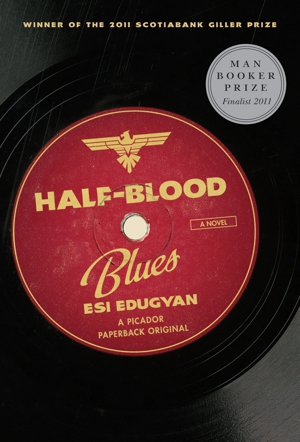
Half-Blood Blues by Esi Edugyan (Thomas Allen Publishers, 2011) 309 pages
* SPOILER ALERT *

This tale is told by Sid Griffiths, a black American musician from Baltimore. As our story begins, two musicians enter a bar in Nazi-occupied Paris in 1940 - one, Hiero Falk, a mischling (who is half black, half German), the other, Sid, light skinned enough to "pass'. One is dragged out by the Nazis and disappears, seemingly, forever.

What happened to Hiero Falk (a.k.a "The Kid"), the gifted trumpeter, hailed by Louis Armstrong himself as "Little Louis", the next big thing in jazz?

Fifty years later, Sid the bassist, and, Chip Jones the drummer, in the jazz band called the Hot Time Swingers still don't know what became of Hiero, and if he died in the concentration camps as he was rumored to have done. The men are now in their seventies and worn down by their sorrows and old age.

The book switches to the present day ... Chip and Sid are invited to return to Berlin in 1992 to attend a tribute to Falk and their jazz band. The symbolism of the fall of the Berlin Wall in 1989 is not an inappropriate image for Sid's predicament, as he is forced to face the crumbling of his self-imposed silence on the days that led to Hiero's disappearance. In a documentary shown at the tribute in Berlin, Chip accuses Sid of doing nothing when Hiero was dragged away by the Nazis because he was jealous of him.

Just prior to the trip, Chip received a letter from someone purporting to be Hiero who had read that Chip was to be in Berlin where they began their careers and asked if Chip would come to Poland to see him. In Berlin, Sid begins to recall the days that led to Hiero's disappearance.

It's 1939, after a violent altercation with some Nazis on the street where one is likely killed, the musicians frantically go into hiding. Sid, Chip, Hiero, Paul the pianist, and Ernst the clarinetist, hole up in a jazz club called The Hound owned by Ernst who comes from a very wealthy background. They begin to seriously consider an offer that had been made to them to play with the legendary trumpeter Louis Armstrong in Paris put forward by a mysterious light-skinned Canadian named Delilah who sings with Armstrong. Sid falls for Delilah, badly. But he is uncertain how she feels about him, suspicious that she has an interest in Hiero. 

After an uncomfortable night in the club, the band disintegrates. Paul, who is the lone Jewish band member and more at risk than the rest of them, insists on returning to his apartment to retrieve something that he won't name; Delilah, after sleeping with Sid, also disappears. Fritz, a German who has thus far eluded the Nazis, comes by the club to say that he is joining another band, the Golden Seven, much to the dismay of the other band members.

What remains of the band (the Americans Chip and Sid and the German born Hiero) decides to drive to Paris and take Armstrong up on his offer but they must secure visas first and seek the assistance of Ernst's father, a wealth industrialist living in Hamburg. In Hamburg, Hiero and Sid witness a terrible sight ... a human zoo called the Hagenbeck peopled with Africans dressed in rags and living in primitive conditions. With a shock, I verified that such places did exist in Europe as late as the early to early mid 20th c. And it wasn't the only one.

In exchange for their papers, Ernst has to make a vow to his father to remain in Germany so that his friends might escape. This means the end of a music career fro Ernst which is likely his father's intention. The three men travel to Paris and, unbeknownst to them, arrive the day that France declares war on Germany. Its citizens are in a state of dread and shock.

When the men arrive in Paris, surprisingly, they re-encounter Delilah (Sid still has no idea how or why she left) and she leads them to Louis Armstrong, who though ailing still wishes to record with them. Edugyan's physical description of Armstrong, while adulatory is razor sharp and poetic: "His bottom lip hung slightly open like a drawer of red velvets".

Armstrong decides to cut a record with the band but passes over Sid who doesn't perform well during a trial rehearsal. This sends Sid into a gloomy depression. It's an interesting twist ... our main character is deemed not good enough, is shunted aside, and that only increases his animosity towards the younger, more talented Hiero.

The men move in with Delilah in her apartment and Sid starts to turn against Hiero for withholding information about why Delilah left. As the Germans advance on Paris Sid fears that Delilah is in love with the Kid. He mistakes her concern for his illness and fragility as sexual attraction and this drives them apart.

Armstrong flees to Bordeaux and the remaining band members attempt to leave but are unable to get a train out of Paris which is flooded with refugees and Parisians desperate to leave. This is a harrowing, well wrought scene - depicting the desperation and horror the fleeing Parisians feel. In desperation they return to the apartment. They decide to cut the record without Armstrong in a primitive sound studio found by Delilah. The next day is the fateful day that Sid and Heiro walk into the bar ... that day changes the fate of all the band members.

Cut to the present day, Chip persuades Sid to find Hiero in Poland. They make an arduous journey to Poland by car and then bus to an obscure location where Sid experiences a feeling of dread. Poland is oppressive, still clearly under the yoke of Communism and the inherent paranoia it breeds. Why Poland? How did Hiero end up there when so many who survived traveled to western Europe or to the U.S.? How did he survive?

Sid is seeking absolution. What he finds in Poland shocks and moves him. We also learn the fate of all the other band members. It does not end how I expected it to end but it pleased me nonetheless.

The dialogue is exceptionally well written, believable, elegant - whether the characters are speaking street slang or refined English and the depiction of the men is utterly believable - salty, profane, sometimes callous and convincingly masculine (i.e. obsessed with women and competitiveness). Edugyan has an amazing ear eloquently evoking the gentle, formal diction of Ernst's father the prickly industrialist or the rougher, street smart slang of Chip.

In fiction, we rarely read about men, main characters, who do not succeed, who fail to achieve their grand dreams. Edugyan achieves something special here. She tells a tale of ambition thwarted, talent wanting ... and she still makes the story fascinating.

Esi Edugyan

Friday, October 5, 2012

Through a Life Obliquely

Stations of the Heart by Darlene Madott (Exile Editions, 2012) 234 pages

Just as the devout Catholic visits the Stations of the Cross to commemorate the Passion of Christ before the crucifixion, physically moving around a set of stations in the nave of the church, so does Madott's Francesca, the main character, in this series of interrelated stories about passion and thwarted desires.

Sensual, vivid, intense, Madott's characters drift in and out of the readers' consciousness like dreams. Love is a treacherous business whether it is personified by a controlling lover or unfaithful lover, a charismatic but irresponsible husband, or the intense, angst-inducing love one feels for an only child. The prose is elegant, sometimes oblique, which adds to a sense of mystery about the characters.

Francesca passes from one "station" to another in an almost hypnotic state: falling in love, trying to extricate herself from damaging love affairs, miscarrying a child, marrying an untrustworthy man, bearing a child, and, parting from her husband - all in a state of almost exquisite emotional torture.

Sexual love is potent, threatening, angst inducing. For true sexual passion is tortuous; sexual passion is self-immolating ... here it disorients, torments, confounds, whether it is the betrayal and lies of Vivi's husband in "Vivi's Florentine Scarf" or Francesca's relationship with the enigmatic Man of the West in "Waiting (An Almost Love Story)" and Francesca's ex-husband Zachary Hamilton who features in several stories ("Getting Off So Lightly", 'Solitary Man", "Zachary and the Shaman", "Chateau Stories") or her one-time lover Vince ("Powerful Novena of Childlike Confidence").

There is something mesmerizing about these stories but there is also a sense of menace, the sense of the treachery of sexual desire even if it is not acted upon whether it is the story of the art-loving girl searching for a painting in "Afternoon in the Garden of the Palazzo Barberini" who fears that the security guard has lured her into unsafe territory or the fearful Francesca watching her husband destroy his career, and potentially his family as well, in "Zachary and the Shaman".

There are many beautiful scenes, too many to recount here but several come to mind: Francesca and her son observing the remnants of a dead star; Francesca looking at the painted image of the Virgin Mary and her cousin Elizabeth and thinking of her lover's mother and sister in "Powerful Novena of Childlike Confidence"; mother and son listening to a children's choir in Spain in "Travel Stories".

In a manner, Elizabeth, Francesca's lover's sister, represents a darker mirror image of Francesca - a woman exploited for her vulnerability as a daughter without rights or power, as a sexual being who must now pay for the sin of conceiving before marriage. Forced into a brutal marriage as a teenager by her parents that she eventually abandons, as well as her young son, Elizabeth disappears only to resurface at her young son's funeral. She is bitter and full of recriminations, accusing all present of having contributed to her son John's death and implicitly to the disastrous consequences of her life's journey. She is what Francesca might have become had she not had the courage to resist the destructive forces in her life.

Unlike the Stations of the Cross, the end of this book does not lead to death but a sort of redemption for Francesca. A reconciliation of sorts.

By the book's end, Francesca has achieved a sort of balance. By returning to her roots in Sicily ("Entering Sicily"), she seems  finally to have achieved a state of peace. Perhaps it is reliving and retelling the travails of a beloved grandmother who suffered and loved a great deal (much like Francesca herself). In the tale of Francesca and son traveling to Spain told in the shadow of a dear friend's death ("Travel Stories") and of their later trip to Sardegna ("Cycling in Sardegna") Francesca has finally come into her own - romantic love is no longer the focus of her intense, obsessive love. Maternal love is.

She is independent. She is an established professional with a successful career and supportive boss. She has her son, is separated from Zachary, and she has reached a sort of emotional equilibrium. She learns something that most women eventually learn - men come and go but if you do it right, your child is yours to love, and be loved by, forever.

Sunday, September 30, 2012

September Cultural Roundup

Utter movie madness this month with TIFF. Haters gonna hate but I love love love the festival.

Films:
The Hunger Games (U.S., 2012) directed by Gary Ross
Io e Te (Me and You) (Italy, 2012) directed by Bernard Bertolucci (review)
Frances Ha (U.S., 2012) directed by Noah Baumbach (review)
Ginger and Rosa (UK/Denmark) directed by Sally Potter (review)
The Iceman (U.S., 2012) directed by Ariel Vromen (review)
Free Angela Davis and All Political Prisoners (U.S., 2012) directed by Shola Lynch (review)
To the Wonder (U.S., 2012) directed by Terence Mallick (review)
Passion (U.S., 2012) directed by Brian DePalma (review)
Argo (U.S., 2012) directed by Ben Affleck (review)
Blondie (Sweden, 2012) directed by Jesper Ganslandt (review)
Great Expectations (U.K., 2012) directed by Mike Newell (review)
The Secret Disco Revolution (Canada, 2012) directed by Jamie Kastner (review)
Much Ado About Nothing (U.S., 2012) directed by Joss Whedon (review)
English Vinglish (India, 2012) directed by Gauri Shinde (review)
Imogene (U.S., 2012) directed by Robert Pulcini and Shari Springer Berman (review)
40 Year Old Virgin (U.S., 2005) directed by Judd Apatow
House at the end of the street (U.S., 2012) directed by Mark Tonderai
Looper (U.S., 2012) directed by Rian Johnson

Books:
Mother's Milk by Edward St. Aubyn
The Hunger Games by Suzanne Collins (review)
Pauline Kael: A Life in the Dark by Brian Kellow
About Alice by Calvin Trillin
Slouching towards Bethlehem by Joan Didion

Museums:
Spadina House, 385 Spadina Ave., Toronto, September 7, 2012

Literary:
Word on the Street, September 23, 2012
Martin Amis at the Toronto Reference Library, September  26, 2012
Quattro Books Fall 2012 Book Launch, Q Space, September 27, 2012

Sunday, September 23, 2012

The Quirky Girl (and why she won't go away)

Deschanel, the It girl for quirkiness
And so begins a new category of blog entry for ALC ... POP goes the world - a discussion of all things pop culture.

Am I just bitter because there is no chance that I will ever be the Quirky Girl that everyone loves? Am I just envious? Perhaps. Possibly that is so ... or is it because the world seems like a much more serious place and I want grown men and women to behave a tad more seriously (oh, that old lament ALC? yes, that old lament). Quirky Girl's predominance has been emerging for decades now. She is the It Girl of the 21stc.

Let us examine this anthropological specimen closely: 

Her physical attributes:
> Young (never over 30, ever young).
> Gamine.
> Sexy but not threatening.
> Pretty but not beautiful.
> Never fat (because then she becomes something else ... perhaps Fat Party Girl, another species entirely).
> Sexually appealing to boys and men. 

Zoe Kazan
Her emotional attributes:
> Ditzy ... but that's just a cover for being clever in a unconventional way.
> Unwise to the ways of the world.
> Always cute and dresses in same said manner usually in bright colours, makeup and occasionally hats (sometimes with pretty dresses) and always in a cute, quirky fashion. Might also be a bit slovenly but that just adds to the cuteness.
> Pop-eyed enthusiasm (see picture above) for the world and all it brings.

Where does she abide in popular culture? 
Her predecessors are legion: the characters of Gidget and Tammy (film series in the 1950s and 60s); Laugh-In go-go girl Goldie Hawn in the late 1960s; Diane Keaton in Annie Hall in the 1970s; the character of Mayim Bialik in Blossom and Lisa Bonet (in general) in the 1980s; the sometimes sullen character of Rayanne in the TV series My So-called Life in the 1990s; the character of Clementine in Eternal Sunshine of the Spotless Mind in the 2000s.

Her current manifestations: Greta Gerwig in Noah Baumbach's Frances Ha (2012); Zoe Kazan in Ruby Sparks (2012) written by Kazan herself; the character of Ramona Flowers in Scott Pilgrim vs. The World (2010); the character of Summer (Ms. Deschanel again) in 500 Days of Summer (2009); and, of course, The New Girl Zooey Deschanel in ... anything.

I want to put Lena Dunham of the HBO TV series Girls in this category but she doesn't quite fit ... being a little too cerebral, not really pretty/cute or not cute in that customary quirky way. And I honestly think she is trying to do something quite different for young women and their self-image. (Why she is on the verge of quirky: gets tattoos like many a wannebe bad girl but they are from Eloise as if she is saying, "See, just kidding, I'm not really a bad girl!" Quirky.)

Why is the Quirky Girl so popular? Why won't she go away?
She is non-threatening. She represents youth and beauty (fine things in and of themselves) unspoiled by womanhood and maternity and responsibility. She is not fully perceived as an adult woman but is closer to a doll or a sex toy; therefore, pliable, easier to manipulate, undemanding. She is attainable, manageable, and she is the female mirror image of the Fan Boy who refuses to grow up.

I would not mind the attire, which personally I think is rather adorable; however, I mind the lack of  involvement with the world, with real life. If only they could get their sh*t together and try to make things better instead of just trying to manage their moods and their wardrobes. 
Lena Dunham, on the verge of quirky
Why she must die ...
She is a concrete manifestation of arrested development - an example of the desire to avoid engagement with the real world, with adulthood. And who could blame her really? I don't want every female to turn into a boring old married lady (ahem) with kids ... it's not that at all.

But seriously, cute after 30 is not cute. Cute after 30 is ... disturbing. It's unappealing. It's depressing. But maybe, okay ... let's not let her die. Maybe we should just hang out with her for a while and then go shopping with her for new clothes. Yeah, that would be nice.