Saturday, September 8, 2012

TIFF 2012: Frances Ha

-->
Les girls, Brooklyn style ...
Frances Ha (U.S., 2012) directed by Noah Baumbach, 2hrs, 
Saturday September 8th, 2012, 12p., Winter Garden Theatre

Co-written by actress Greta Gerwig and director Noah Baumbach - director of The Squid and the Whale (2005), Margot at the Wedding (2007), Greenberg (2010) - this film goes to interesting places - part Woody Allen comedy, part New Wave homage as was duly noted at the screening. 

I liked the energy of the film and its very conscious effort to emulate the French New Wave in the cutting of the scenes – filmed in a richly toned b&w and set in Brooklyn it has rapid, quick cuts featuring scenes that don’t always follow chronologically. They have energy and spirit as if mimicking the intensity of the youth and the activity it depicts. It reminded me of Godard’s Breathless (1959), a film that I just recently re-watched with a new sometimes surprised perspective (gist for another blog I'm afraid).

TIFF's Cameron Bailey described this film as being about two female friends Frances and Sophie (Greta Gerwig and Mickey Sumner) who are part of an “over-educated, underemployed generation more intimate with their friends than their lovers”. That has a sort of resonance for me.

Frances is a struggling dancer in Brooklyn who teaches a little, dances a little and tries to make due in Brooklyn, trying to make her relationship work, trying to pay rent, trying to be a professional dancer. She’s not particularly good at any of those things it seems. But she is good at being Sophie’s friend and roommate with whom she has an oddly intense relationship so when Sophie (Mickey Sumner) wants to move out and move on with her soon to be fiancé Patch, Frances flounders like a left behind lover suffering from unrequited love.

I can’t say that I quite buy into Frances’ obsession - Sophie is a sour-faced, acid tongued and pictured here (but certainly not in person as we could see after the screening) not particularly attractive sidekick to the more ebullient and pretty Frances but Frances can’t seem to let go. Questions posed to Gerwig after the screening shed a bit more light on this … it seems it was more Frances’ youth that she can’t seem to let go of – the college years, the years of having a roommate to share one’s money woes and complain about boyfriends, the nights of staying up late, drinking too much, waiting for the future to happen.

And this leads me to my perennial distress (and critique) about young adults in the 21st c. - this horror of growing up and doing adult things, this unfounded thinking that suggests that being a serious person will make you old or boring or a sell out.

I think the screenwriters are with me on this because even at the presumed nadir of her young life once Frances accepts Sophie’s relationship and her desire to move on, she begins to behave like more of an adult herself. She accepts a low paying job but much needed job with the dance troupe after she is dismissed from the company; she focuses on choreography young students which is her strength; she finds her own apartment instead of cadging off more prosperous friends. She is happier, more satisfied, because she is making her way in the world on her own terms.   

The writing does have a bit of that talky, too cerebral patter going on that sometimes grates (as does the quirkiness of the girls at times). Who talks like that - all witty asides and artsy, intellectual references? Or maybe I just don't run in the right circles? But hot, smart and self-aware (Baumbach) is very appealing ...

Baumbach, Gerwig and Sumner were present after the screening and the best line was the director’s after someone commented that they were dissatisfied with the happy ending – they were anticipating something else. That sent a titter through the audience for anyone who has seen The Squid and the Whale, Margot at the Wedding or Greenberg. To this he wryly commented, “Well, then I recommend anyone of my other films.” And thus ended the Q&A. 
(L-R) Baumbach, Sumner and Gerwig from 
our vantage point (courtesy of Katie Franklin)

Friday, September 7, 2012

TIFF 2012: Io e Te

The fearsome Falco as Olivia 

Io e Te (Me and You) (Italy, 2012) directed by Bernardo Bertolucci, 103 minutes
Friday, September 7th, 9.45p, Scotiabank Theatre 3

This is my first film at TIFF with the lovely Ms. C. We will see about ten films together over the next ten days. So happy to start with the Italian film director Bernardo Bertolucci, a hero of mine.

Last Tango in Paris. The Conformist. The Sheltering Sky. Stealing Beauty … he is a true master. So with reluctance I am somewhat sad to report that Io e Te fails to kindle that sense of intense pleasure or discomfort or unease that Bertolucci’s films often elicit.

Lorenzo (Jacopo Olmo Antinori) is a troubled fourteen year old teenager from an affluent background who seems to have rage issues and a strange fixation on his mother likely because they are often alone together. He appears to both loathe and covet her and that makes for some strange dinner conversations. He is trying to resolve these issues with a therapist paid for at great expense by his frequently absent rich father.

Perversely, rather than go on a ski trip with his school, he decides to hide in the basement of his apartment for a week and pretends to go on the trip. Stocked with food, drink, blankets and his favourite music all appears to go as planned until his half-sister Olivia (Tea Falco) appears searching for a gold bracelet that she can pawn to get more drugs to feed her habit. A heroine addict (probably the most voluptuous and gorgeous addict you might ever see on film), Olivia enters Lorenzo’s sacred space like a hurricane, belittling him, threatening and accusing, and heaping scorn on Lorenzo, who is the son of their father’s second wife whom Olivia once tried to kill buy bashing her over the head with a rock.

The film initially hints at a possible entanglement between son and mother and then brother and sister but that fades away with the calming of the emotional storm within Lorenzo. At the end, we have a sense that Lorenzo has worked something out of his system and Olivia will try and give up drugs. The director even ends on a freeze frame of Lorenzo’s smiling face as if to emphasize the somewhat happy ending.

The acting by all three principals is proficient. Antinori is convincingly alienated and confused – replete with bad skin, tousled mop and a hostile manner. Falco is by turns petulant, rage-filled then penitent and cowed by her attempt to go cold turkey in front of her bewildered half brother. But the ending disappoints. Has Bertolucci gone sentimental in his old age? Now 72 and confined to a wheelchair he is no longer able to travel and was not at the screening although his producer was.

Where is the threat of danger and violence that suffused Tango? The paranoia and tension in Fascist Italy as depicted in The Conformist? Or the beauty of The Sheltering Sky and The Last Emperor? It feels as if Bertolucci’s energy is depleted … the anger and passion flushed away. I felt the same disappointment in seeing Coppola’s last offering, Twixt, at last year’s TIFF. As if he had softened and mellowed. 

This was how Last Tango in Paris was once described:
"Obscene content offensive to public decency... presented with obsessive self-indulgence, catering to the lowest instincts of the libido, dominated by the idea of stirring unchecked appetites for sexual pleasure, permeated by scurrilous language ... accompanied off screen by sounds, sighs and shrieks of climax pleasure." 

It saddens me that old lions don’t leave us with a roar … more like a comforting purr.

Tuesday, September 4, 2012

When the Czar Knew


In the Garden of Beasts: Love, Terror and an American Family in Hitler's Berlin by Erik Larson (Broadway Books, division of Random House Inc., 2011) 448 pages

Before the Russian Revolution when the serfs experienced the terror of Russia's police forces, the people would often exclaim, "If only the Czar knew ..." In Nazi Germany, not only does the Czar (President von Hindenburg) and many of the principals know, including the democratic countries that were soon to be named the Allies and wage a war against the Nazis in WWII, but many were content in the knowledge that Hitler and his men would quash the Communists and other "disruptive" elements in German society. Honorable men and women who opposed the Nazis were quickly silenced and/or destroyed.

William Dodd, Ambassador to Germany in the mid 1930s, was a lonely and largely futile voice in the woods who protested what he saw during his tenure there.

How apt a title for the depiction of this era -"Garden of Beasts". It is a literal translation of the word Tiergarten in central Berlin, an enormous urban park. William Dodd and his family resided along the perimeter of the Tiergarten in the mid 1930s. The title represents the juxtaposition of the beauty and culture of Germany (the image of the cultivated garden) and the horror and monstrosity of the Nazi regime (a menagerie of beasts) with the Dodd family thrust in the midst of it.

William Dodd was asked to serve in Germany in 1933 by Roosevelt in a period where it became increasingly obvious that the country was rearming for war. Jews (and others suspected of hostility towards the Nazis) were being singled out, stripped of their civil rights, beaten in the streets, deprived of their livelihoods, driven out of their professions, and, taken to secret cells to be tortured. Purity laws were being refined and acted upon in some regions. Violence was rampant and despite vociferous disavowals from the German government that these were isolated instances, the violence was spreading.

Germany was on the cusp of tremendous change. Hitler had just been appointed Chancellor. He was seen by some as powerful and charismatic with legitimate grievances against the Jews. Germany had an "image problem" internationally and part of Dodd's responsibility as an Ambassador was controlling the negative impact of this image.

This, initially, was not what most concerned the Americans even when Americans themselves were being beaten as well sometimes just for failing to salute in the Nazi manner in the street. ("Give men a chance to try their schemes." Dodd was told when he protested about the treatment of Jews and Americans in Germany.) The American government was concerned that Dodd do nothing to upset the payment of reparations for the damages of the First World War under the Treaty of Versailles - perceived by some to be excessive and unsustainable. Some fifteen years after the war, the Germans were still expected to pay.

Dodd, a history professor who was once a student in Germany and fluent in the language, had moved to Germany with his wife, son Bill Jr. and daughter Martha. Martha was, shall we say, a ... coquette? Let's use that word rather than a more obvious one. She had relations with a number of Nazi officials. She was not particularly partial to Nazis or their ideology - after all, she also had an intense love affair with Boris Vinogradov, a Communist and diplomatic official representing the newly formed Soviet Union - but initially she was largely indifferent to the violence even that which she had witnessed herself such as the public beating and humiliation of a German woman named Anna Rath (a horrifying incident you made read about here) who was being punished for the unpardonable crime of being engaged to a Jew.

On a more personal level, Martha, at one point, was being urged to throw herself in the path of Hitler as a possible consort by one of her own admirers Ernst Hanfstaengl, nicknamed "Putzi", who was one of Hitler's confidants. She was told, "Hitler needs a woman. Hitler should have an American woman - a lovely woman would change the whole destiny of Europe. Martha, you are the woman!"

The Dodds arriving in Berlin
Martha was "convinced that Hitler was a glamorous and brilliant personality who must have great power and charm.” But she was perhaps not sufficiently enthusiastic to enchant der Fuhrer. The encounter came to nothing.

Dodd, largely liberal, humane and educated, was alarmed by Hitler and his cohorts but disconcertingly anxious to preserve relations between the two countries. When he became aware of these disturbing instances he protested quietly to the appropriate persons. But the casual racism of the diplomatic circles appall. He freely uses the phrase "Jewish problem", citing America's own issue with the "growth" of Jews in powerful positions.

Dodd is not blameless. He spends an inordinate amount of time complaining about bureaucratic waste - for instance the length and cost of telegrams sent by embassy staff rather than being alarmed by more pressing concerns. More disturbing is his concern that the number of Jewish staff at the embassy will distress German officials and his desire to reduce that number. The casual racism of the Dodds often infuriates although is likely very representative of their class and the time.

But, within a year, daughter Martha's own admiration slowly recedes despite her attraction to the handsome, blonde youths of the movement. The Dodds begin to have paranoid sentiments that their home is likely bugged and that they might be being followed and observed. Martha lies in bed dreading the thought and imagining the worst. Politically the winds are shifting ominously with President von Hindenburg's death in 1934 and Hitler's consolidation of absolute power as President.

Eventually Dodd is removed despite (or perhaps because of) his dire warnings. The family does not fare much better in America. Mattie Dodd soon dies after moving back. Bill Jr. ends up working for Federal Express and the senior Bill's health soon falters and he eventually declines. Only Martha appears to land on her feet. Martha's relationship with Boris fizzles when he delays in divorcing his wife and marrying her. Perhaps this is a lucky escape as he as trying to recruit her for the NKVD (precursor of the KGB). But she marries well and lives a long and prosperous life.

If only the fate of the Germans and those persecuted by the Nazis had been as fortunate.

Friday, August 31, 2012

August Cultural Roundup

Jean-Paul Belmondo & Jean Seberg
This month left me ... breathless!

When R and I were on our honeymoon, we bought this great poster for A Bout de Souffle that we had laminated and have kept ever since (it's enormous!).

Books:
Wolf Hall by Hilary Mantel (review here)
Stations of the Heart by Darlene Madott (review here)
Half-Blood Blues by Esi Edugyan (review here)
Out of the Blue by Jan Wong (review here)
First Love by Ivan Turgenev

Films:
The Queen of Versailles (U.S., 2012) directed by Lauren Greenfield (review here)
Se7en (U.S., 1995) directed by David Fincher
Breathless (France, 1960) directed by Jean-Luc Godard
2 Days in New York (U.S., 2012) directed by Julie Delpy
Ruby Sparkes (U.S., 2012) directed by Jonathan Dayton and Valerie Faris

Tuesday, August 28, 2012

Killing the Chicken to Scare the Monkeys

Kill the chicken to scare the monkeys.
殺雞儆猴
Chinese proverb

Out of the Blue: A Memoir of Workplace Depression, Recovery, Redemption and, Yes, Happiness by Jan Wong (2012)

I wasn't sure how to critically approach this book about the depression Ms. Wong experienced after she wrote a controversial article in 2006 that was construed to be critical of Quebecois and their treatment of non-Francophone Quebecois in the aftermath of a mass shooting at Dawson College.

The newspaper article on the mass shooting was only one of many probing articles written over the years by Ms. Wong during an award winning twenty year career at the Globe and Mail. Wong had the temerity to suggest that there might be a connection between how immigrants were treated in Quebec and the fact that three out of three mass murderers involved in recent shootings in Quebec were of non-Francophone backgrounds or not "pure laine", “pure” Francophones. Were these immigrants so alienated in Quebec society that it perhaps drove them to such extreme and violent retribution?

Never one to shy away from truth or controversy, questioning the Quebecois penchant for “pure laine” outraged many and that manifested itself in a very ugly response. 

It excited a great deal of animosity and just plain irrational behavior culminating in racist cartoons in the Quebec press, pejorative editorials, hate mail including an envelope of feces or possibly blood delivered to the Globe, death threats, being denounced in Parliament, and, her own newspaper renouncing her views even though the article had already been vetted and approved.

But it wasn't only the overwhelming hostility that the the article garnered. It was her ensuing battle with the Globe and Manulife Financial, the Globe's insurer, that initially refused to pay her medical leave that rankled and worsened an already difficult situation for Wong. She will tell the story much better than I could and you may read about that fight in abbreviated detail here.

The newspaper's hostility mystified her friends and colleagues - why attempt to so thoroughly destroy a proven money earner with an extensive readership for the newspaper in such perilous financial times? Did they want to set an example so other reporters would not follow suit in similar situations? It reminded Wong, she recounts, of the Chinese proverb cited at the beginning of this post: "Kill the chicken to scare the monkeys."

I have a friend who has a close colleague in a senior position at the Globe and Mail who feels the book is not an accurate representation of the manner in which Jan Wong was treated by that newspaper when she struggled with accusations of racism and lack of professionalism.

Stylistically, I found the book to be well written and extremely moving. But why was it self-published? Doubleday Canada cancelled her contract at the last minute. Why so? Someone implied to me that she might have refused to have the book fact checked. Yet another friend said that Doubleday was threatened with legal action by the Globe. 

But I really don't want to argue about the veracity of her claims because I can't determine the accuracy of her claims - whether the book is truthful or accurate which I sense (without conclusive proof one way or the other) is as close to the truth as Wong is able to present as a person who suffered a terrible ordeal at that time. I do want to talk about depression and how debilitating it is and the stigma surrounding it. I want to talk about how someone close to me dealt with this issue.

I started to do that in this post. In great detail. I wanted to talk about my own struggles. But I don't have the courage to do that. Then I thought I'd talk about the struggles of those close to me but that seemed cowardly - why their story and not mine? I began to recap this one individual's history but what right did I have to do that? It was not my story to tell.

I see that the stigma lingers ... even in myself as I struggle to protect people that I care about, hoping to shield them from the world around them and from others finding out how they are, or were, suffering. Was there a selfish sense of self-preservation in that effort? Yes. Did I fear the judgment that would ensue? Yes. Did I feel that I would be judged as well? Yes.

I remain humbled and silenced by that fear.

So I applaud Ms. Wong's honesty, her eloquence, her guts. The way she depicts the events that happened may or may not have been 100% accurate (personally, I am siding with Wong on this) but I do know that it takes an enormous amount of courage for a person as tough-minded and strong as Wong to come forward and admit that she had these issues, that she felt incapacitated, diminished, not in control of her feelings. The crying, the sleeplessness, the irrational fears, the day to day anxiety, the exhaustion, the inability to act constructively, the inability to rise from one's bed and perform the simplest acts ... 

I know it, I remember it. I feared I would never escape it. But I did. She did. And so can you.

Jan Wong

Tuesday, August 21, 2012

Some Hope

Some Hope by Edward St. Aubyn in the omnibus edition of  
The Patrick Melrose Novels by Edward St. Aubyn (Picador, 2012)

The titles of St. Aubyn's semi-autobiographical fiction in this quintet are stubbornly simple. Never Mind, the first novel, we can assume is about little Patrick Melrose's abuse at his father's hands and how he tries to cope with it - by casting it out of his mind, stiff upper lip and all that British nonsense. The second book, Bad News, involved the death of his father and how that leaves Patrick in the throes of a nasty addiction to heroin in NYC where he has gone to retrieve the body of his father. Some Hope offers just that for recovering addict Patrick and a sort of reconciliation of the abuse he suffered at his father's hands as a child. (Please see reviews of both books here and here).

Some Hope feels like an interim sort of novel. Patrick is on his way to a fancy soiree with his friend Johnny, also a former addict, who seems to be faring a little better than Patrick. Patrick and his crowd are often in transit, it seems, which may serve as a metaphor for Patrick himself - his journey from abuse, to addiction, to eventual salvation (one hopes). Patrick finally reveals to Johnny the abuse he suffered. It's one of the few moments of compassionate humanity that our protagonist experiences.

As much as I like St. Aubyn's writing (his elegance, his wit) I find, perhaps based on his rightfully felt anger, that he deals with acerbically rendered stereotypes: the aristocratic are shallow and calculating (Patrick's own class); the royals (represented by Princess Margaret here) are rude, bullying and impossibly stupid; the French (as personified by the ambassador and his wife) are pompous, social climbing buffoons.

The upper classes, the ultra rich sort who consort with royals, are jockeying into position to have access to Princess Margaret at this soiree. The hostess, Bridget, wife of the very wealthy Sonny, will even go so far as ask her own mother Virginia to have dinner elsewhere so that she is not embarrassed by her commonness. Bridget hires a nanny who terrifies her (and her child) because she thinks it's the proper thing to do despite her misgivings about the woman. Sonny spends time with the child, not particularly because he cares for her but with an eye to how she will treat him in the future as his sole heir.

They, Patrick's fellow aristocrats, pair, and separate, on seeming whims (boredom, lust) or more calculating ones (they want a male heir for their estate).

At this party held by Sonny and Bridget will be the inestimable Princess Margaret that sets the time period probably at some point in the 90s before her death in 2002. And doesn't the princess come off sublimely? She's rude, bullying and impossibly stupid. She forces the French ambassador to clean spots off her dress with his own hands, kneeling before her. In fact, we know that Johnny is a "good'un" in the author's eyes as he is the only one who flouts royal etiquette by refusing to address the Princess as "Ma'am" and has the gall to shake her hand before she extends her hand first. Quelle horreur ... The idiotic rituals surrounding these personages are rightfully skewered.

The French Ambassador (he who is forced to kneel before Princess Margaret) is a ridiculous fop, disdained by all, muttering canned platitudes that impress no one.

But there is a greater sense of resolution in this novel that was lacking in the first two I feel. Patrick appears to be on the mend psychologically by the party's end. Patrick has also somewhat reconciled his feelings for his mother who did little to protect him. Bridget leaves the philandering Sonny and acknowledges how badly she has treated her mother. Johnny seems to have chosen the correct path in attending Narcotics Anonymous.

Patrick seems to be healing ... but that remains to be seen in Mother's Milk, the fourth book in the quintet. Don't change that dial ...

Tuesday, August 14, 2012

"This dynasty, this miserable rainy island"

Wolf Hall by Hilary Mantel (Picador, 2009) 604 pages

I greatly admire Mantel's fictional approach to a revolutionary historical event in English history - King Henry VIII's epic feud with the Catholic church to rid himself of his wife Katherine of Aragon, a Spanish princess and aunt of the then current pope, so that he might wed Anne Boleyn - cataclysmic events seen largely from the perspective of Thomas Cromwell, chief minister to King Henry VIII from 1532 to 1540. How wonderfully she illuminates this time period in "This dynasty, this miserable rainy island at the edge of the world ..."

Mantel's brilliance, and it is brilliance, is to render historical events that may appear dry and unappealing to the modern day reader in a manner that is entirely believable and emotionally involving. It's a style that I aspire to in my own historical fiction. She does so by creating an utterly human Cromwell using simple but elegant language: a man who was beaten and abused by his father as a boy, who witnesses the public burning of a heretic, who marries happily, has and loses children to fatal illnesses, one whose head is turned by a pretty face or ankle even one belonging to a noblewoman such as Anne Boleyn's sister Mary. A man who is by turns mercenary, loyal, lustful, dutiful towards his family and dependents, pensive, melancholy, in short, immensely human. Cromwell is seen as a bit of a roughneck but shrewd, an operator of the highest order. 

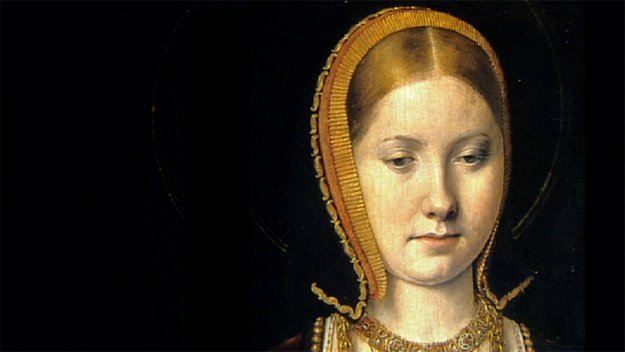
Katherine of Aragon, aunt of Pope Clement, 
hence the stickiness of the business of a divorce
Cromwell was under the patronage of Cardinal Thomas Wolesly, Archbishop of York, until Wolesly fell into disfavour with the King. Although loyal to Wolesly, Cromwell was not above playing both sides of the issue by currying favour with Anne Boleyn, her family (largely presented here as schemers and pimps to the royals) and those who supported the removal of Katherine who was to be plucked from the monarchy like an overripe piece of fruit. This despite the fact that she has borne Henry several children and had been married to him more than 20 years. She is unable to bear him a son - a son who would live beyond the first few months. Henry sought a male heir and was convinced that Anne would provide him with one.

With Wolesly's death, Cromwell was elevated into Henry's inner circle of advisers. He courts Anne, has his eye on Mary Boleyn, Henry's discarded mistress, who makes advances towards him, and on Jane Seymour, a lady in waiting to Anne and (unbeknownst to all) Henry's soon to be third wife after Anne meets her unfortunate fate. After all, what are Anne's sins - tearing Queen Katherine from her throne, facilitating the lie that Henry and Katherine's was never a true marriage and therefore should be annulled, stealing her sister's lover? Hmmm, no wonder she ended up losing her head in the ensuing kerfuffle.


Anne Boleyn, the second wife

Henry VIII is vain, vaguely stupid and impossibly spoiled. It may or may not be historically accurate, I am unsure, but it certainly makes for a captivating read. It feeds two parallel desires in the reader: the voracious thirst for gossip about the royals and their bloody doings as well as a certain smug satisfaction that they are as morally worthless as human beings as we think they might be. Yet Mantel has a light touch and even in the subtlest description one knows exactly what she is implying such as in this description of Henry at archery:
Then he holds out his arm for someone to unstrap and restrap the royal arm guard; for someone to change his bow, and bring him a choice. A cringing slave hands a napkin, to mop his forehead, and picks it up from where the king has dropped it; and then. exasperated, one shot or two falling wide, the King of England snaps his fingers, for God to change the wind.
Anne Boleyn, who is seen by Cromwell (and a good many historians it seems) as plotting to dethrone Queen Katherine of Aragon and take her place, is described as having eyes like the black beads of an abacus, which go click, click, click, tabulating what the person before her can do for her cause to be the next Queen of England.

Anne is shrewd, calculating (and much disliked) but in Mantel's hands, her ambition to be Queen, to be recognized takes on an almost noble, feminist turn at times. When she learns that she is finally pregnant, mother to the future Queen Elizabeth I, she muses: I was always desired but now I am valued. And that is a different thing, I find. 


"Lucky" number 3, Jane Seymour 
who supplants Boleyn
But the historical events are not seen merely through the eyes of the upper strata of society; they are also seen through the eyes of the servants, the tradesmen, the young ... history is filtered through gossip and innuendo about the King and the people around him. 

Mantel understands desire, how it is not rational, how it overcomes you. Here, Cromwell tells a protege of how King Henry speaks of Anne:

... how he shakes with desire when he thinks of Anne, how he has tried other women, tried them as an expedient to take the edge off lust, that he can think and talk and act as a reasoning man, but how he has failed with them ... A strange admission but he thinks it justifies him, he thinks it verifies the rightness of his pursuit ... 

The challenges to reading this novel: there is a plethora of royals, noblemen, clerics, politicians, not to mention Thomases (Cromwell, Boleyn, Cranmore, Wriothesley, Audley, Wolesly, Avery, as well as many Marys, to cite a few) in the book but a list of the cast of characters helps orient the reader. 

It would help to read up a bit on English history, just to prepare yourself as to the context. Usually, whenever Mantel refers to "he" in a scene, it is  a reference to Cromwell and his point of view which lends a bit of confusion to the reading. I heard Mantel say in a radio interview that that is why she appeared to overuse the phrase "said Cromwell" in the second book Bring Up the Bodies, to avoid that confusion. 

But these are minor impediments. I look forward to Bring Up the Bodies and then the third book in the trilogy that charts Cromwell's demise. I imagine it will be sufficiently gory based on this first book.


Cromwell, not pretty 
but very captivating ...

Tuesday, August 7, 2012

Can you smell the hubris brewing?

The Queen of Versailles (U.S., 2012) directed by Lauren Greenfield, 1 hour, 41 minutes

"Let Them Eat Crow" was a headline the New York Times review used about this documentary. That's a little harsh. Jackie and David Siegel are, or were, uber-rich, extravagant and oblivious to the repercussions of limitless spending. That soon changed with disastrous results for them.

But I wish I felt the same compassion towards the subjects of this film that the filmmaker Greenfield appears to have towards Jackie Siegel (said "Queen" in the title) and her husband David Siegel, the so-called time share mogul based in Orlando, FL. His company was, pre-recession, the biggest private time-share developer in the country. I have to say that much of the time I felt disgust and disappointment with them even as they endured their most strenuous woes watching their wealth disappear when the 2008 recession hit.

Siegel built a series of time share resorts under the name Westgate Resorts in Florida and became a billionaire. Jackie was a fairly ordinary girl from a humble background in New York state, pretty enough to be a model in New York and thirty years David’s junior. The years are catching up with her though which adds to the poignancy of her situation. Her fresh, girl next door looks are now enhanced by botox, leopard prints and silicone implants assisted by the bravest push up bras on the planet.

When the doc starts they are at the height of their prosperity and in the midst of building the biggest home in the U.S. modeled on Versailles, the former residence of Marie Antoinette. You can smell the hubris brewing can’t you?

The recession devastates the subprime mortgage industry and Siegel’s business starts to tank. The building of the house ceases and the couple must make drastic changes to their lifetyle: reducing household staff in their Orlando mansion from nineteen to four beleaguered nannies who care for eight children under sixteen (seven are Jackie's and David’s with the eighth being Jackie’s niece). The kids are taken out of private school; the personal jet is gone and they must fly commercial; Jackie starts Christmas shopping at Walmart and buying meals at McDonalds (arriving by limo no less). Both intimate that the kids may have to do something drastic, like get a college education, if things don’t work out.

It’s hard to like this family (with the exception of Jackie) at times. They behave like hillbillies. Dog poop everywhere goes unnoticed and unattended to by family except for the nannies; there are so many pets (two of which die during the course of the film due to neglect) that the atmosphere is circus like; there is such an excess of clothing, toys, gadgets, that it sickens to watch the accumulation of excessive material crap. Obscene is also a word that has been employed here in describing their lifestyle. Sadly, the most sensible of the Siegel family appears to be Jackie's 16 year old niece Jonquil who was rescued from a dirt poor background to come and live with the Siegels and who often comments on the surreal nature of their life.

Jackie is sweet enough and truly goodhearted (helping both family and friends with money in times of financial need) but she seems naive and bewildered about how things have come to this stage. Yet she cannot stop her compulsive shopping. I struggle to imagine how a grown woman thinks a rented car from Hertz comes with a driver or why buying absurdly overpriced purses (Jackie was a personal client of Donatella Versace) is a good investment as one can sell them on eBay afterwards. Although Jackie is a loving mother, a great deal of the mothering falls to the four Filipino nannies who have their own disappointments and tragedies to deal with.

David comes off very badly - an ill-tempered troll who literally gets physically uglier and more nasty-tongued as the film goes on although the filmmaker does nothing to try and portray him as such. He is exhausted by his efforts to keep the business together and seems to take it out on Jackie who tries to cajole him out of his work den for a birthday dinner or offer endearments that he repulses with joking threats that when she turns sixty he will trade her in for three twenty years olds. As Jackie is David’s third wife this may not be an idle threat.

The final shot is telling … as fireworks from Disneyland explode in the background we see the half finished Versailles house in the foreground in the semi-shambles of partial construction. The American dream, beautiful, exciting, overwhelming, over-shadowing the 21st c. reality: economic depression and the disillusioning impossibility of that dream in the current climate.

And true to the nature of her subjects, the filmmaker Lauren Greenfield has recently said that David is suing her for the portrayal of him and the business. And Jackie just keeps showing up at premieres of the film with a big smile on her face … just happy to be there.

The couple in happier, more prosperous times (pre-2008) ...