Monday, November 3, 2008

Halloween P.S.

This is the first year that J has gone out sans parent to trick or treat - she went with two close friends this year whom she has known since she was three. The girls had an instant rapport and have remained friends ever since then.

This new development was making the husband a little sad. He usually walks around with J; I hand out the candy because I love to see the little kids' costumes. But those days are over!

J was a hockey referee (again - none of that princess stuff for J) with her hockey helmet, a white and black striped shirt and a whistle. Her other friends were an "Ipod" and a "grand lady" in ball gown complete with a black wig of curls. Such a cute and odd configuration of costumes ...

I saw the little girl, S, a neighbour (she is four) too with her band of siblings and the four kids that live across the street. A few days ago she knocked on my door and asked my daughter to give me something. It was an elaborate card made of red construction paper with fantastic multi-coloured squiggles on it, and my name.

I was pleased but a little surprised. I could not surmise to what I owed this honour. She is one of my favourites in the neighborhood that is filled with at least a dozen children under ten. She said to J, I know it's not your mom's birthday but ... She is absolutely lovely, a little spitfire and quite beautiful with her enormous blue eyes and porcelain skin.

The next day I went to her house to thank her and ask her why she had given me the card. She was embarrassed, but pleased, I think. She could not seem to articulate the reason for the gift. Her mom said that she just felt like doing it. Oh lord, here come the waterworks I thought. I was very touched by this lovely gift.

I asked her what her costume would be for Halloween. She said that she wanted to surprise everyone but was having a hard time containing herself. But I will give you a clue ... It starts with a "K". Or a "C", her mom said smiling as she gently corrected her.

Hmm, okay, I agreed that I wanted to be surprised.

The next night, I saw a small "black cat" in a black leotard and black face mask, two black protruding cat ears and tail, prancing across our lawn with her confreres. These included: Indiana Jones, a pirate, a Jedi Knight, a witch, a small bear and a very tiny lion who was just learning to walk. Absolutely enchanting!

Friday, October 31, 2008

A Fairy Tale with Extras

A year ago ten or twelve little girls gathered at our house for a Halloween party ... it was their last year in my daughter's grade school (grade six) and many of them would head out to different schools: public, private or alternative. The next year they would be in middle school. The little band would soon be broken up.

It was a very emotional year especially for our daughter J's very emotional mother who was already feeling nostalgic.

The house was decorated with cobwebs and realistic looking, small, plastic black rats on the table and fireplace mantle. The Halloween lights, pumpkins and skeletons, were set up glowing orange and white. Candles were lit throughout the house and an ivory coloured skull was lit up with a tea candle within. The lights were dimmed.

The girls, delighted to be going to a Halloween party at night, decided amongst themselves that many of them would go as fairies. Each would have their own colour theme - blue, yellow, pink, black, green, etc ...

They swooped in in their tutus and tiaras that night gripping glittering wands and shod in ballet slippers, some wearing lip gloss and other sparkly makeup. Not everyone was a fairy, one was a gypsy, one was a vampire. But most were fairies.

Our offspring, ever the maverick, came as ... a "dead punk rocker". Oy. Does she have to be dead? I asked the husband. Apparently so. She did.

They gobbled up the chips, candy and the popcorn and gathered around the monitor in the living room to sing karaoke sounding like pint size versions of drunken sailors as they stumbled through the songs and slurred through the lyrics with much giggling and screeching. But they had such fun. Our neighbor, who could hear their hoots of laughter, said that she had never heard girls have such a good time.

Initially J shrank back, uneasy about singing, not joining in. Unsure of herself. I urged her to join in ... she demurred. Okay, I said, if you don't start singing in five minutes, I AM going to do the karaoke. You never saw a kid jump up so fast in her short life. She sang alright ... The kid sang like there was no tomorrow.

And at the end of the night, the brightly coloured fairies and the gypsy, and the vampire, all went home, drunk on candy and soda pop and bad karaoke music ... I blew out the candles and turned off the lights knowing it would all be different next year. And it was.

Monday, October 27, 2008

Death of a Red Heroine

Death of a Red Heroine by Qui Xialong (Soho Press, 2000) 464 pp.

China. Murder Mystery. Communism. These four words do not usually appear together.

Set in 1990, just one year after Tianemen Square, Mr. Xialong, now living in the U.S., presents an intriguing picture of Communist China, written from the insider's viewpoint.

Shanghai born, Xialong came to the U.S. on a Ford Foundation fellowship in 1988 and stayed after Tianemen Square in 1989.

There is a good description of the book here. I approached the book reluctantly (it was a fellow book club member's choice) but I did find the Communist Chinese insider's POV intriguing. The political manipulations, the disastrous repercussions of the Cultural Revolution, the paranoia and Big Brother atmosphere of 1990s China, the dreariness of Communist life ... oh boy, I'm starting to sound like a neo-con.

Comrade Chief Inspector Chen, a 30 something police official, uncovers the murder of Guan Hongying, a young "National Model Worker", a worker celebrated for her dedication to Party principles and socialist ideals. A national celebrity featured many times in the media as a shining example of womanhood, she ends up in a canal with a belly full of caviar. Her murky double life is slowly discovered by the committed Chen.

The Chinese poetry spouting Chen, who has translated T.S. Eliot, is also a published poet, and is conflicted between a life of art and poetry and a professional life dedicated to eradicating crime. His path to solving the crime is blocked by senior party officials who seek to subvert the investigation for political reasons. The main suspect is a HCC (one of the High Cadre's Children) and thus very well protected.

The language is stilted sometimes, the phrasing awkward. I don't know if the writer is translating his work from the original Chinese or trying to replicate the rhythms of Chinese language in English. It feels very formal and does not flow to my ears.

Published in 2000, already it feels a bit dated. Or is it that life in Shanghai is so much more conservative in nature than ours? The murdered woman's sexual life is described as "perverted" (we would say perhaps kinky here - it ain't nice but it would not be considered extremely unusual here nor "perverted"). A man found babbling on the street is casually referred to as an "idiot".

Women are saintly paragons of virtue like Chen's love interest, the ambitious reporter Wang Feng, or Chen's assistant Detective Yu's wife Peiqin or ... whores (literally). There are a few of those in this book. Really - is this still where we are regarding the depiction of women? Even in 1990s China?

I don't know what to make of the ending where Chen concludes that "... a son's return for his mother's love is always inadequate, and so is one's responsibility to the country". It's almost as if he has a government censor sitting on his shoulder. Chen the maverick, Chen the one who challenges the system, appears to buckle and accept the somewhat unsatisfactory ending to the story.

The thing that always disturbed me too about conventional murder mysteries is the loving detail lavished on the female corpses. A little too detailed, a little too graphic, almost as if the writer is relishing these details. If you are looking for these deets you've come to the right place (oh and extensive details of Guan's extra-curricular activities which got her into this mess).

Thursday, October 23, 2008

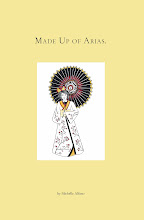
Book Launch for Made Up Of Arias

How odd and exciting to be writing these words!

A small press called Blaurock Press in Kitchener-Waterloo has accepted a novella that I wrote sometime ago entitled Made Up Of Arias. The novella is based on a short story called "Opera" which I wrote and which was nominated for the Journey Prize eons ago and printed in a Journey Prize Anthology.

Blaurock Press is an independent literary imprint committed to "publishing good writing in well-designed and enduring books". The books are quite beautiful and lovingly done with a great deal of craftmanshuip.

Arias will be published in late November and will be edited by the esteemed, the adorable Stan Johannesen, author of Luggas Wood: A Novel and many other works. Many thanks Stan and Penny Winspur, Blaurock's publicist and supreme reader, for all your hard work. Both Penny and Stan may be seen on the Blaurock blog.

A special thanks to Christian Snyder, the founder and publisher of the Blaurock Press, for making this all possible.

A joint book launch with Coach House Press will be held on December 1st , 2008 at:

Starlight Social Club
47A King Street
North Waterloo
Tel. (519) 885-4970
The doors will be open at 7 pm, with book readings to start at 7.30 pm.

Till then!

Friday, October 17, 2008

Culture Chick

Between November 14-16, 2008, I will be attending a conference entitled "Envisioning Culture: Evolving Writing & Community" hosted by the Association of Italian Canadian Writers (AICW). It will be held at the Frank Iacobucci Centre at the University of Toronto (my alma mater).

This conference will "focus on identifying or defining the impact that this writing might have had on both its immediate Italian Canadian community and on the more general Canadian literary landscape".

I will be reading from my forthcoming novel Made Up of Arias. Paesani, hope to see you there!

For general information about the Association of Italian Canadian Writers please refer to: http://www.aicw.ca/.

Tuesday, October 14, 2008

Drowning in cool

Rachel Getting Married (U.S., 2008) directed Jonathan Demme, 114 min.

"It's drowning in cool!" my exasperated spouse said after we viewed the film trying to explain his dissatisfaction with the film. We didn't dislike it - we both thought Anne Hathaway and Rosemary DeWitt were terrific as the troubled, warring sisters in this dysfunctional Connecticut family - it's just that this family circle which the talented director Jonathan Demme tries so hard to convince us is real, is so boho, so alternative, that we were both literally cringing by the end of it especially at the wedding party itself.

Sometimes, unfortunately, it comes off as a first rate student film with its hand held camera, unrehearsed scenes, multi-cultural cast with unpretty (read normal) faces, excepting of course Hathaway herself, and so-so production values. It's like a step back into a style of film making that perhaps Demme might have employed early on in his long career.

Kim (Anne Hathaway) is the junkie fuck-up younger sibling who inadvertently harms a family member during a drug induced spree when she was a teen. She has been in and out of rehab ever since. Rachel (Rosemary DeWitt) is the older, more responsible sibling obtaining her Ph.D. in psychology and poised to marry. Kim gets out of rehab a few days before the wedding which is to be held at their father's home in Stamford, CT.

Where to begin with the white, liberal stereotypes? Who knows, maybe this is the way some upper middle class people really live ... The pre-wedding house is a haven for eccentric musicians with odd looking instruments, people of various colours and inclinations (the bride is Jewish, the groom black). The bridesmaids are to marry in saris. Uh - please.

Kim, whom we can tell is a bad girl by her edgy, dark hairstyle, pasty skin, dark circles under her eyes, and smudged eyeliner, wreaks havoc (she refers to herself as "Shiva the Destroyer" at a pre-wedding party for family and friends). She is selfish, narcissistic, irresponsible. She insists on being the maid of honour even though Rachel wants someon else. She crashes her car on the eve of the wedding in a toxic rage of guilt and anger at her mother. She sleeps with the best man, also a recovering alcoholic, fights with her sister, fights with her weak, ineffectual father and the bitchy maid of honour, culminating with a heated, face-slapping argument with her mother.

Hey - I'm not saying the film is not immensely moving nor that Hathaway doesn't do a good job in this role but why is Kim like this? Why does Kim do this? She has done this horrible thing to her family and feels that she has never been forgiven (likely she has not, nor ever will be). But it all seems to come down to her icy, unemotional mother who is played to chilling perfection by Debra Winger and possibly her loving but overly indulgent father.

But you don't become a junkie merely because mommy didn't pay attention to you as a child and daddy was too liberal. Isn't it a bit more complicated than that?

Sunday, October 5, 2008

Our Town: A Play in Three Acts

Our Town: A Play in Three Acts by Thornton Wilder (1938; republished by Longman, Green & Co. , 1956) 129 pp.

I picked up an old volume of this play at the Victoria College Book Sale, an annual event that I have come to enjoy since having started working at the university. The university has four annual sales at four different colleges: Victoria, University, Trinity and St. Michael's Colleges - Trinity being the best I think.

I love this volume published in 1956: faded green cloth hard bound covers and yellowed, slightly brittle pages with that old book smell.

I didn't know much about the play aside from the fact that it is the American play most often produced (for the first time in 1938) and I really didn't know what to expect but I was pleasantly surprised by the modernist structure of the play.

The audience is directly addressed by the "Stage Manager" who serves almost as a Greek chorus to the events that take place effectively smashing the fourth wall. The stage is minimal, the scenery almost non-existent - one must imagine all that is described to you. The Stage Manager is akin to a "homespun philosopher" or perhaps one of Shakespeare's fools - commenting on the plot's development.

Each of the three acts describes different phases in the life of the Wells and the Gibbs families, in 1901 in the sleepy little town of Grover's Corners in New Hampshire. It briefly chronicles the lives of Emily Wells and George Gibbs from youth until the death of one of the partners: youth, marriage, death, in three acts.

The play appears to have been written by Wilder in response to over elaborate stagings of drama produced in the 1930s according to the introduction of the play. Let the characters and the story tell you what the story is about not the costumes and the set ... Wilder rejects the "picture frame" stage as the introduction describes it.

Act One opens in a small town in New Hampshire at the turn of the 19th c. The town is comprised of simple folk: WASPy, down home, simple, in the best sense of the word. Milk is delivered by horse and cart, the town drunkard whom no one chastises plays the organ at the Congregationalist church, doors are left unlocked, everyone knows everyone else including all their flaws and problems. Sometimes the small town witticisms rankle this city girl's cynical ears but we are meant to see these people as uncomplicated and disarming.

The Stage Manager introduces the Gibbs and the Wells families. George Gibbs and Emily Wells are very young and you see the sparks of their future relationship here. She is the brightest girl in her class; he wants to work on his uncle's farm after attending agricultural college.

The sets are exceedingly simple: two ladders represent George and Emily in their respective rooms doing homework, a row of chairs representing the church sequence, etc ...

In Act Two, the two young people fall in love and marry. The scenes are honestly portrayed. The parents have misgivings as do the bride and groom who have cold feet at the altar. Emily wears only a veil as a symbol of the wedding ceremony. There are frequent flashbacks which provide a back story for the characters' growing attachment prior to their engagement.

In Act Three, the action takes a dramatic and unusual turn away from the realistic. Nine years later, Emily has died in childbirth after the birth of her second child. As the scene opens we are confronted with a row of chairs holding the dead who survey and comment on Emily's funeral. And they are vocal. And dismissive about the living and their "blindness" to the afterlife.

George's mother is there as is Simon Stimson, the town drunkard, and Mrs. Soames, a lady who attended Emily and George's funeral. Emily soon joins this group, somewhat dazed, as if she has not quite navigated the trip from the living to the dead. She watches her husband and family at the ceremony and begs to return for one more day.

The dead discourage her by telling her that she will regret it because she will always carry the knowledge of her death with her into the past life. Despite their warnings, Emily insists and returns for a day - for a specific moment - the morning of her 12th birthday, a day of great joy for her. But it is too painful. It is painful for the reader as well as.

Emily retreats to the world of the dead, consoled by the others and now accepting her new existence. It is an intriguing mix of realsitic drama with the fantastic and an utter surprise for me, a novice to this genre.

Wednesday, October 1, 2008

Me and Robert Kaplow and Orson Welles

Me and Orson Welles by Robert Kaplow (Published by MacAdams Cage, 2003; republished by Penguin Group, 2005) 260 pp.

Readers of this blog will remember my embarrassing faux pas at TIFF a few weeks ago regarding the author of this book ... hence the blog's title. I saw the film by Richard Linklater at TIFF and really enjoyed it.

I love stories of this type where you create a fictional character to co-exist with a real historical figure. The insertion of this young 17 year old boy, Richard Samuels from New Jersey, into this exciting situation - the first production of the revolutionary Mercury Theatre in New York in 1937 and his encounter with the great, the maniacal Orson Welles - what a charming idea. I like the mingling of historical fact with a little fantasy. It's a bittersweet New York fairy tale - my favourite kind.

Kaplow captures the innocence, the yearning for freedom and success and yes (I hate this word) the horniness of a boy like Richard.

Richard, dreamy, insecure, talented Richard, wanders into New York city - he loves the theatre, music, Broadway, New York. He is the embodiment of every small town kid who is ambitious and talented and a little naive. He wanders into the path of the opening of the Mercury Theatre in the heart of Broadway and lucks into a small role as Lucius in Caesar set in contemporary Fascist Italy with the assertion that he can indeed sing and play a ukulele (to be disguised as a lute in the play). The character of Richard seems to be very loosely based on Arthur Anderson (the boy who played the role in the original production). The book acknowledges the role of Anderson in researching the history of the production.

In the week preceding the opening of the production, Richard falls in love with Sonja Jones, an assistant of sorts, to Orson. He falls in love with the theatre. He falls in love with Orson himself it seems at times. That's what great talent does the novel asserts: the power of talent sucks you in, makes you fall in love with the artist himself/herself and to imagine that you are that person. It's empowering in a way for a young person with aspirations.

Kaplow creates a believable world: the arguments, the ego, the drama, the vindictiveness, the insecurities of the actors in that small, exciting, chaotic theatre world.

Welles, all devastating charm and monstrous ego, manipulates, cheats and bullies his way to this revolutionary first production. Extraordinary to think he was only 22.

The attention to detail, how the theatre office looked, what the stage looked like during the production, who played whom (the roguish Joseph Cotten, the talented but acerbic George Coulouris, the exasperated John Houseman's role as a house manager in the Mercury Theatre), the music that was used, the props, which critics were there opening night ... it creates a vivid, intriguing picture of what it might have been like.

Richard is betrayed and used by several people and grows up a little the process. It breaks your heart to see how casually he is thrown away because he dares to stand up to the controlling Welles and those around him are too intimidated to intercede in any real way. But it feels thoroughly believable too.

It's difficult to think about the book without thinking of the film and probably not fair to the writer - but, oh well, here goes!

I think it was wise to cut out the high school drama in the novel from the film. It's impossible to imagine the telegenic Zac Efron having trouble with girls. He is too good looking to be perceived as geeky, lacking confidence, losing the girl and being embroiled in the sorts of humiliating episodes that Richard experiences at school and with girls in general (as realistic as these scenarios are in a real high school). I think it was a sound decision not to include that aspect of the book in the script.

Likely a face like Efron's was not what Robert Kaplow imagined for Richard but it works in the film because you can easily believe that he is picked from a crowd to play the small role of Lucius, that he momentarily captures the attention of the older more sophisticated Sonja, that he can mill about and mix with these older theatre actors and hands. Perhaps the presence of Richard's "friends" - a group of annoying, bullying boys in the novel - appeals to the demographic (the book is listed as a "young adult" novel) but I think it takes away from the more intriguing aspects of the story (his encounter with Orson and the theatre world).

Sonja Jones, Richard's illusive object of desire, is much more layered in the book - she is a troubled, unhappy girl with huge mother issues but it seems so at odds with the sophisticated veneer of the character - her emotional meltdown about her mother and her sense of identity during her night with Richard feels tacked on, extraneous to the plot. It also doesn't ring true to me. I don't think girls really feel this kind of anger in this way (not that we don't all have our mother issues - ahem!). But I think over-protected boys with overbearing mothers feel this way.

Another small thing which I felt the book did not need was the insertion of two great historical characters attending the play on opening night - it was too much. One encounter with a bona fide genius suffices!

Thursday, September 25, 2008

War and Peace in Pieces

War and Peace, Volume 1 by Leo Tolstoy (Published 1869 - republished by Penguin Books Ltd., 1957) translated by Rosemary Edmonds, 712 pages

I have been toying with re-reading Leo Tolstoy's War and Peace which I have not read since my post-university days. I remember being curled up on the couch reading during very cold, snowy weather - or am I imagining this memory?

My reading cupboard was bare and I wanted a challenge, a big challenge. I was joking to a friend that I will be reading this on Valentines day next year (likely this is not a joke). But let me parse it book by book, part by part so that I may comprehend the whole. The cast is so vast that I keep a small chart of who's who in my copy of the book.

Aside from the obvious cliche of a lit geek picking up the mother of all novels to read (deemed by some to be "the best novel ever written" etc ...) this has been a very satisfying reading experience. Again, I dare not criticize the master but I do have a few observations. You must force yourself to slow down and accept the rhythm of the book which is much slower than we are accustomed to as modern readers. But I am looking forward to enjoying the two volumes over the fall and winter.

The cataclysmic effects of the Napoleonic Wars (the name given to the military campaigns in Europe between 1803 and 1815 prompted by Napoleon's designs on the rest of Europe) looms in 1805 and the aristocracy of Russia blithely dances on when the book begins. Several aristocratic families will be impacted and torn apart by the wars and we are introduced to them here in Part 1, Book 1.

I am reminded of how misanthropic Tolstoy seemed to be in his writings at times. How melancholy the Russian psyche appears ... conforming to all stereotypes about fiery, impassioned natures and bitter perspectives about life. Pierre broods, "He had the unlucky capacity many men, especially Russians, have of seeing and believing in the possibility of goodness and truth, but of seeing the evil and falsehood of life too clearly to be able to take any serious part in life. Every sphere of activity was ... linked with evil and deception."

Nikolai Rostov and Prince Andrei Bolkonsky head off to war to fight Napoleon ... the passages about the war are somewhat turgid unless, I suspect, you are totally immersed in the ins and outs of the Napoleonic Wars and the role of the Russian army. I know he had two illustrious ancestors with the same last surname who participated in the wars.

I can't attest to the historical accuracy of the scenes depicted of the Wars in the period of 1805 - 1809 although many if these fictional scenes are compelling: the brilliant image of Prince Andrei's almost hallucinogenic first glimpse of Napoleon on horseback while he lies wounded on the battlefield, presumably dying, at the end of Book One; soldiers being stripped naked and beaten for their minor transgressions; commanders stealing provisions to save their men from starvation; and, the wounded and dying, pleading for assistance, and being abandoned on the battlefield as the troops withdraw from Napoleon's forces are others.

Tolstoy does not spare us from the war obviously, but infinitely more interesting to me is the "peace" experienced by five aristocratic Russian families. Tolstoy touches on many elements of Russian society: religion, the class system, relations between men and women, history, Russian culture, familial obligation, wealth.

In St. Petersburg, Pierre Bezuhov, a newly minted Freemason and the "illegitimate" son and heir of his father Count Bezuhov's vast fortune, is disillusioned in love (both in romantic love and in his purported love of the common man). Helene Kuragin, his wife, cheats on him and he suspects, probably rightly, that all of high society knows of his sorrows and secretly laughs at him behind his back.

Trying to apply Masonic precepts to the liberation of the vast number of serfs under his command on Bezuhov's estates results in little progress and elicits scorn by his "inferiors" and contemporaries. Pierre is sometimes seen as Tolstoy's alter-ego.

Pierre Bezuhov, like Konstantin Levin in Anna Karenina, struggles with his faith and with the desire to do good for his family and his serfs. Yet one senses the despair of the aristocrats Pierre and Levin - that their good deeds will all be for naught as the serfs are too deeply entrenched in their degradation and poverty to progress. Pierre, like Levin, is socially awkward, cerebral, easily offended and quick to offend ... mystified and perhaps slightly terrified by women. Misanthropic, angry and constantly struggling to find peace within himself.

His closest friend, Prince Andrei Bolkonsky, is heading out to fight against the French forces leaving behind his pretty, if neurotic, wife Lise with his difficult and demanding father and devout sister Princess Maria in the countryside, at Bald Hills, the Bolkonskys' country estate, much to his wife's displeasure. Prince Andrei returns home to watch his wife Lise perish during childbirth. Andrei, disillusioned by his role in the Napoleonic Wars after Emperor Alexander I negotiates and "befriends" Russia's former enemy Napoleon, suffers a long period of bitterness and cynicism relieved only by the prospect of the sixteen yeard old Natasha Rostov's love and a prospective marriage.

Princess Maria Bolkonsky, his sister, devout, plain and virtually starved of love, channels all of her considerable spirituality and passion into raising her nephew Nikolai and caring for her "God's folk", pilgrims committed to a life of spiritual enrichment and physical abasement before God.

In Moscow, we meet the Rostov family who will figure prominently in the book. When the book opens twelve year old Natasha Rostov is in love with Boris Drubetskoy, a handsome if impoverished aristocrat and a near relation. Her brother Nikolai Rostov, an ambitious soldier, is in love with Sonya Rostov, also an orphaned cousin. We will learn more about elder sister Vera Rostov and younger brother Petya Rostov later in Volume 2.

Tolstoy underscores the frivolous, inconsequential life that many of his kinsmen lived (best expressed perhaps in the bitter diatribes against the aristocracy by the character Levin in Anna Karenina). They attend balls, conspire to court wealthy relations and marry off their daughters, indulge in frivolous, drunken, dangerous activities, challenge each other to duels, and expire sometimes very foolishly.

Nikolai Rostov thrives under military life despite his injuries at the Battle of Austerlitz returning only when begged by his rapidly impoverished family to return and take hold of the financially crumbling family fortune which he has hastened with a foolish gambling debt. Nikolai is more frivolous than Andrei, both with family and with the affections of his cousin Sonya who desires, but does not insist on, his honoring a childhood promise to marry.

Natasha Rostov, who is as delightful and impulsive as she is often portrayed in cinema, falls in love repeatedly ... with her impoverished cousin Boris, Nikolai's military friend Denisov (he of the annoying lisp), with Prince Andrei, and then yet another whom she will eventually marry. Every two hundred pages she has a new suitor!

Boris Drubetskoy, frivolous, irresponsible and poor, seeks a wealthy wife although drawn to the vivacious Natasha. He gets one.

Prince Vasili Kuragin (father of Helene) conspires firstly to deprive Pierre Bezuhov of his rightful inheritance and then to (successfully) marry off his daughter Helene to him with very unhappy consequences. While son Anatole Kuragin, vain, handsome and calculating, searches for a wealthy wife ...

Tolstoy seems to understand both the feminine and the masculine psyche so well within the constricted social hierarchy of the Russian aristocracy ... the passion that women hold for romantic love, family, social activity, gossip, children, friendship, fashion, society. The allure of war and valor for men, the importance of comradeship between men, and proving oneself before other men.

And as with Anna Karenina, I am always amazed by Tolstoy's understanding of the female psyche whether he writes of the young Natasha's delight at her first ball, her first love and her disastrous near elopement; Sonya's passion for her cousin Nikolai; Princess Maria's shame and dissatisfaction at being paraded before a potential suitor; or, Mademoiselle Bourienne's quick and fruitless infatuation with the disarming Anatole Kuragin which quickly sabotages Princess Maria's hope of a marriage.

In a far more inferior book published last year, The Emperors' Children, the characters debate whether they are a "Natasha" or a "Pierre". I could not remember the significance of that reference when I read the book. Now I see it likely refers to Natasha's enthusiasm and love of life versus Pierre's self-doubt, cynicism and misanthropy ... which are you? I haven't decided yet.

Sunday, September 21, 2008

A Debate

We've been talking about the HPV vaccine a great deal. J, when she reaches grade eight next year, will have the option of getting the shot or not. It is meant to prevent cervical cancer which the girls can develop after contact with the virus in a sexual relationship. Can I tell you how unpopular this discussion is with a squeamish 12 year old and two protective parents of a lone female child? I think you can imagine.

But the consensus after discussing this with J's doctor and a close friend who is an ob/gyn doctor is yes, we should proceed.

J dislikes the idea intensely ... it's not just the needle which she is nervous about, it's thinking about the whole thing ... cancer, boys, sexual activity ... yuck.

J asked her father why I didn't have to have the vaccine and R had to explain that circumstances were different and this was not recognized, or seen as a threat, at that time.

J very sweetly said, "So ... 12 years ago [when she was conceived] that virus didn't exist?"

I looked at her dumbstruck (momentarily). "Oh sweetheart, did you think the first time mummy and daddy were "together" was just before you were born???"

The wave of shock and horror that passed over her face in successive waves ...

"Ewwww, why did you say that? Eww, I don't want to think about that!!!" True disgust distorted her sweet little face in a grimace of horror.

"But sweetie, we were married for a while before you were born ... you didn't think we ---?"

She marched off in disgust. "I don't want to talk about this!" she yelped. And she rapidly disappeared into her room presumably to escape her icky mother. :)

Saturday, September 13, 2008

TIFF 2008: Disgrace

Disgrace (Australia, 2008) by Steve Jacobs, 120 minutes (Cumberland 3)

My last film for this festival ... I enjoyed it despite losing an earring and spilling my entire cup of coffee all over myself and on the floor in front of me. I was chatting with the woman behind me; she had seen 45 films - lord my head would have exploded - those days are well behind me (not that I ever saw 45 films at the festival).

I begin and end the festival with a film featuring John Malkovich.

Based on J.M. Coetzee's book of the same name, it features the ever present John Malkovich. He has been busy with three films at the festival. Here he plays David Lurie, an arrogant yet lonely professor of romantic literature at a university in Cape Town; he is also a loathsome lothario preying on his students and finessing young girls with good wine, classical music and the romantic poetry of Byron. His last sexual affair goes wrong and the girl files a complaint against him at the university. Although not coerced, she appeared unwilling and faintly disgusted by the whole process even though she submited to his advances.

Losing his job and stalked by the vindictive and potentially violent boyfriend of the girl, he fancies himself some sort of Byronic hero. He admits to his involvement but refuses to apologize for his actions and leaves Cape Town. He decides to visit his daughter Lucy (Jessica Haines) who lives on an isolated farm in the Eastern Cape. There is a lot of blather about men following their impulses and such which will eventually bite him in the proverbial you know what it turns out.

Lucy co-exists happily with Petrus, a black farmer with ambitions to improve the property that he co-owns with Lucy. Lucy's laid back live and live philosophy is severely tested when she and her father are attacked by three black youths, one of whom it turns out is related to Petrus by marriage and eventually comes to live with Petrus.

Lucy's liberal guilt is maddening to witness. She feels compelled to leave things as they are even though they have both been horribly violated and she will have to live with the consequences for the rest of her life. She even submits to some humiliating conditions in order to preserve her way of life and keep the peace.

To say more would ruin the story but it seems that Lucy's resignation to the violence of men and the consequences of those actions prompts David to re-examine his own disreputable behavior and impulses. He undergoes a transformation of sorts, perhaps growing up for the first time and realizing that although he is less evil than the three boys, his own actions have created perhaps irreparable harm to those around him.

Friday, September 12, 2008

TIFF 2008: Che

Che by Steven Soderbergh (U.S., 2008) 4 hours, 20 minutes(!) with an intermission at Ryerson Theatre

I couldn't resist using this iconic image. It's still incredibly powerful isn't it? It's little chilling looking at actor Benicio Del Toro in his Guevara garb in the film ...

Clearly director Steven Soderbergh worships at the altar of Che as do many left of centre artists and politicos. Ariel Dorfman had an interesting article in Time on Che and his enduring image (both visual and political). Che is, as they say, ubiquitous appearing on T-shirts, purses, book covers, coffee mugs. Forgotten is the complexity and darkness that was also a part of the man and as the article reminds us: "This erasure of complexity is the normal fate of any icon."

The simplest examination of the man's life will reveal Che to be extraordinarily humane, brave, articulate, respectful of women and protective of children, literate, fair, virile, handsome, loyal ... But Che was also the one who ordered prisoners executed without a fair trial in Cuba and killed deserters from the Communist cause on the spot.

The film is ambitious and adheres to history, it seems, accurately, perhaps too much so. Ernesto Guevara, an Argentine doctor, is invited by Fidel Castro to try and overthrow Fulgencio Batista in Cuba. They do so with a small rag tag group of guerillas that conquer the island region by region. Often they are abetted and cheered on by the campesinos themselves.

He achieves international fame or notoriety, speaking before the UN, being feted and adored int the West and everywhere he goes it seems. This is the first half of the film. In the second half, it is the mid 60s and he "disappears". He leaves wife Aleida and children in Cuba to go to Bolivia in disguise with a false passport to foment revolution but his reception is at times indifferent or openly hostile. He is perceived as a foreigner and troublemaker. He fails and dies for his efforts when caught by Bolivian troops. Reputedly, he was shot and then had his hands cut off as if, Dorfman points out, to minimize his power even further in the grave.

This is an extremely brief synopsis of a long film filled with historical detail - too much detail - we needed more exposition about what drove this man, what created what he was.

I remember watching Walter Salles' The Motorcycle Diaries (2004) and crying throughout it because I felt I had finally understood what drove this man to become a revolutionary. In the film, Che says something to the effect that he had seen too much and could no longer be the same person that he was. That quiet film, where two adventurous boys travel through South America on motorcycles and finally see, truly see, how other South Americans are suffering, are dying because of the evils wrought upon them by the state and corporations and the general indifference of their countrymen was infinitely more moving than this film where we see violent death and destruction dozens of times.

What is lost is the essence of the man. This is hagiography not a biography. He was a son, a friend, a lover, a husband, a father ... Yet he remains a beautiful icon much like the gorgeous photo we see here - pure without flaws or ugliness, only beneficence and valour. And for that reason specifically I think Soderbergh has failed with this film.

Not that it is not immensely appealing in its presentation, that it isn't fascinating to dwell on what he did and where. But why is it so?

From Ariel Dorfman again:
Perhaps in these orphaned times of incessantly shifting identities and alliances, the fantasy of an adventurer who changed countries and crossed borders and broke down limits without once betraying his basic loyalties provides the restless youth of our era with an optimal combination, grounding them in a fierce center of moral gravity while simultaneously appealing to their contemporary nomadic impulse. To those who will never follow in his footsteps, submerged as they are in a world of cynicism, self-interest and frantic consumption, nothing could be more vicariously gratifying than Che's disdain for material comfort and everyday desires. One might suggest that it is Che's distance, the apparent impossibility of duplicating his life anymore, that makes him so attractive.