Thursday, September 17, 2015

TIFF 2015: Sky

Norman Reedus, Diane Kruger and Lena Dunham avec bebe
Sky (France/Germany, 2015) directed by Fabienne Berthaud, Ryerson Theatre, 3p, 100 minutes

Romy (Diane Kruger) is a young French woman unhappily married to the rather brutish 
Richard (Gilles Lellouche) and holidaying in America. After a violent altercation during a drunken fight, Romy flees and heads for Las Vegas, fearing that she has killed Richard. 

She later finds out that she has not. But this is only after many mis/adventures (in a small cameo, Kruger's real life boyfriend Joshua Jackson appears as a police officer who informs her that Richard is still alive). 

Romy hitchhikes to Las Vegas, dons a bunny costume to pose for photographs for money, is mistaken for a working girl, and meets the enigmatic Diego, a park ranger who claims only to sleep with prostitutes. 

Director Fabienne Berthaud with translator
Romy is the sort of romantic European who is in love with the southwest, aboriginal cultureand the image of cowboys. A seedy bar in the middle of nowhere with a cast of dubious characters has enormous appeal for her. To my North American eyes, the locale seems as sad and desperate as something out of The Last Picture Show. But for Romy, she feels that she is finally amongst honest, authentic people.


She follows Diego home and decides to remain there, finding a job as a waitress, befriending Diego's pregnant sister-in-law Lena Dunham, and seeking solace from a wise and benevolent Indian grandmother who serves as a surrogate  mother to the lonely Romy and christens her "Sky". This makes me squirm a bit in that I recognize my own infatuation with aboriginal culture and values. I see pieces of Romy in myself and it makes me uneasy. 

Here she finds a kind of happiness even though her plans do not evolve as she has hoped. Krueger is convincing as the dislocated Romy and Reedus is appropriate as the mysteriously sexy Diego, the elusive object of her desire.

The footage of California and Nevada is stunning, romantic, picturesque ... much as Romy imagines it to be. It is easy to buy into the fantasy, the romance of the southwest. 

TIFF 2015: I Smile Back

Sarah Silverman (Laney) and Josh Charles (Bruce)

I Smile Back (U.S., 2015) directed by Adam Salky, Winter Garden, 1p 85 minutes

Laney (Sarah Silverman) is a dangerously deceptive person living a seemingly idyllic life - with a kind, attractive, successful husband named Bruce (Josh Charles) and two picture perfect children whom she is completely devoted to, living in great comfort and security in an upscale New York suburb. He's in insurance but you can't have everything.

And this security and veneer of contentment appears to be part of the problem because Lainey is an addict. She is addicted to cocaine, marijuana, bennies, among other drugs and she is also addicted to dangerous situations. Whether she is having unsafe sex with violent strangers, sex with a close friend's husband, or crudely insulting her child's good friend's mother with whom she has a petty disagreement over the value of Thanksgiving.

Silverman is perfect in this role - roiling with some unexplained rage that can be, in part, tied to abandonment by her father at the age of nine. But this can't be the whole answer. Laney also has a brother who has somehow reconciled and forged a relationship with the long gone father. But not Laney. She cannot forgive him for finding a new life and the kindness with which he treats his other young daughter from his second marriage.

Whatever is tormenting Laney seems only to be assuaged by drugs, sex and/or turmoil and usually all three at once.

Although I applaud the fact that there was no easy solution to Laney's problems or a pat resolution in the film, in the end, as much as I enjoyed her performance (and I did a great deal) I was left with the thought that this film, based on the book by Amy Koppelman, brought nothing new to the genre. What are we left with - junkies are dishonest, unreliable, dangerous, unpleasant, uncontrollable? They disappoint you, cheat on you, destroy your happiness?

We need more - it's an exceptional performance by a talented woman but that alone won't suffice to make the film meaningful.

The ceiling of the Winter Garden 

Director Adam Salky

Wednesday, September 16, 2015

TIFF 2015: Room

Jacob Tremblay (Jack) and Brie Larson (Ma)

Room (Ireland/​Canada, 2015) directed by Lenny Abrahamson, Princess of Wales, 3p, 118 minutes

This Booker-shortlisted phenomenon by the Irish-Canadian novelist Emma Donoghue was a hugely  successful - both critically and commercially. It certainly shocked and entranced many of us when it was released. Expectations were very high for this film. 

Joy (Brie Larson) was kidnapped and held in a sound proof bunker disguised as a garden shed at seventeen. Two years later she was impregnated by her captor (whom she refers to simply as Old Nick) and gives birth to Jack (Jacob Tremblay). They live in a space that Jack calls the "Room". When the film opens, Jack is five. 

In the book, Joy (known as Ma to Jack) creates a complete and wondrous world for Jack - she is creative, mindful of his health, actively physically engaging him, all in one single room that contains everything they need to live in a very minimal manner: drinking water, food, heat, a toilet, a bath. 


Larson is wonderful here - striking the right balance between loving, fearful and very close to the edge as she struggles to survive under horrific circumstances. At night, the repulsive and sometimes violent "Nick" brings food and supplies and forces sex on Joy while Jack is confined to a wardrobe, unseen and unheard. 


The young boy Jacob Tremblay is a wonder here - the little boy is, by turns, loving and inquisitive, angry and confused, defiant and all five year old petulant when required by the script. 


When Jack turns five, Joy conceives a plan to escape and then the duo are forced to live under the scrutiny of the press and the pressures of existing in the wider world when they are successful in their escape.  

The script is constructed such that the tension does not diminish with the transition to the post-Room world. Joy is angry, sometimes unstable. sometimes rough with Jack. He has high anxiety dealing with new people and chaotic situations. Mercifully, we no longer see their captor and the film does not dwell on the abuse that Joy suffered or how she was entrapped by "Nick". 


It's balanced and non-exploitative in area that could easily slip into a very salacious re-working of the novel. 


View from the very very back row

TIFF 2015: Louder than Bombs

Louder Than Bombs (Norway, France, Denmark, 2015) directed by Joachim Trier, Ryerson Theatre, 12p, 108 minutes

It may be that Louder than Bombs is so appealing as a film because it depicts the dynamics of a family in the aftermath of the death of the mother as rather complicated and sometimes ugly. No one escapes scrutiny or censure here.

Gene Reed (Gabriel Byrne), a high school teacher and former actor, struggles with the death of his wife, Isabelle Reed (Isabelle Huppert), a highly respected and accomplished photojournalist who had killed herself four years before in a car crash. Isabelle's photographs are exceptionally beautiful and relevant (I would love to know who the real photographer is, they are mesmerizing). She travels the world and captures humanity at its most poignant. This makes the return home problematic; she always appears to be yearning for something else and seems ill at ease at home.

Gene takes solace in the arms of a sympathetic colleague at school unbeknownst to his sons. The two boys, Jonah and Conrad, vastly different from each other, pursue divergent paths in recovering from the tragedy. 

Jonah (Jesse Eisenberg) is a gifted if intellectually overbearing young professor - highly talented, articulate but somewhat cold, much like his mother. He is also a new father who seems unsettled by the arrival of a new daughter and indulges in a dalliance with an old flame to alleviate some of the anxiety he is experiencing. 

Conrad (Devin Druid) is an awkward loner who is immersed in violent video games and obsesses over a girl in his class who doesn't even know his name.

Gene tries desperately to connect with the boys but mostly fails as many parents do. As we all do.

The performances are uniformly good. No one - perhaps with the exception of Byrne - appears likeable, least of all the sons but it is an honest portrayal. We are judgmental, angry, immature, in the face of tragedy. We blame each other, we blame ourselves. We are weak. We are confused. We are human. 

Tuesday, September 15, 2015

TIFF 2015: Janis: Little Girl Blue


Janis: Little Girl Blue (U.S., 2015) directed by Amy Berg, Scotiabank 2, 4p, 106 minutes

If you are like me and have a limited knowledge of Janis Joplin’s life, you might have shared the view that Joplin was a carefree, happy-go-lucky hippie. This film is important in that the filmmaker Amy Berg has discovered some previously unseen material that paints a fuller, more nuanced portrait of the singer.

Born in Port Arthur, Texas in 1943, it might surprise you to learn that Joplin was an early and vocal supporter of integration in Texas, a highly unpopular view in that era and place. She was an early Beatnik who loved the blues and black music and a loner with few friends. She was once voted “Ugliest Man’ by her schoolmates. 

That early ugliness and sense of alienation drove her, after high school, to embrace the scene in San Francisco amongst hippies and rockers and like-minded people. It was also her first taste of hard drugs.

As a member of the increasingly popular Big Brother and the Holding Company, she became a rock star but still, she wondered, “Why do the guys in the band go home with some girl and I go home alone?” Even when she was calling the shots with her own band, the Kozmic Blues Band, her insecurities did not seem to abate. 

What would drive this young woman, at the height of her fame, to return to her high school reunion ten years after she graduated in her feather boa and psychedelic glasses - to say "Look, I am better than you think I was."

I find it extraordinarily empowering to see a woman succeed on her own terms in the music industry - through sheer will power and talent rather than sex appeal and and the usual trappings of conventional - short-lived as it was.

A profoundly complex person of great sensitivity – we learn about a more this vulnerable and lonely person through rarely seen footage, interviews and her personal letters to her straight-laced yet loving family back in Texas who watched in wonder as she soared into the stratosphere.

TIFF of the Day: Wonderful to see artists such as Pink, Juliette Lewis and other female artists acknowledge Joplin's influence in the closing credits of the film. I could easily see Pink in a bio pic about Joplin's life. 

TIFF 2015: Hyena Road

Rossif Sutherland (Ryan) and Paul Gross (Pete)
Hyena Road (Canada, 2015) directed by Paul Gross, TIFF Lightbox 2, 120 minutes

Paul Gross wrote, directed and co-starred in his newest offering about Canadian troops in Afghanistan. Did you realize that our engagement there was longer than our involvement in WWI, WWII and the Korean War put together? 

There were words at dinner tonight as the husband teased me about how much I cried during the film. (It's true. It's not a testimony to its quality - and it is very good - but certainly a tribute to the intensity of the scenes it depicts.) 

The characterizations of both the Canadians and the Afghans are nuanced and fair-minded. I would love to hear from a solder stationed there to hear their sense of its accuracy. Wounded Warriors - a charity and veterans service organization that offers programs for the wounded veterans of the military actions following 9/11 - were involved in the making of the film. 

The Canadian troops are building a key road through the county - called Hyena Road - in a conflict zone. Sniper Ryan (Rossif Sutherland) patrols the region with three fellow snipers seeking out potential dangers, of which there are many. Paul Gross is Pete Mitchell, an intelligence officer seeking to engage "hearts and minds" in the region and secure information that will permit further engagement with the Afghans. 


Writer/Director Paul Gross
The men encounter a former mujahid known as The Ghost (Neamat Arghandabi), an elder marked by his distinctive and alluring eyes - one disturbingly blue, one brown. The Ghost shelters Ryan and his men preventing them being massacred by the Taliban during a fire fight. He harbours an important secret that makes him valuable to the Canadian forces. 

Their lives come together in a terrible and eventful manner - to say more would ruin the film and I want you to see it because it's a moving, nuanced depiction of the conflict. The men and women may, or may not, be uniformly heroic but they are realistically portrayed - neither saints nor demons. There seemed to be a number of servicemen and women in the audience (or people affiliated with servicemen and women) and they were openly appreciative of the film. I hope he got it right. 


TIFF of the Day: Objectification of the day and there has to be at least one - why else do we go to the movies and stare at beautiful creatures? When Paul Gross came out after the film to answer questions, I said to myself "Ooooh, his hair is silver now." (I was thinking of that Mountie from way, way back with the dark brown hair) But then I looked at him, really looked at him, from my perch in the third row, and thought, "Ooooh, his hair is silver now." Nice.

Monday, September 14, 2015

TIFF 2015: Eva Doesn't Sleep


Eva Doesn't Sleep (Argentina, 2015) directed by Pablo Agüero, Scotiabank, 4.15p 85 minutes

Reviewing this film is problematic if you do not have a sense of Argentina's troubled history and the obsessive nature of the populace's devotion to First Lady Eva Peron (nee Duarte) - also known affectionately as Evita Perón. I knew very little of the history so have had to rely on a bit of post-screening research to understand the context.

Evita was the wife of the fascist-leaning Colonel Juan Perón, a member of the military group that orchestrated the 1943 coup that overthrew the civilian government of Argentina and became its President.

Eva Perón died of cancer at the age of thirty-three in 1952 (how like her to die at the same age as Christ sneers one of her detractors in the film). Her body was embalmed by the same man who embalmed Lenin (the director revealed this after the screening). There is a haunting scene of a beautiful woman floating in formaldehyde and another of a child peering at Evita through the lid of her coffin.

This might give you a sense of the importance of the event to Argentinians. Millions mourned her early death and Agüero has the archival footage to demonstrate it - waves and waves of the descamisados (the shirtless ones), the working poor, the indigent and the well-heeled who flocked to her funeral.

In 1955, Perón's government was overthrown by a military coup. Juan Perón fled the country but was unable to make arrangements for the transport of Evita's body.The military junta that had assumed control also seized the corpse of Evita. The body came to have such an intense symbolic and religious value to the country that they sent the corpse out of the country to Europe. The junta was so afraid of Eva's symbolic power that they even made it illegal to utter her name.


Agüero creates surreal, fictional scenarios surrounding true events - the veneration of the body by thepoor (a young cleaning woman who wishes to see the corpse in the beautifully candle-lit cathedral); the transportation of the body by the military by a frightening military man/driver (Denis Lavant) who struggles with a young recruit to keep the transaction secret; a general rumoured to have been kidnapped then interrogated by young Perónists in the 1960s about where Evita's body is truly buried (when he cannot reveal the information he is murdered).

The general tells a fantastic story to the Perónist revolutionaries who kidnap him - is it true, who knows? - that the body was shipped to Milan, buried by a nun who was unaware of Evita's true identity in an unmarked grave.

Gael García Bernal has a very brief appearance n the film (really just a red herring to entice Bernal admiring viewers such as myself as the role is so minimal) as Admiral Emilio Massera who was responsible for orchestrating Argentina's Dirty War (Guerra Sucia) waged from 1976-1983 by the military dictatorship of the time against suspected left-wing political opponents. The Admiral was responsible for burying the body of Evita under six metres of cement when the body was returned to Argentina in the 1970s. He demonstrates the obsessiveness, perverse sexual interest and misogyny that she elicited and, still to this day ... the power.

A more detailed history of the travails of Evita's body may be read here.

TIFF 2015: Freeheld

Moore and Page as Laurel Hester and Stacie Andree
Freeheld (U.S., 2015) directed by Peter Sollett, Ryerson Theatre, 12.00p, 103 minutes

In this reenactment of a recent true story, Julianne Moore stars as New Jersey police officer Laurel Hester who is engaged in a legal battle to allow her pension benefits to be passed on to her domestic partner Stacie Andree (Ellen Page) - an important story told with middling results as a drama.

Laurel Hester was a closeted but highly successful detective before she met Stacie Andree, a much younger mechanic who avidly pursues the older woman. Stacie is out, has an excellent relationship with her mother, and is anxious that Laurel come out and acknowledge their relationship. Fearing repercussions from working in an all-male and a seemingly homophobic environment, Laurel keeps mum, even with her partner, fellow police officer Dane Wells (Michael Shannon). 

Until ... Laurel is diagnosed with stage IV cancer. Laurel requests that her pension benefits be transferred to Stacie upon her death but is denied by county officials. Steven Goldstein (Steve Carell), an openly gay and observant Jewish activist, seizes on the issue to push forward the issue of gay marriage in New Jersey. Carell is flamboyant, comical and lends a certain lightness to a very intense storyline. "It's Steven with a "V" which stands for 'very' gay," he informs the initially reluctant women.

Moore, always admirable in all she does as an actress, has a difficult role - playing a mortally ill person is a challenge, dying of cancer, a near impossible thing to portray realistically. Too little expressed or portrayed and it feels false, too much and it is devastating to watch. But she is sexily effective as the swaggering police officer taking down thugs and pursuing suspects (Laurel freaks Stacie out by pulling out a gun when the two women are menaced by a trio of foul-mouthed thugs - "Do you always carry a gun on a first date?" asks the bewildered Stacie.). Page is more successful in the film as the vulnerable and under-confident but determined partner of the stricken woman.

The drama feels forced and a bit cliched but the challenges the two women and the director face are formidable - the issues of inoperable cancer, homophobia, chauvinism in the workplace, bigotry at city hall - all difficult topics to handle without resorting to cliches and melodrama.

Sollett directed Nick and Nora's Infinite Playlist (2008), much lighter fare, and with a defter touch. 

Saturday, September 12, 2015

TIFF 2015: Rocco and his Brothers (Rocco e suoi Fratelli)

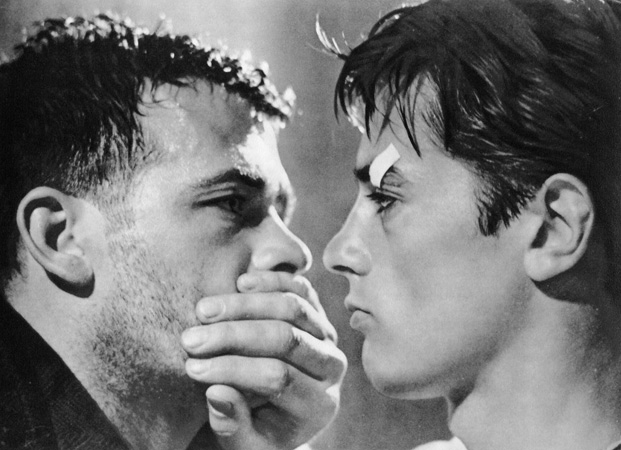
Simone (Renato Salvatori) and Rocco (Alain Delon)
Rocco e suoi Fratelli (Rocco and His Brothers) (Italia, 1960) directed by Luchino Visconti, TIFF Lightbox 4, 2.45p, 180 minutes

Visconti's family saga recounts the tale of the Parondis, an impoverished, Sicilian family comprised of a widowed mother and five sons seeking a new life in Milan. Despite its operatic dimensions and the sometimes histrionic performances, it is a tragically realistic portrayal of the Southern Italian diaspora in the late 1950s and early 1960s. Touted as the last of the neo-realist classics of Italian cinema, it tears at you with the ugly truths about the immigrant experience for the working poor in a hostile, alien environment - even if it is within a country that is presumably your own.

Poverty drove Southerners from Sicily and Calabria abroad and to the north of Italy in the early and mid 20th century. Regarded as intellectually and racially inferior and buffoonish (one neighbor calls the Parondi clan “Zulus” – an crude allusion to the racial heterogeneity of Sicilian history, culture and blood) - the Sicilians are relegated to the poorest of living conditions and the most menial of employment.

The Milan pictured here is dreary, cold, shrouded in fog or cold weather. In one scene the family rejoices when it snows because it means work for the four older brothers shovelling snow. The boys do what they must to survive. In the same way that new immigrants in Canada may turn to manual labour or factory work, are forced into crowded, unsafe living conditions and engage in brutal sports such as boxing to succeed – the Parondis must do so as well in Milan. 

Each brother responds differently to the challenges of life in the north and the film is divided accordingly: Simone becomes, for a time, a highly successful boxer; Vincenzo, a devoted family man; Rocco (played by a dreamy and angelic looking Alain Delon) works in a laundry; Ciro works as a labourer in a Alpha Romeo car factory; the youngest Luca remains with his mother witnessing the family turmoil with alarm and vowing that he will one day return to Sicily.

The portrayal of Rosaria (Katina Paxinou), the matriarch, falls into the tropes that plague all dramas about Sicily – she is histrionic, possessive of her boys, suspicious of all women, irrationally protective particularly regarding Simone who is violent, abusive and troubled. 

When Rocco and Simone fall in love with the same girl – a high-spirited prostitute named Nadia (Annie Girardot) – the men are locked in a turbulent battle with Nadia as a sexual pawn to the extent that one brother rapes Nadia in front of the other brother to humiliate him and mark his territory. There is a disturbing religious element to Nadia's death when she is stabbed to death by Simone after she rejects him. Leaning against a pole, she raises
her arms as if being raised upon a crucifix. It is as if, Christ-like, she is sacrificing herself for the two brothers and their relationship. 

Visconti – northerner, Marxist, aristocrat and homosexual – clearly views the North as a corruptive influence destroying good and honourable men such as Rocco and his brothers. Ciro’s last words echo this accusation when he speaks of the improbability of returning to Sicily and of the South treating its villagers as “beasts of burden”, under the yoke of the padrone. And yet the last scene we see is of Ciro and his workmates, slowly advancing towards the factory in a meandering, bovine fashion – like calves to the slaughter.

Rocco, though victorious in his boxing championships and forced to commit to an unsavoury boxing promoter for ten years to clear the family of Simone’s horrendous debts, is trapped as well. The only thing that appears to offer redemption for the Parondis is family – in the image of Ciro’s sweet-faced fiancée and Vincenzo’s small and growing family. This too is a trope in the depiction of Sicilian culture that we see repeated but it does offer the possibility of hope, of redemption from enslavement to the snares of capitalism, of industrialization and dislocation from one's home.

TIFF OF THE DAY: The presenter of the film noted that, though vilified by the critics, Rocco drew record crowds in Italy and was second only to La Dolce Vita, in box office, when released in 1960.