Friday, September 11, 2015

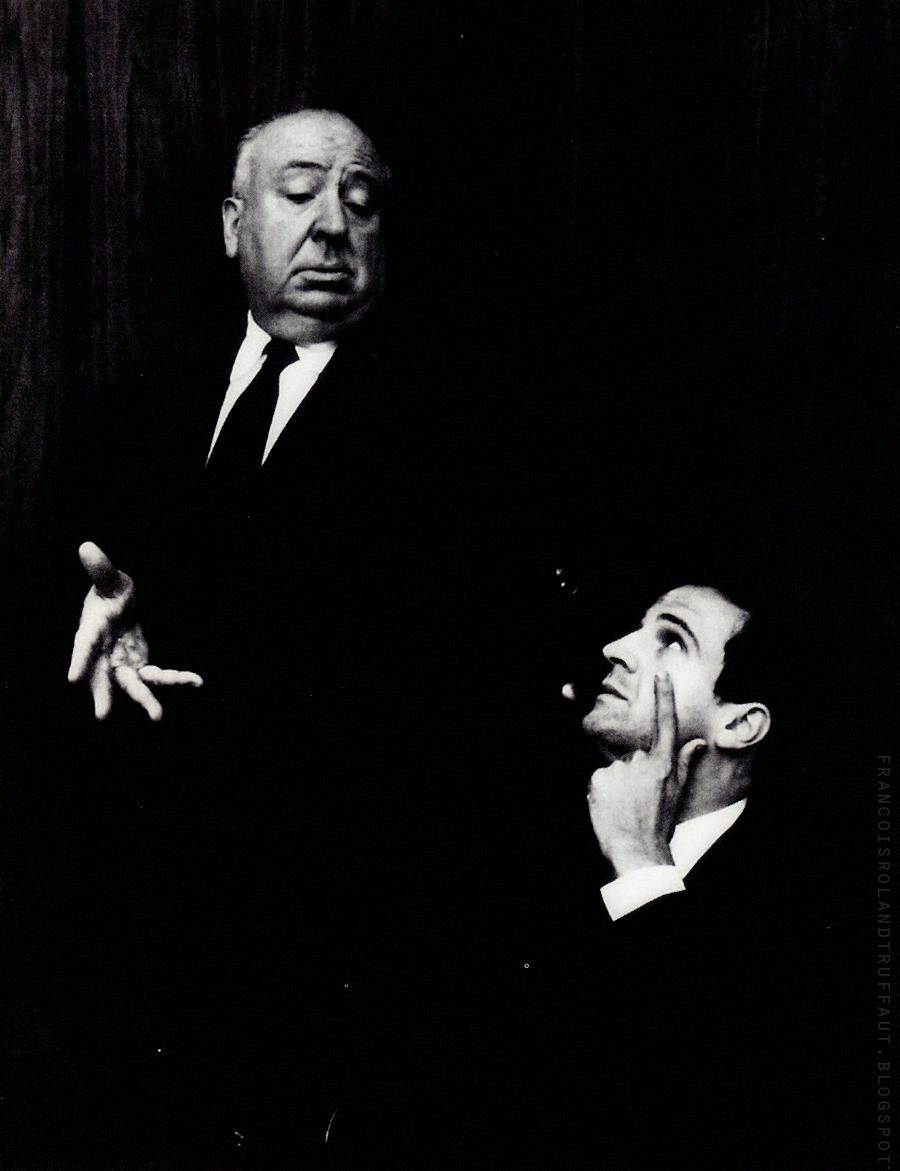
TIFF 2015: Hitchcock/​​Truffaut

The masters ... Hitchcock and Truffaut
Hitchcock/​​Truffaut (U.S., 2015) directed by Kent Jones, 80 minutes, AGO Jackman Hall, 11.30a

First film of the festival for me! Nearly didn't make it to the film. Standing in line, I suddenly realized that I didn’t have enough cash for a rush ticket. I quickly texted my intrepid child who was attending classes at OCAD during his first week of classes and as J was leaving he quickly ran to the ATM and saved my proverbial bacon.

In the 1960s, French director Francois Truffaut proclaimed that Hitchcock was his favourite director. At the time, this generated a certain amount of surprise and perhaps derision amongst the admirers of the French New Wave of which Truffaut was one of the fresh, new creative forces behind the new movement. In 1962, Truffaut was determined to demonstrate the artistry of the British director’s work with a week-long interview, interrogating him on many of the films he made, with the assistance of a translator. Photographs and an audio tape was made of the session that eventually became the much admired tome of cinema history Hitchcock/​​Truffaut in 1967. 

The narrator of the doc, Bob Balaban, spoke of Truffaut’s desire to find a father figure – something he sought in many artistic mentors from Andre Bazin to Jean Renoir to Hitchcock. I admit I was more drawn to why Truffaut wanted to interview Hitchcock than to the work of Hitchcock himself.

The book that Truffaut produced became an influential publication for many aspiring filmmakers, many of whom are interviewed in this film: Martin Scorsese, Peter Bogdanovich, David Fincher, Paul Schrader, Wes Anderson, James Gray, Richard Linklater. Where are the women you ask? Well, it appears that the director Kent Jones had three in mind and none of them could contribute for various reasons (he would not name them specifically, more on this anon).

The director, who also serves as the Director of Programming for the New York Film Festival, spoke before and after the film and said he did not want to dwell on the salacious material connected to Hitchcock. So … yes, I can see why so few female directors may not have wanted to laud Mr. Hitchcock. But let’s not dwell on what the film isn’t right now, let’s talk about what the film is, lest you throw the book at me for indulging in identity politics. You can't speak to all people in your artistic work, that's not your obligation as an artist. 

The documentary is beautifully put together. It covers a broad range of films in Hitchcock’s oeuvre from the 1920s to the 1960s (born in 1899, Hitchcock started making films in 1922). The directors are thoughtful, articulate, specific in their admiration of his techniques, and, sufficiently full of awe. I thought it important that Hitchcock wanted to employ a cinematic language that would, say, move audiences in Bombay and Stockholm. He strove to reach the audience; he respected that they wanted to be entertained. His attention to detail was phenomenal. I don’t know if he perceived himself to be an artist. The directors who spoke of him certainly did, as the audience I was in seemed to.

I don't agree that art should be judged by the behaviour of the artist - if I did, I would never be able to look at another painting by Picasso or see another Woody Allen film. 

But I can think of a few impediments for the female viewer/artist with respect to Hitchcock's work – specifically the concentration on the male gaze and what might be perceived as particularly “masculine” obsessions/proclivities.

James Stewart’s efforts to physically remake Kim Novak in the image of the wife he lost in Vertigo; Anthony Perkins’ psychotic delusions about his mother and subsequent adoption of her hateful, and ultimately, murderous persona (Psycho); the punishing manner in which Hitchcock tormented Tippi Hedren both during, and after, the filming of The Birds (a tortuous interaction that Hedren herself has written about) or the scene in which Marnie (Hedren again) is raped by her husband Mark (Sean Connery) after she admits that she can't stand to be touched by a man (Marnie).

I would have preferred to learn more about his wife Alma Reville’s role in the creation of these films as she was crucial to their formulation. Or to learn what was at the root of Hitchcock’s seeming animosity towards women - especially the icy blonde variety. But that’s not the film that was made was it?

But perhaps it is best to follow Flaubert's edict: "We should not touch our idols; their gilding will remain on our hands."

TIFF OF THE DAY: Of the three female directors whom Jones approached, one said she had nothing to say on Mr. Hitchcock. The second was unsure of herself on camera and the third was immersed in pre-production work and unable to participate. That pretty much wiped out the number of female directorial voices in Hollywood. 

Monday, August 31, 2015

August Cultural Roundup

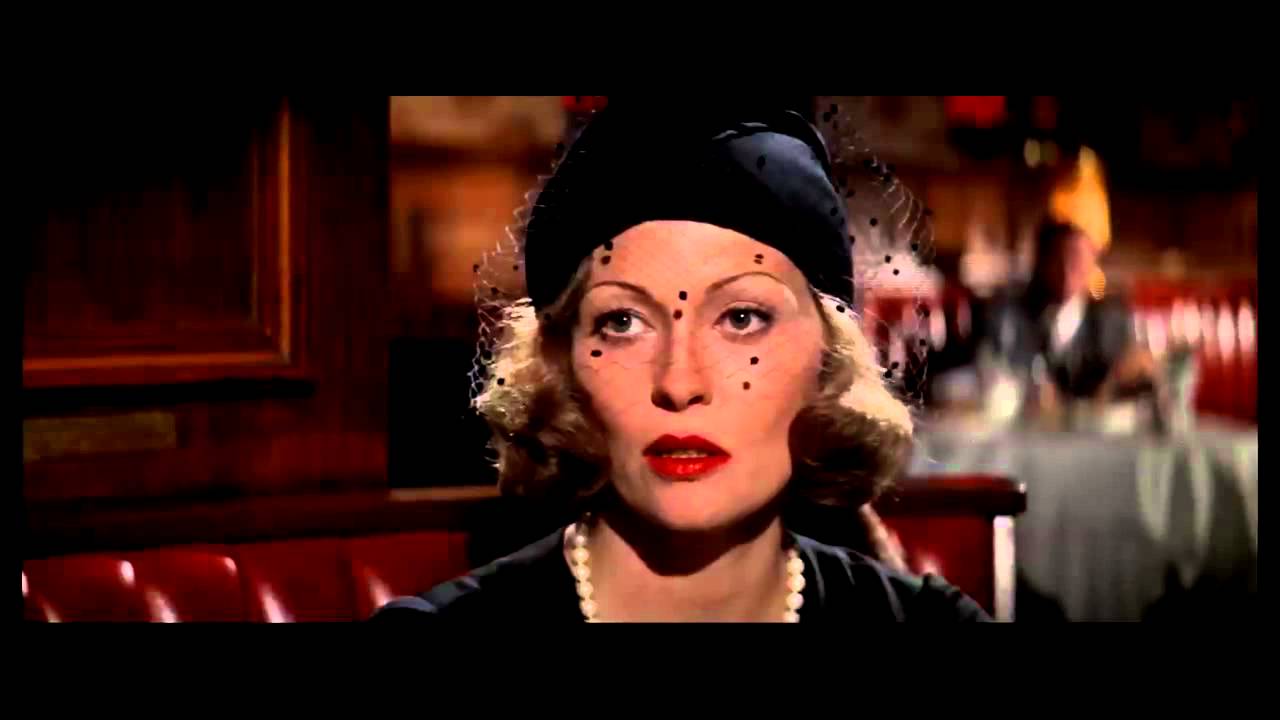
Faye Dunaway in Chinatown
Films:
Roman Holiday (U.S., 1952)
I am Chris Farley (U.S., 2015)
Diary of a Teenage Girl (U.S., 2015)
True Story (U.S., 2015)
Ghost (U.S., 1990)
The Last Picture Show (U.S., 1971)
Chinatown (U.S., 1974)

Books:
H is for Hawk by Helen MacDonald 
Trans by Juliet Jacques

Theatre:
Macbeth - Shakespeare in the Rough, Withrow Park, August 23rd 

Art Exhibit: 
Camera Atomica at AGO, August 29th

Thursday, August 27, 2015

On Chaz, on Caitlyn

I feel like we can’t talk about being Transgender without addressing the issue of the most well-known, highly publicized Transman and Transwoman currently on the planet – Chaz Bono and Caitlyn Jenner. Like many others who felt they had no connection or emotional investment in treating these persons with respect, I was cheerfully and blissfully dismissive of their trials and tribulations in the media.

I didn’t understand what I was witnessing on this very public stage when Chaz Bono transitioned from female to male. I was somewhat alarmed by the transition at some point, and, perhaps, mightily relieved I did not have to deal with this issue as a mother. More fool me. As they say, pride comes before the fall …

At best, I was condescendingly sympathetic at publicly witnessing his evolution from adorable little girl (daughter of the singing duo Sonny and Cher) to out lesbian and LGBTQ activist as a young adult to Transman and Transgender advocate. Now, because this hits so close to home, I am completely mortified by the manner in which he is sometimes referred to in the media. If it is not outright hostility, then it’s a quietly snickering attitude at times.

Flash forward to Caitlyn Jenner’s transition in the spring and summer of 2015 and I see it from a very different perspective as a mother of a Trans child and as a sentient human being.

Now, because I am so close to the situation with my own child I can no longer be blasé or amused at what I see. Whether it is the paparazzi provoking Jenner before she outed herself as Trans or seeing images of a “Caitlyn Jenner” Halloween costume for men posted on-line or pointless and insulting criticism of her high femme style as a woman – now it’s personal. And infuriating.

Is it really your concern if Jenner likes pretty clothes and makeup? Does it set back the cause of Transgender people if she favours manicures and weaves? I can’t help thinking that even the progressive people who purport to be feminists and Trans-positive criticize her style are anti-femme, as if things that are feminine (and I include even the supremely artificially feminine) are inferior, shallow, less than human. It’s as if the embracing of masculine style or an androgynous style is a superior political and personal stance. If femininity is a social construct, it’s my construct to employ or destroy and no amount of finger wagging likely will dissuade someone who chooses to embrace it.

If you knew someone who went through this transition, if you knew how hard it is to come out to the people who love you the most. If you saw how difficult it was to do the most basis things – purchase clothes, find a bathroom, change your name, feel comfortable in your own skin  – you might have second thoughts before you started snickering about it or making jokes.

It’s been a long, difficult journey in a very public forum for both of them – whether you think they have been successful at it or not – it’s their journey to make. If anything, I have felt intense empathy for Bono’s mother the singer Cher, now in her sixties, who sometimes has expressed sorrow, confusion, and resistance to Chaz’ decision to transition.

My child has said to us on more than one occasion, “If I had a choice, I would not go through this.” He has often expressed a wish that things were not so difficult for him. But this feeling almost always centres around trying to battle the fear and discomfort that other people feel towards the transition. I would say that my son is comfortable in his decision to transition but dealing with other people’s fears and insecurities is another matter.

It’s not a choice about a lifestyle. Now I finally understand why some gay people are so dismayed by the term “gay lifestyle” as if it’s some sort of fashionable attire you’ve acquired for a season or two – it’s an honest, brave embracing of being true to one’s inner self. It’s not a question of wanting to be something else, it’s a question of needing to be something else – to have the external correspond with the internal and to have it validated by the people you care about, as well as those you don’t.

An excerpt from The Unfinished Dollhouse. 

Tuesday, August 11, 2015

A House Filled with Wildness


H is for Hawk by Helen Macdonald (Penguin-Random House, 2015) 300 pages

I would not have thought that as a frightened as I am of animal violence (and birds) that I would grow to love Helen MacDonald's descriptions of the fierce goshawk named Mabel that she trains in this memoir. She recounts her acquiring and training this particularly fierce bird in the aftermath of her father's death as a way of coping with the grief.

Something unravels in Helen when her beloved father dies - a photographer and as avid a lover of nature and birds as Helen - she has lost a soul mate. She sinks into a depression that, oddly, only the purchase of a goshawk seems to alleviate. Does she require the taming of something wild, might that tame her tumultuous heart?

Her love of fierce birds comes early to her. One day, as a young girl, her father brings her to a group of men who practice falconry. She describes her first encounter with goshawks and the quiet, stolid men who own and train them. The birds were described in historical texts that Macdonald pores over as "ruffians, murderous, difficult to tame, sulky, fractious and foreign". They perched in trees above the men at times, refusing to return to their owners.

These men did not seem annoyed, fatalistic merely. They shrugged their waxed cotton shoulders ... we trudged on into the gloom. There was something of the doomed polar expedition about it all, a kind of chivalric Edwardian vibe.
Her first goshawk, imported from another country, is so intimidating that she requests a smaller one. In the process of reacquainting herself with goshawks she re-reads T.H. White's The Goshawk - the T.H. White of the Arthurian novels including The Once and Future King. White was a brilliant but troubled man who harbored sadistic fantasies and repressed his homosexuality. The violence of the goshawk becomes a conduit for all his violent and unruly feelings and, consciously or unconsciously, the same may be true for MacDonald. 

White's early life was harrowing, volatile. His parents fought viciously and violently with each other and the boy often feared that he might be murdered (one night he woke to find both parents struggling with a pistol over his bed - he presumed that one of them meant o to shoot the boy). 

When his father built a child-size castle and installed a real pistol into the brick work, he told his son that he would fire the gun on White's birthday. The boy became convinced that his father had planned to kill him on that day. Hi childhood was filled with "dictators and madmen", vicious corporal punishment from school masters, marital turmoil - no wonder that his thoughts were filled with senseless violence. Perhaps MacDonald sought some of this violence too ...  She notes:
The hawk had filled the house with wildness as a bowl of lilies fills a house with scent. 
MacDonald ponders why goshawks have such an intense reputation amongst falconers. She surmises, after a thoughtless comment from a friend's husband, that " ... unlike other animals that have lived in such close proximity to man, they have never been domesticated. It's made them a powerful symbol in myriad cultures, and a symbol, too, of things that need to be mastered and tamed". Like women, she adds wryly.
 
If she is not mad, she is very close to it at the time. Bills go unpaid. She is unkempt and does not eat well. She lives alone and sees hardly no one. When she sees a woman scraping a decal of a skylark off a window in a business in town she is apoplectic. Mabel's sometime lack of response drives her to misery and insecurity.

I'd turned myself into hawk …  I was nervous, high strung, paranoid, prone to fits of terror and rage; I ate greedily or didn't eat at all; I fled from society, hid from everything, found myself drifting into strange states where I wasn't certain who was or what I was ... I had assumed [Mabel's] alien perspective.

Eventually Macdonald pulls herself out of her depression long enough to seek professional help - but it is a long and tortuous process and she is largely alone during it.

I must admit that I had to read the book in short passages - its melancholy was too fierce and I felt myself being pulled into its emotional trough at times. I was exhilarated to find her resist the pull of madness, of violence, and to thrive again amongst the goshawks in us all.

Helen and Mabel

Friday, July 31, 2015

July Cultural Roundup


Films:
Wolfpack (U.S., 2015)
Love and Mercy (U.S., 2015)
What happened, Miss Simone? (U.S., 2015)
Apocalypse Now Redux (U.S., 2001)
Amy (U.S., 2015)
Copenhagen (U.S., 2014)
Trainwreck (U.S., 2015)
To Kill a Mockingbird (U.S.,1962)
Shawshank Redemption (U.S., 1994)
Irrational Man (U.S., 2015)

Books:
Undone by John Colapinto (please see review here)
All my puny sorrows by Miriam Toews
Go set a Watchman by Harper Lee

Thursday, July 9, 2015

There's Undone and then there's ... I'm done


Undone by John Colapinto (HarperCollins, 2015) 394 pages
                          * SPOILER ALERT *

Shall I tackle this book, I thought? This seemingly Lolita wannabe that is causing quite a stir? Forty publishers rejected the manuscript, I'm assuming, because the main character Dezollet is a predatory manipulator with pedophile tendencies. The topic made me uneasy but it also intrigued me. How would John Colapinto handle the issue of father-daughter "incest"? You will understand the quotes in a moment.

John Colapinto, a talented and respected, award winning journalist, is not subtle but he is, at times, proficient in creating drama and intrigue if you are willing to suspend disbelief regarding a number of serious plot points. I tried hard to eliminate the snark in this review but it was tough. And not entirely successful ... just hear me out.

Colapinto's work has the aspirations of a Lolita but the commercial appeal and technical proficiency of a Gone Girl. The writing is not beautiful but the plot does pull you along. However, you must accept the fact that a man, with incestuous thoughts, would or could act in the most reckless manner imaginable to, firstly, appease his lust and then, secondly, appease his guilt after consummating his lust.

Dezollet (known as Dez) - think desolate, dissolute - happens upon Chloe, his prospective Lolita, in a classroom in a public school where Dezollet is teaching, ostensibly to be closer to his objects of desire. She, too, like Lolita has a pesky, louche mother who conveniently dies. Chloe, friendless and lithesome, runs into the arms of her older lover. But Dez is not an "ordinary" lowlife. A trained lawyer who has worked on the Innocence Project with a "hanging judge" for a father, he has had a troubled background fighting with, and mostly succumbing to, his desire for teenage girls.

Dez hatches a plan, after a fortuitous glimpse of a literary celebrity named Jasper Ulrickson on a well -known talk show called Tovah in the Afternoon (obviously based on Oprah). The writer Ulrickson was the one time lover of Chloe's mother Holly when they both worked at a country club eighteen years ago. Her mother, Chloe exclaims, once thought that Jasper might be Chloe's father. Jasper is most famous for a memoir he wrote about his life with his wife Pauline who had survived a stroke to live as a non-verbal quadriplegic after giving birth to daughter Maddy. He is rich, famous ... and ripe for the pickings. Jasper convinces Chloe to approach Jasper and claim him as her father so that they might relieve him of his wealth.

Dez falsifies a DNA test and bribes a lab technician to conceal the true lab results. He is gratified to learn that the lab tech has fortuitously died in a motorcycle accident before Dez is compelled to kill him to conceal his evil designs. 


Jasper, decent if somewhat self-absorbed, wants to welcome Chloe into the family. The only impediment is his wife Pauline's reaction to the news. Pauline can only communicate by blinking as she is in a frozen, locked-in state, and cannot communicate with Jasper in her post-stroke state. But Pauline has witnessed the intrepid Jasper extracting DNA with a swab from their sleeping daughter Maddy (to falsify Chloe's DNA test) and is unable to tell Jasper. Pauline is terrified at the news that Chloe will come and live with them.

On the long ride home after the hearing that grants Jasper custody of Chloe, Chloe uses all of her coquettish ways to ensnare Jasper, according to Dez's plan. This gives Colapinto pages and pages allotted to Jasper peering and drooling over Chloe's body. My good people, is there nothing more boring than the male gaze for the female reader? Chloe goes from a vapid, immature teenager in the first few pages to a full blown vamp - sexually manipulative and calculating - and not entirely convincingly.

Jasper stares at her, dreams of her, catalogues all her physical virtues and perfections.
These shoes, to whose height she was unaccustomed, also introduced a poignant teeter and tremble to her gait, which emblematized how her body so precariously perched between foal-like childhood and the full, fecund effulgence of erotically charged womanhood.
Is there a quicker way of saying she was hot, do you think? Enough with the thesaurus! There are pages and pages of these descriptions, first from Dez then Jasper.

Dez's plan goes awry. Chloe falls in love with her new family and her new life - father, mother and younger sister - tout! Dez, desperate to see Chloe, contacts her and she confesses she is unable to go through with their plan. Through a series of improbable occurrences, Dez shows Chloe Jasper's erotic musings about her on Jasper's computer. Chloe, crestfallen, who has been making an honest attempt to fit into the family, is persuaded that Jasper will direct his bestial urges towards the younger daughter Maddy. In order to protect Maddy, Chloe determines that she will seduce Jasper.

Dez, posing as Chloe's psychiatrist (after pages and pages of psychobabble) urges the conflicted Jasper to demonstrate more physical affection rather than less towards Chloe to "purge" himself of these improper feelings towards his daughter. Jasper, desperate to come clean with his wife, tells Pauline of his illicit feelings towards Chloe which plunges Pauline into some sort of shock and then a coma. I ask you, what sort of idiot husband would do that to woman struggling with the horrendous medical issues that Pauline is suffering from?

That night Jasper, drunk and prodded on by Dez's urging "to be more affectionate" has sex with Chloe. This scene is the worst written scene in the whole book. I never want to see the words "inflamed member" or "savage desire" in print (except in an ironic context), ever. Sex scenes are difficult to write, very difficult, so it is best to leave more, rather than less, to the imagination or else you will end up with this little gem:
Rage, as much as desire, seized him, and in a spasm of fury and lust he tore away his short. He bent and wrenched off his pants and underwear, liberating the smarting prong, which stood out from his body at an almost upright angle not achieved since he was , himself, Chloe's age.
"Daddy!" she cried. 
With an animal bellow that combined plangent mourning and savage desire, he collapsed upon her.  
During the night, Chloe disappears (who could blame her) and soon the law is at Jasper's door. The family is effectively destroyed. Jasper is charged with raping his "daughter" and goes to prison for a very long time. Pauline lapses into a coma and is hospitalized. Maddy is sent to live with her aunt. Chloe disappears with her lover Dez to NYC after inheriting a third of Jasper's sizable estate.

In prison, Jasper is severely beaten and loses the vision in one eye. After he is released, he happens upon a written message transcribed by Maddy in her childish scrawl in one of her old notebooks. Pauline had communicated her suspicion of Chloe and Dez by blinking her way through the alphabet. Okay Colapinto, pull the other one now. Jasper rushes to tell Pauline in the hospital that he knows the truth - this miraculously awakens Pauline who has been in a coma for eight years.

Jasper tracks down Chloe, living apart from Dez, disgusted by his substance abuse and womanizing (girl-izing?), and living in impoverished circumstances as she has walked away from the wealth they stole from Jasper. She confesses it was all a plot to ruin Jasper. Chloe's frightened roommates call the police and Chloe almost lets them take Jasper away but at the last moment confesses that everything he is saying is true.

In the last few pages, the family is reunited. Pauline is regaining her health, tenuous as it is. Maddy is returned to her parents. Jasper miraculously recovers his sight through another operation. And Dez is just a broken, substance abused disaster who gets his just desserts.

You can't have it both ways ... a salacious exploration of a man's lust for his supposed "daughter" and then make this man, in the end, the noble, victimized hero who stands by his impaired wife and young daughter, having forgiven Chloe for destroying him and his life (all his lust for Chloe has disappeared by the way). And Chloe makes four in this happy family, forgiven and reintegrated.

Colapinto makes coy reference in the acknowledgments to possible angry mail from readers. Instead I find myself irritated by the flimsy plot points: the ease with which the DNA sample is extracted from the sleeping child, switched for Chloe's DNA ... the DNA technician conveniently eliminated from the story line ... the ridiculous premise that Dez can walk in, unprepared, and impersonate a psychiatrist to an educated man like Jasper and then guess Jasper's computer password and reveal Jasper's secret thoughts to Chloe ... the silliness of Pauline transmitting Dez's villainy to Maddy by blinking out the message letter by letter ... the pathetic manner in which the writer tries to elicit sympathy for Jasper when he is almost beaten to death and blinded in prison for his perceived crime ... the idea that the prison would allow the near blind Jasper to just leave the prison without an escort ... the miraculous awakening of Pauline once she learns from Jasper that she has been vindicated in her fears ... the idea that the family could reformulate and include Chloe after all that has happened. I might be able to accept one or two of these premises but not all.

That coupled with the baroque language and sexual descriptions effectively quenched any thoughts of rage or revulsion.

Verbs repeatedly expressing emotion - gaping, chuckling - mar the text. During this interminable car ride from the court hearing (and a few times more after that) either Chloe or Jasper "gape" no less than three or four times. It is the editor's role to eliminate the repetitions that mar the reading experience. And it's also the editor's role to pull back on all the erotic fantasizing that merely becomes laughable and does not enhance the narrative. Is this a Harlequin romance or is this a serious novel?

The tale is so farcical and far-fetched, it elicits sighs of boredom and expressions of disbelief rather than rage. No topic is verboten in fiction. As a writer, I feel strongly about that but if you are going to tread into this explosive area - make it honest, make it real, make me think about the topic in an open and questioning way rather than want to throw the book down in disgust because it is salacious and poorly written.

Tuesday, June 30, 2015

June Cultural Roundup


Books
Liza's England by Pat Barker
The Prime of Miss Jean Brodie by Muriel Spark

Art
Riverdale Art Walk, June 6, 2015

Films
Maps to the Stars (Canada, 2015)
The Prime of Miss Jean Brodie (UK, 1969)

Literary:
Amazons of the Mediterranean Reading at the Black Swan Tavern, June 7, 2015

Events:
Città Aperta, Bata Shoe Museum, June 23, 2015

Thursday, June 18, 2015

Books on Film: The Prime of Miss Jean Brodie


Now in its fifth season, TIFF's Books on Film brings together book and film lovers to examine great cinema that began as outstanding literature. Eleanor Wachtel, host of CBC Radio's Writers & Company, sits down with filmmakers, authors and experts to discuss the art of adaptation and the sometimes challenging passage from page to screen. This is the last film of the series in 2015.

The Prime of Miss Jean Brodie (U.K./U.S., 1969) directed by Ronald Neame
The Prime of Miss Jean Brodie by Muriel Spark (Macmillian, 1961)

Miss Jean Brodie (portrayed by the inestimable Maggie Smith) is magnificent. She is independent, fiery, intelligent, sensuous, and if it were not for her disturbing and ultimately destructive admiration of Fascism she would be near perfect. Those of us who only know Smith as the acerbic dowager from Downton Abbey will be pleased to remember her seductive visage in this film.

A teacher in Edinburgh, Scotland in the 1930s when Fascism, in the guise of Mussolini, had a glamorous, if dangerously misguided, sheen for many, she knows that she is made for  greater things and that the girls that she teaches at the Marcia Blaine School for Girls – the members of the much envied, infamous "Brodie set" – are made for finer things as well. After all, Miss Brodie is in her prime and has never been more sublime.

No matter that Miss Brodie is sometimes controlling and an insufferable snob. Windows opened more than six inches are vulgar. Rolled up sleeves on girls are common crudely suggesting washerwomen about to set about their work. No matter that she manipulates her girls, tortures them emotionally, segregates them by characteristics that she admires or envies. Sandy (Pamela Franklin), who will eventually become Miss Brodie’s betrayer is "full of insight" and a perfect "spy". Jenny (Diane Grayson) who will be “famous” for sex  and Miss Brodie hopes will become the future lover of one of her own lovers. Mary (Jane Carr) is pitifully dim-witted and will, of course, die tragically. Monica (Shirley Steedman) is famous for her "anger", her passion.

Spark comically highlights the dangers of charisma and passion (an essence of the allure of Fascism in the 1930's - when even high ranking politicians and British royalty in the West saw Hitler and Mussolini as bulwarks against the creeping "evil" of Communism) manifested in the person of Miss Brodie. Her attraction to power and "beauty" overtake the desire for the common good, overtake common sense, at times.
 
Ms. Brodie, who reputedly had a lover named Hugh who died on Flanders Field during the Great War, juggles not one but two lovers at the school – the sweet but feckless ginger-haired Mr. Lowther (Gordon Jackson) who teaches music and singing and the caddish art teacher Teddy Lloyd (Robert Stephens) who is so prolific in his sexual activity that he has six children by his wife Deirdre and still aggressively pursues Miss Brodie as well as one of her students.

The director clothes the seductive Smith in vibrant sensual colours illustrating her passionate nature - vibrant reds, lush purples, vivid pinks and oranges - and she starkly stands apart from the other dour, grey-clad school mistresses particularly the unfortunately named Miss Gaunt who does the malicious bidding of the headmistress Miss Mackay (Celia Johnson).

It is this sort of sexual charisma that alienates some of the other teachers, specifically the headmistress, who must see to it that this tall poppy is cut down to the appropriate size. To this end she encourages the girls to spy on Miss Brodie about her relationship with both men.
In the film, Teddy Lloyd is more obnoxiously portrayed than he is in the novel – he is lecherous and predatory in the book, yes, but on film we see him physically accost both Jean and Sandy and force himself on them in a brutal manner. The climate then was such that this behaviour was tolerated along the lines of “they can’t help themselves”. Today we would have a vastly different perspective on it. 

The magnificent Maggie Smith
Muriel Spark, the author, intersperses the narrative set in the present with flashes of the future fates of both Miss Brodie and the girls and this lends a melancholy air to the book despite the comedic elements (the film does not include the fate of the girls). In the film we never learn that Sandy will convert and become a nun, another girl will be a failed actress, etc ... In the film, the fate of Mary MacGregor is merged with the fate of different girl in the book who dies on route to fight in the Spanish Civil War, inflamed by Miss Brodie's exultations about Franco and fascism. But to illustrate the pernicious nature of Miss Brodie's view, we learn that Mary fled to Spain to fight with her brother in the mistaken belief that he was fighting with Franco's forces rather than against him with the Republicans as Sandy so heatedly informs Miss Brodie. 

Sandy appears inflamed by sexual jealousy and then the fear of Miss Brodie's political ideas. But in the novel, Miss Brodie never learns who her betrayer is. 

It is a more satisfying denouement in the film when Sandy openly confronts Miss Brodie and tells her both that she is Teddy Lloyd's lover (not Jenny as Miss Brodie had perversely hoped) and the one who betrayed her to the head mistress. It is clearer in the film that Miss Brodie is perceived as a dangerous influence and yet Smith's performance is so nuanced and carefully constructed that we can do little more than despise the beady-eyed Sandy when she destroys her teacher's future. 
 
We regretfully (and perhaps shamefully) sympathize with Miss Brodie's anguished cries in the halls of Marcia Blaine that the icy Sandy is nothing but an assassin. I couldn't help but hear echoes in her operatic cries of "Assasssin!" in the anguish of traditional Italian operas. She very much reminded me of one of these 19th c. operatic heroines - flawed, tragic and somehow eminently desirable.
Muriel in her prime
 

Wednesday, June 10, 2015

Amazons of the Mediterranean Reading

 On June 7th, 2015 fifteen Amazons of the Mediterranean gathered at the Black Swan Tavern - they were comedians, poets and writers - serenaded by one brave singer/musician. They laughed, they commiserated, they shared ... and a wonderful time was had by all.

Our first set ...


Brave comedian Daniela Saioni leads the way ... 
La poetessa, award winning 
Gianna Patriarca
Gianna
The always charming poet
Josie Di Sciascio-Andrews


Poet Giovanna Riccio schools us 
on the definition of "Amazon"
One of our Greek Amazons - the writer Tina Tzatzanis 
reading for one of her very first times
Tina

Serenaded by the multi-talented 
musician/singer Nigel Barnes
The writer and arts supporter Darlene Madott
Darlene
Poet Silvia Falsaperla (truly the 
name of a poet), at her first reading
Silvia 
Talented writer Bianca Lakoseljac, a true trooper, who
drove five hours from up north to make the reading
Bianca
Nicole Haldoupis,
writer & co-founder of untethered
Nicole 
Nigel opens the third set 
Sandra Battaglini, comedian extraordinaire


Poet Sonia Di Placido bound for
new literary adventures soon
Sonia
Cristina Rizzuto
Cristina Rizzuto, 
author, traveller, bibliophile.
Daniela Nardi speaks about 
Città Aperta on June 23, 2015
Carmela
Carmela Circelli,
philosopher, academic, daydreamer
Art director and Amazon poster 
creator Rob Fujimoto


Emcee & Organizer Michelle Alfano